


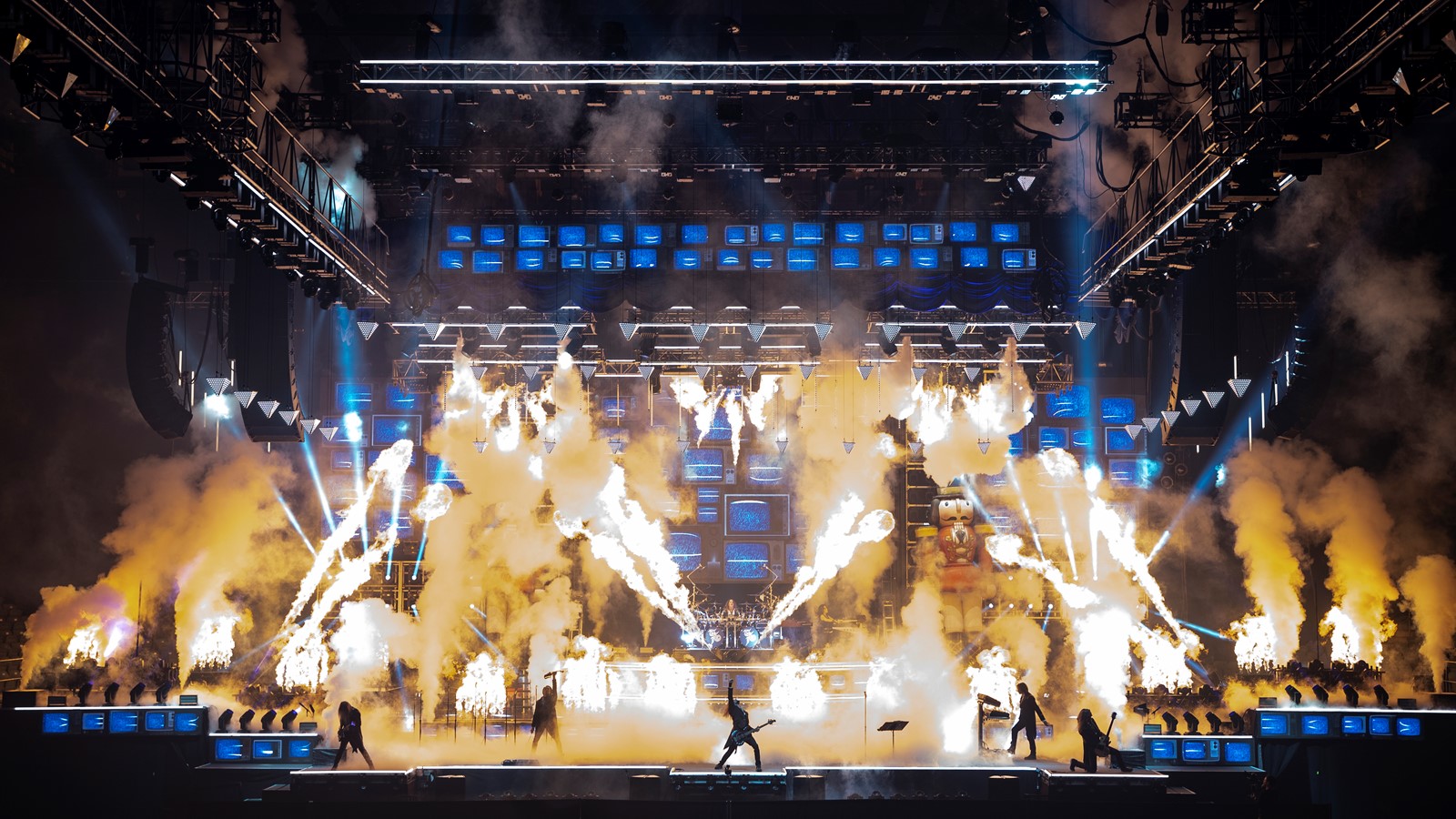


Trans-Siberian Orchestra is celebrating the 20th anniversary of its rock opera “The Last Christmas Eve” this holiday season on a tour that marks having sold 20 million tickets, and in doing so, surpassed more than $20 million in donations to charity.
The American rock band will stop at the Honda Center in Anaheim on Saturday for 3 and 7:30 p.m. shows, with ticket prices ranging from $80-$150.
Those numbers — 20 million tickets sold in 20 years — would seem impossible for a production that tours for just two months of the year.
But the production has a secret weapon. Make that two not-so-secret weapons.
“I think the first thing is, most people don’t realize we have two different touring groups,” said music director and lead guitarist Al Pitrelli in a late-September interview. “There’s a West Coast and East Coast group. So when you look at that schedule, it’s literally impossible for one band to cover all that.
“We’ve been doing this with two bands ever since the year 2000, but we play to roughly 1 million people a year between the two groups,” he said. “Along with that is the charity, the dollar per ticket.”
Trans-Siberian Orchestra is known for lavish productions that combine rock show pyrotechnics and lasers with the performance of music and story written by late founder Paul O’Neill.
For Pitrelli, the production grew out of a single song the group recorded for its debut album, “Christmas Eve and Other Stories.”
“It’ll be 30 years ago this coming February or March when I first started working with (drummer) Jeff Plate, the guys (in the band), Savatage and Paul,” Pitrelli said. “When Paul first put the faders up on ‘Christmas Eve/Sarajevo 12 /24,’ I knew that there was something (different than) a lot of people artistically that he was going after, then what would have been maybe the norm in that era. And I knew people would be drawn to it.”
Plate had the same feeling during the sessions for “Christmas Eve/Sarajevo 12 /24.”
“When we recorded this song, there was no denying when you heard it, it was fantastic,” said Plate, who joined Pitrelli for the interview. “You hadn’t heard anything like it. Christmas music, up to that point, had been relatively safe. Even if a rock band was doing a Christmas song, they really sugared it up quite a bit. There wasn’t much of an edge to it. That song certainly had an edge.”
“Christmas Eve and Other Stories” (featuring “Christmas Eve/Sarajevo 12 /24”) went platinum. So did 1998’s “The Christmas Attic,” setting the table for the holiday tours.
“I’ve always thought when we started touring back in 1999, the curiosity of people that come to see the band was one thing,” Plate said. “But I think once they got in the room it’s the story, it’s the lyrics, it’s the songs. I think Paul’s story is the star of the show.”
The first couple tours were far from the massive undertakings that now find about 40 semi-trucks and buses rolling out of Council Bluffs, Iowa, each November as the two bands hit the road.
“We started (in) ’99, Jeff and I,” Pitrelli said. “It was one band back then. We had one box truck, a bus and a fog machine, and Paul had a saying: ‘Put everything back into the show, make it bigger, bigger, bigger, bigger.’ We always want to surprise the repeat offenders, and the folks who are coming for the first time have no idea what to expect anyway. We absolutely want to keep them on their heels as well.”
Now the production, with its stories and music, has become a holiday tradition for thousands who come to the shows each year. It’s also a tradition for Pitrelli and Plate.
“It has become, like ‘It’s a Wonderful Life,’ or in my case, ‘A Charlie Brown Christmas,’ where I want that comfort of the familiarity of my holiday tradition to remind myself,” Pitrelli said. “But to be honest, becoming families’ holiday tradition was never on my radar.”
That, he said, began to be clear before the COVID-19 pandemic. But in 2020, Trans-Siberian Orchestra learned just how much it meant to fans who wanted to keep their holiday traditions alive.
“When we had to cancel our tour, and the only thing we had to do was livestreaming, we didn’t really know too much about what was going on with that,” Pitrelli said.
“We played one show that year, which was a gift for us,” he said. “When we found that 250,000 homes purchased that livestream because they wanted to spend the holidays with their favorite band celebrating that story again, that’s when I said, ‘You know what, this is a lot bigger than I thought it was.’ ”
 PREVIOUS ARTICLE
