




BELEM, Brazi — World leaders warned Thursday that time is running short for urgent and decisive action to prevent the worst effects of climate change, and blasted the United States for its retreat from those efforts, as they gathered at the edge of Brazil’s Amazon rainforest for the annual United Nations climate summit.
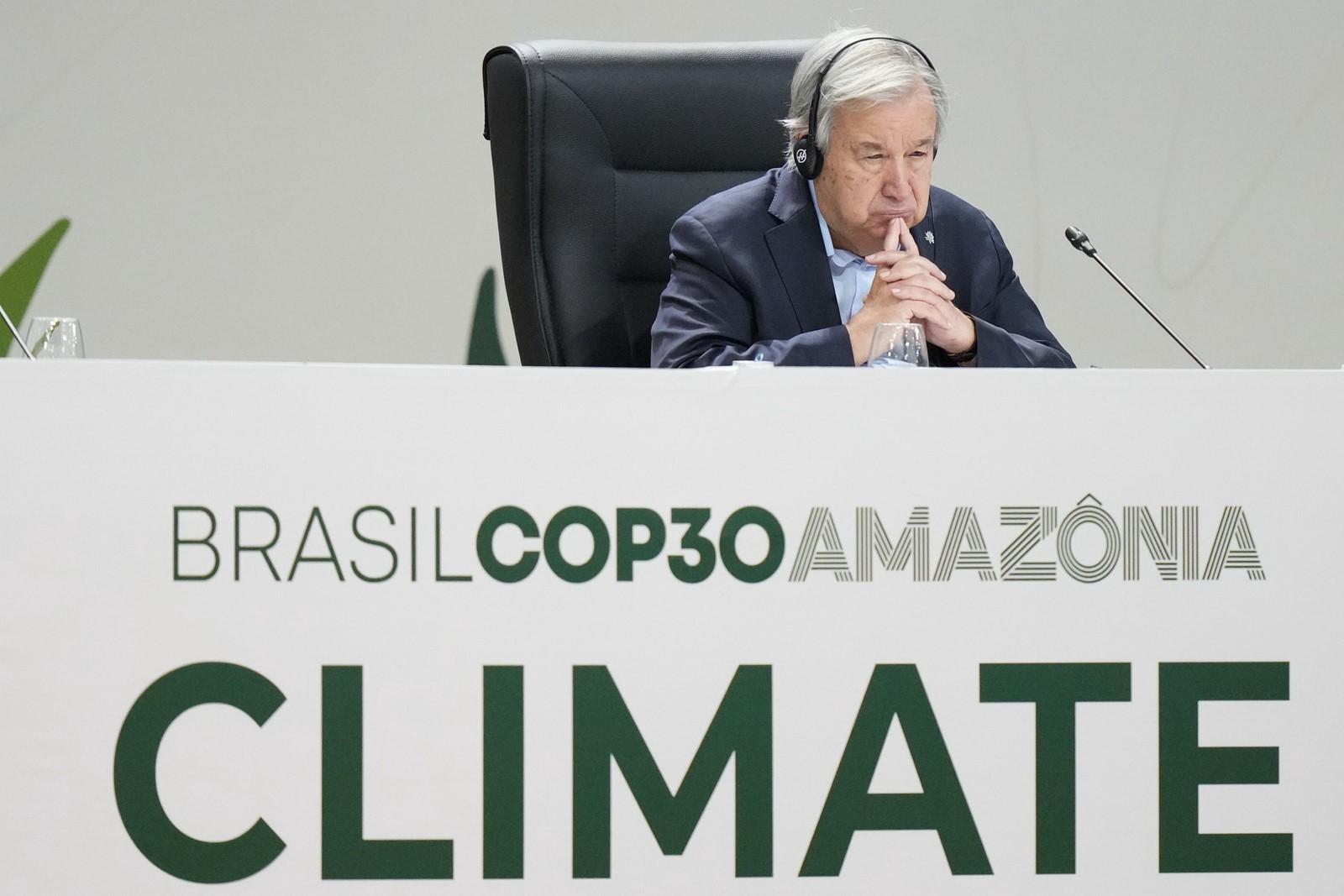
U.N. Secretary-General António Guterres opened a gathering of heads of state in Belem, Brazil, with harsh words for world powers who he said “remain captive to the fossil fuel interests, rather than protecting the public interest.”
Allowing global warming to exceed the key benchmark of 1.5 degrees Celsius (2.7 Fahrenheit), laid out in the Paris Agreement, would represent a “moral failure and deadly negligence,” Guterres said, warning that “even a temporary overshoot will have dramatic consequences ... every fraction of a degree higher means more hunger, displacement and loss.”
Brazil President Luiz Inácio Lula da Silva sought to convince world powers to mobilize enough funds to halt the ongoing destruction of climate-stabilizing tropical rainforests and advance the many unmet promises made at previous summits.
But reduced participation across the board — with only half the heads of state in attendance as there were at last year’s summit — highlighted global divisions and set a somber tone. The leaders of the planet’s three biggest polluters, China, the United States and India, were completely absent from the preliminary gathering ahead of formal climate talks that begin next week at the Conference of Parties, known as COP30.
In a rousing speech, Lula warned that the “window of opportunity we have to act is rapidly closing and said there was “no greater symbol of the environmental cause” than the Amazon rainforest.
Known as the “lungs of the world” for its capacity to absorb vast quantities of carbon dioxide, a greenhouse gas that warms the planet, the biodiverse Amazon rainforest has been choked by wildfires and cleared by cattle ranching.
“It is only right that it is the turn of the Amazonian people to ask what the rest of the world is doing to prevent the collapse of their home,” Lula said.
Leaders spoke in Belem as the U.N. weather agency announced that 2025 was on track to be the second or third warmest year ever recorded. The concentration of greenhouse gases in the atmosphere, which hit a record high last year, continued to rise in 2025, as did ocean heat and sea levels, said the World Meteorological Organization in a report released Thursday.
U.S. absence looms over leaders’ meeting: U.S. President Donald Trump, who calls climate change a hoax and withdrew the U.S. from the Paris climate accords the day he entered office, won’t send any senior officials. China sent its deputy prime minister.
Advocates and diplomats have raised concerns that the absence of the U.S. — which has at times played a key role in convincing China to restrain carbon emissions and securing finance for poor countries — could signal a broader global retreat from climate politics.
“Extremist forces fabricate falsehoods to gain electoral advantage and trap future generations in an outdated model that perpetuates social and economic disparities and environmental degradation,” Lula said, without mentioning Trump directly.
President Gustavo Petro of Colombia, however, called out Trump directly, saying his absence was “100% wrong.”
“Trump is against humankind,” said Petro, whose feud with his U.S. counterpart escalated in recent weeks as Trump accused him of being a drug kingpin and imposed financial sanctions on him and his family.
Chile’s left-wing President Gabriel Boric similarly singled out Trump, saying his claims that “the climate crisis does not exist ... is a lie.”
Indigenous groups also warned that Trump’s inaction could embolden other countries to ignore the crisis.
“It pushes governments further toward denial and deregulation,” said Nadino Kalapucha, the spokesperson for the Amazonian Kichwa Indigenous group in Ecuador. “That trickles down to us, to Ecuador, Peru, Argentina.”
President Javier Milei of Argentina, who threatened to quit the Paris Agreement and last year pulled Argentine negotiators out the climate summit in Azerbaijan, also boycotted this week’s meeting.
That left leaders like U.K. Prime Minister Keir Starmer, German Chancellor Friedrich Merz and French President Emmanuel Macron to confront not only the consequences of an intensifying global climate crisis but a daunting set of political challenges.
 PREVIOUS ARTICLE

