


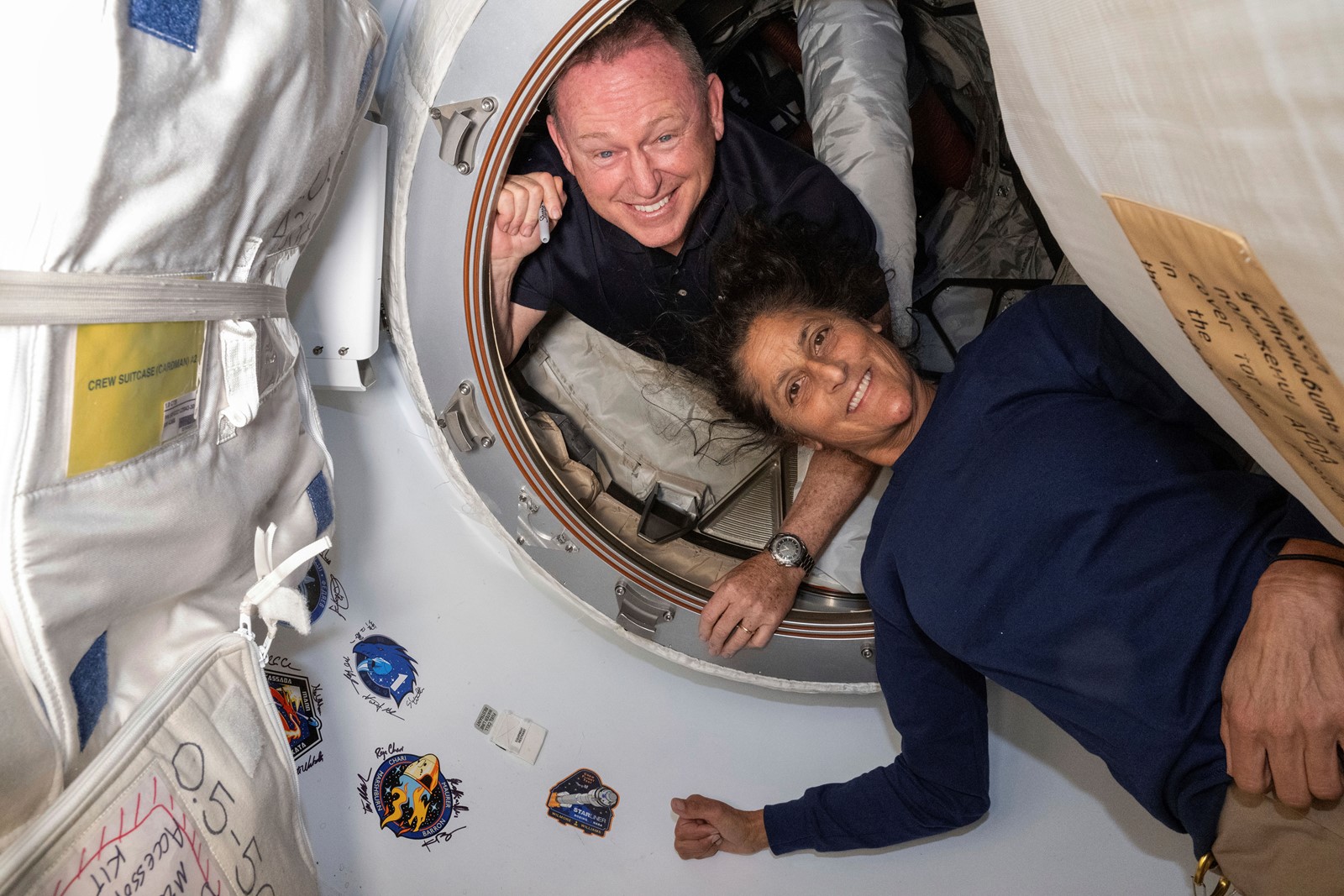


NASA is keeping its two astronauts who flew in Boeing’s Starliner to the International Space Station safe on board until next year to fly home on a SpaceX Crew Dragon.
Starliner making its first crewed spaceflight arrived to the ISS on June 6, one day after launching from Cape Canaveral with NASA astronauts Butch Wilmore and Suni Williams on board for what was supposed to be about an eight-day stay. Now they won’t get home for at least eight months.
“NASA has decided that Butch and Sunny will return with Crew-9 in February and that Starliner will return uncrewed,” NASA Administrator Bill Nelson said in a press conference Saturday following an agency-level review of Starliner’s flight safety risk.
Dubbed the Crew Flight Test, Boeing has been trying to get Starliner certified to join SpaceX as one of two commercial providers to ferry astronauts to and from the ISS. SpaceX has been doing the job from the U.S. for more than four years, and now Starliner has an uncertain future.
While trying to dock with ISS, problems with Starliner emerged with it propulsion system, when five of 28 reaction control system thrusters failed on approach. The propulsion module also suffered helium leaks.
“Spaceflight is risky, even at its safest and even at its most routine, and a test flight by nature is neither safe nor routine, and so the decision to keep Butch and Suni aboard the International Space Station and bring the Boeing Starliner home uncrewed is a result of a commitment to safety,” Nelson said.
He said NASA’s decision considered the specter of the tragedies of Apollo 1, Space Shuttle Challenger and Space Shuttle Columbia.
“This whole discussion, remember, is put in the context of we have had mistakes done in the past,” Nelson added. “We lost two space shuttles as a result of there not being a culture in which information could come forward.”
What went wrong?
The problems that emerged on what had otherwise been a good trip up for Starliner to the ISS led to delays in a decision to return home while Boeing and NASA worked to figure out the source of the problem — including running a series of tests on the ground and hot firing Starliner while still attached to the ISS.
While four of the five thrusters came back online and ground tests revealed the likely cause, there remains nothing that can be done to fix the source problem now in space. The return flight could see a repeat of thruster failures, which are needed for the spacecraft’s departure from the ISS and its reentry burn to land on Earth.
“Our focus is on safety all the time and this certainly is no different. The uncertainty in our margins is where we have come to make the decision,” NASA Associate Administrator Jim Free said. “That uncertainty remains in our understanding of the physics going on in the thrusters, and we still have some work to go.”NASA Commercial Crew Program Manager Steve Stich said the data ultimately drove the decision.
“Bottom line relative to bringing Starliner back is there was just too much uncertainty in the prediction of the thrusters,” Stich said.
He said ground testing results were a surprise to NASA and begun the shift in course where NASA began seriously considering keeping Williams and Wilmore on board the ISS and bringing Starliner home without crew.
Boeing future
While Boeing had in weeks past been stumping for a crewed return of the spacecraft to complete the mission as planned, Ken Bowersox, associate administrator of NASA’s Space Operations Mission Directorate, earlier this month revealed there has been dissent among NASA officials worried about the risk involved to the astronauts.
No Boeing official was at Saturday’s press conference, but NASA officials gave them credit and said they thought the decision ultimately laid in NASA’s hands.
“We want to further understand the root causes and understand the design improvements so that the Boeing Starliner will serve as an important part of our assured crew access to the ISS,” Nelson said, noting he had just spoken with Boeing’s new CEO Kelly Ortberg.
Nelson later stated he believed “100%” that Boeing would continue with its efforts to satisfy their commercial crew contract, which calls for six Starliner flights to the ISS once the spacecraft is certified.
Boeing initially won the larger contract alongside SpaceX in 2016, but it was a fixed-price contract worth $4.2 billion for which Boeing has yet to see payout except for development costs. Years of Starliner program delays, though, including the company having to fly a do-over of its uncrewed flight test when the first go didn’t rendezvous with the ISS, have cost Boeing more than $1.6 billion to date.
Starliner’s planned departure date has not been revealed, but would come no earlier than September with a desert landing in the southwestern United States.
“We’ve accomplished a lot on this mission and learned a lot about this vehicle, satisfied a lot of the objectives,” Free said.
Remaining in space
Wilmore and Williams then, would become active members of Expeditions 71 and 72, and would fly home on the SpaceX Crew Dragon Freedom in February joining Crew-9, which slated to fly to the ISS no earlier than Sept. 24.
It’s set to fly up with two instead of four astronauts so Wilmore and Williams could take the remaining seats when that mission concludes. Which two astronauts fly up and which stay home was not revealed by NASA. The decision now stretches Williams and Wilmore stay on board the ISS to more than eight months.
This is their third visit to the ISS with both having visited on both space shuttle flights as well as Russia Soyuz flights during their careers.
ISS Program Manager Dana Weigel said the long stay is not an issue since there have been some astronauts who have gone a year on board.
 PREVIOUS ARTICLE
