


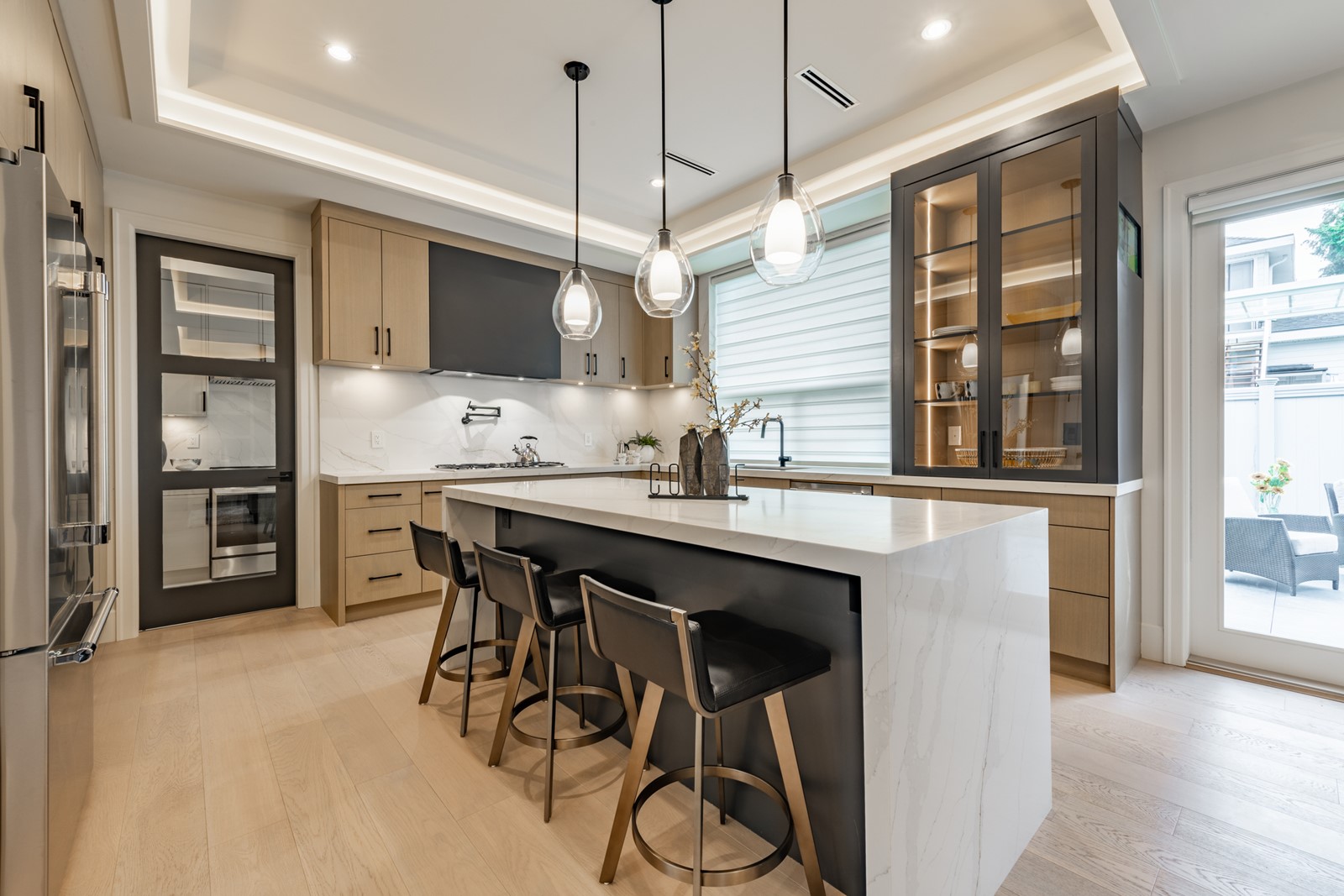


The American kitchen did not begin life as an enormous room where Carmela Soprano might check the mail at a marble-topped counter, or where everyone at the dinner party wants to hang out.
During the first century or so of American life, kitchens were usually hidden down a hallway at the back of a house, crammed into a basement or banished to another building entirely, if you had the land. “We didn’t put them where you could see them,” said Dawn Viola, a Colorado kitchen designer who specializes in historical home preservation.
Today, our kitchens serve both as a headquarters and a “beautiful showpiece,” said Kishani Perera, an interior designer in Los Angeles. We might spend thousands of dollars customizing them — picking out the perfect backsplash tile or knobs for the cabinets. And yet, so many American kitchens share the same DNA — from the placement of the sink and shelves, to the microwave over the stove, to the clutter.
Let’s look back in time to find out why our kitchens look, and work, the way they do.
The science of housework
Manufacturing, electricity and home economics arrive, shaping the modern American kitchen.
1915: With the industrial revolution in the rearview, the government begins promoting homemaking to young women as an exciting new science — “just as useful to maid as to mistress.”
Meanwhile, kitchens are adopting technology like mass-produced metal stoves, the early iterations of refrigerators (just iceboxes, at first) and electrification. The electric kitchen leads to the first generation of countertop tools including automatic toasters and stand mixers. A century later, these appliances have barely changed.
1926: Architects begin applying the lens of domestic science to the kitchen, with many inspired by the work of Viennese architect Margarete Schütte-Lihotzky. Her compact, sleek, function-driven “Frankfurt Kitchen” feels like a forerunner of Ikea, said Alexis Barr, an expert in kitchen design history at the New York School of Interior Design.
“She’s actually labeling some of those drawers, so it’s sort of set out for the homeowner, like, ‘This is where you’re going to put your flour; this is where you’re going to put your bread,’ ” Barr said. “And she’s integrating that fitted kitchen and the components of it. And it’s all sort of predicated around the idea that you’re going to have this certain set of appliances.”
1934: Kitchens are evolving, but most are still closed off from the rest of the home. Enter Frank Lloyd Wright, who designs what many believe to be the first open-concept kitchen.
‘Look at my new stove’
Brands sell better living, and we’re buying it.
1945: A rush of homebuilding and suburbanization emerges after World War II, as does the use of more processed design materials perfected in military applications. The company that makes Formica, for example, expands its line of kitchen countertops with new patterns and colors. Plywood manufacturing takes off.
Showing off our new purchases — “look at the latest convenience, look at my new stove” — becomes increasingly chic, said Hull. As a result, “the kitchen really transforms after 1950 into much more of a modern space.”
1963: Julia Child’s first TV show, “The French Chef,” introduces millions of Americans to French cooking and also to her large, open, well-equipped, semiprofessional kitchen — including a massive Garland gas range, a peg board and Le Creuset pots and pans, all of which are now on view at the Smithsonian. Viewers don’t just want to cook like her, they want to own the products they see her use on screen.
1978: General Electric Co. manufactures an over-the-range microwave oven, freeing up counter space. It quickly becomes the visual centerpiece of many American kitchens.
1983: What do personal computers have to do with kitchens? They become a regular presence in the “command center,” the new kitchen-office combination sweeping the country, said Lauren Tolles, who founded the Michigan custom cabinetry company Maison Birmingham.
What an open concept
The kitchen matures … into the center, and centerpiece, of the home.
1990: As suburbs and houses continue to grow, the term “McMansion” makes its way into the vernacular. Kitchens, a practical space up through the 1950s, morph into a “decorative space,” said Hull. Cabinets grow more luxurious, ceilings grow taller and stoves with braggable brand names like Viking or Wolf become more mainstream. “That’s really when it becomes kind of the most expensive room in the house,” he said.
2005: New homes with the most up-to-date kitchen plans — large, open to the rest of the home and increasingly central — are emerging across the country, at the tail end of a housing building boom that began in the late 1990s.
“All of a sudden, it was like this open-concept kitchen where you just had, like, literally one room,” said Aurora Farewell, whose namesake architecture and interior design firm is based in Connecticut. Even with renovations to older homes, she said, “almost always it’s a conversation about, ‘How do you make that kitchen feel central?’”
2011: “The Property Brothers” reality show, starring Jonathan and Drew Scott, becomes a breakout success for HGTV. The show, along with the advent of social media and affordable home-furnishing retailers like Ikea, has a huge impact on home renovations.
“They’ve really made design and kind of DIY projects accessible to the masses,” Tolles said. “And there’s so much information out there on TV, on the internet. You walk into the Ikea store, they have planners. They do make it easy to do.”
2012: Imported cabinets made from lighter-weight, affordable engineered wood — flat-packed and shipped ready to assemble — are taking off in the United States. “The quality of a lot of those are not that great, but the price point is so reasonable,” Viola said. “If you watch any of those HGTV shows and you see someone that says, ‘Yeah, well, we got this complete kitchen done for $10,000,’ you know it’s because they spent $1,000 on that flat-pack cabinetry that’s going to last maybe a year.”
Too many cooks!
What happens when everyone and everything is in the kitchen at the same time?
2016: Japanese clutter consultant Marie Kondo is so popular that her name becomes a verb. Across the country, companies that focus on organizing emerge to help us deal with the storage of too much stuff — one consequence of a kitchen that’s open to the rest of the house, Tolles said: “In a small house, it’s nice to have that openness. But then you literally have just lost like an entire wall of storage.”
2020: As COVID-19 pandemic lockdowns begin in March, Americans are working from home, often in the kitchen. Children attend school online, often in the kitchen.
“It really was during COVID that people realized that the open concept is loud,” said Sarah Snouffer, the founder of Third Street Architecture in Washington, D.C. “It’s hard to find enough space. It’s hard to have multiple people working or learning in the same space.”
2023: The pandemic is easing, but pressure on usable space in the kitchen remains high. Shopping and cooking habits change, said Wendy Trunz, a partner in the New York City home organization company Jane’s Addiction. More people are buying in bulk and cooking at home. And many still don’t go to an office. “Some never really went back because they didn’t have to, and they kind of took over a little part of the kitchen, or a part of a dining room,” Trunz said.
 PREVIOUS ARTICLE
