




Note from Rich Archbold: This week, I’m turning my column over to my wife, Pat, who knows a whole lot more about art and architecture than I do. For years, she introduced grade school children to the works of art created by the great masters. We recently attended the grand reopening of the Historic Terminal at the Long Beach Airport. While I was busy talking to the speakers and other attendees, she was like a kid in a candy shop, feasting her eyes on all the art work and displays. Here are her observations mixed in with a little Long Beach Airport history.
After more than 60 years hidden away in darkness and mystery, Grace Clements’ masterpiece was recently displayed once again in all of its 1.6 million pieces of glory — at the coolest airport in America.
Right here in Long Beach.
You don’t have to take my word for it either. Cynthia Guidry, Long Beach Airport’s director, twice described the travel hub as the coolest in the nation — echoing LGB’s own branding on its website — during a recent speech. Guidry, the former deputy director at Los Angeles International Airport, was lured from that job in 2019 — to run California’s oldest municipal airport.
And in her speech during the July 27 ribbon-cutting ceremony for the refurbished Historic Terminal, Guidry reflected on Long Beach Airport’s 100-year legacy.
“Not long after this Historic Terminal was built in 1941, amid World War II, Winston Churchill wisely said, ‘We shape our buildings; thereafter, they shape us,’” Guidry told the crowd. “That’s certainly true here at Long Beach Airport, where this cherished architectural treasure stands as a testament to our rich history and dedication to preserving it for future generations to come.”
What makes the airport so cool, so special?
Maybe it’s the access to California sunshine and the great outdoors even after you go through TSA security. Maybe it’s the coziness that lures passengers who find the behemoth airport up the freeway a bit too daunting.
Maybe it’s nostalgia for days gone by when you could smell the airplane fuel, hear the engines rev up and look in awe at a giant ship of the sky as you boarded your flight all in the great outdoors. Hustling down a sterile enclosed jetway at major airports today seems to pale in comparison.
The Long Beach Airport is also a place of many milestones in aviation history, going back to the early days of aviators like Earl S. Daugherty, who ran a successful flying school and in 1923 helped the city open the airport, which was named after him. It was the first municipal airport in California, opening three years before LAX.
The architectural centerpiece of that history is the terminal that was being celebrated last month. It was a good-sized crowd that was looking forward, as was I, to finally seeing inside the building after a multiyear and multimillion-dollar restoration — which included the careful uncovering of Clements’ masterpiece work.
The Works Progress Administration, part of President Franklin D. Roosevelt’s New Deal that put millions of people back to work during the Great Depression, helped fund the construction of a new terminal at the Long Beach Airport, one of the most commercially significant American airports in the late 1930s. Highly regarded local architects William Horace Austin and Kenneth Smith Wing collaborated on the terminal design, which was completed in 1941.
The new terminal was all ready for its grand opening, scheduled for December 8, 1941. But fate intervened.
The day before, the country was plunged into war with the attack on Pearl Harbor. Instead of a grand opening, the terminal was painted in camouflage colors and used for troop housing and other military business during World War II.
At last month’s ribbon-cutting, one speaker said the terminal was finally getting the grand opening it never had.
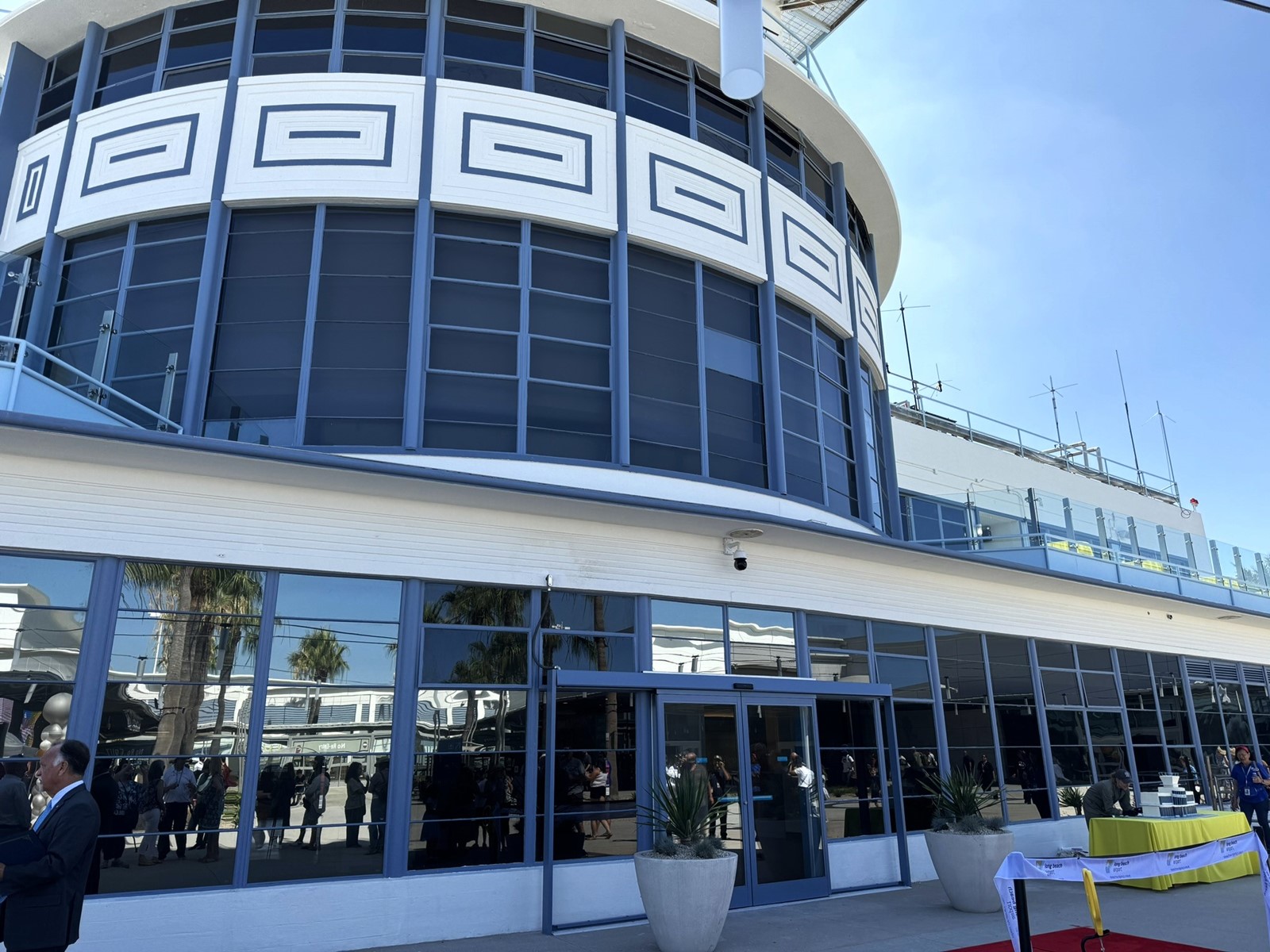
Austin and Wing designed the terminal in streamline Moderne style, which is second-generation art deco with less ornamentation. Used often in buildings related to transportation, like bus and train stations and airports, this design features long horizontal lines, curved corners, glass walls, a nautical feel and white- or light-color paint.
The Long Beach terminal has all of those elements, looking like a streamlined ship complete with a deck and railing on the roof.
The terminal is still painted white, but it’s been trimmed in a beautiful shade of medium blue, which enhances the streamline Moderne features, especially on the west side. On a personal note, the new color reminds me of Pan Am blue, which gladdens my heart, since my father worked for that now defunct airline for more than 40 years.
The east end of the terminal — what you see when you drive up on the airport roadway — is sort of nondescript. It looks like a long and squat white breadbox. (By the way, the roadway is undergoing a major overhaul as part of the multi-phase airport redo, so driving around the airport is a bit challenging right now.)
The showpiece part of the building is the west end facing the runways, with its curved second floor and bank of windows on the main floor. For years, those windows and the large glass doorway were blocked by offices and other airport business. But at the ribbon-cutting, natural sunlight poured through those windows and the main doors were opened to the public for the first time in decades.
Finally getting to walk through those doors was a visual feast.
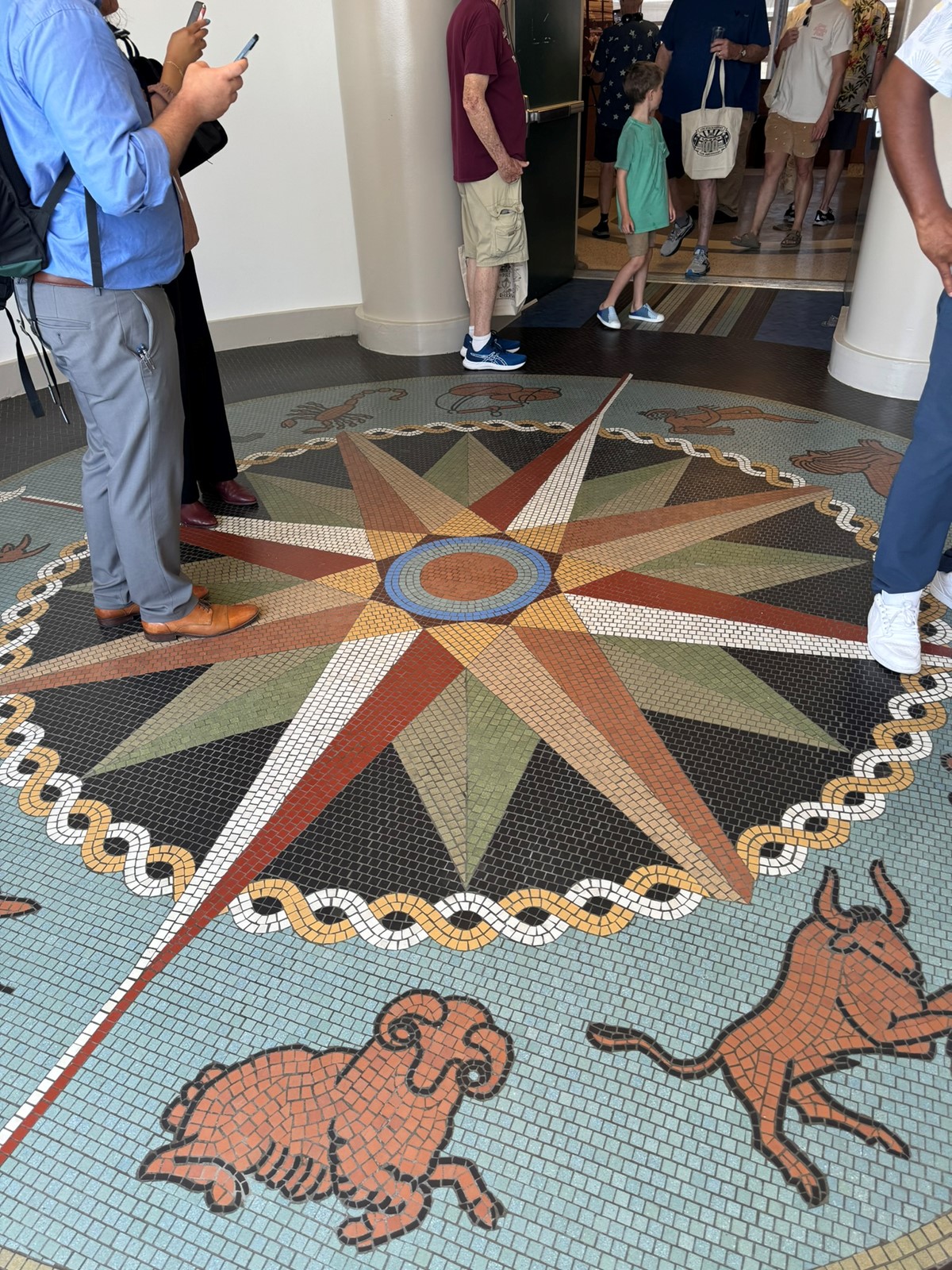
We all looked down at the terminal’s floors to admire Clements’ mosaic masterpiece, made up of 1.6 million small pieces of tile in a palette of 32 colors bathed in California sunshine.
Clements was already an established painter when she created nine vignettes of tile work with themes of transportation, communication and nature, among other topics that highlighted the importance of Long Beach at the time. It’s considered to be one of the best surviving examples of WPA projects nationwide.
Grace Richardson Clements was born in Oakland in 1905 and died in Los Angeles in 1969. In the 1930s, her art was exhibited at the Los Angeles County Museum of Art, San Francisco Museum and the Brooklyn Museum. She gave up painting in the 1940s and became an art critic, contributing to major art publications.
Clements was a bit of a free spirit. She married several times (Clements was her first husband) and never had children, according to her niece, Margaret Lyman of Bakersfield, who attended the ribbon-cutting ceremony with her brother, Bob Richardson. They were both delighted that their aunt’s legacy has been so carefully restored and displayed.
Clements also painted several murals on the terminal walls, with similar themes as the mosaics — but, sadly, those were painted over long ago and are lost forever.
And, if you can believe it, in the early 1960s, officials decided to cover up the mosaics with carpeting and other flooring to cut down on noise created by the high heels in fashion at the time. For years, multitudes of travelers who walked through the terminal had no idea Clements’ unique mosaics lay beneath their feet.
And in time, the existence of this historic art was forgotten.
But then, in 2012, some maintenance workers made the surprise discovery of her work.
Preservationist and art deco expert John Thomas of Long Beach was brought on board to oversee the terminal’s restoration. He told me that it was painstaking work to uncover the mosaics, carefully using simple tools like a paint scraper instead of heavy-duty machinery that contractors normally use to remove old flooring. Surprisingly, less than 10% of the tiles need replacing with modern-day materials so restoration work is still ongoing.
Here are a few highlights of her mosaic work:
• Next to a large mosaic of a ship that reminds some of the Queen Mary was a large photo on an easel of Clements crouched down laying tile for that ship. Her niece said the family didn’t know how long it took her aunt to complete all the mosaics.
• At the south entrance doorway closest to the new ticketing lobby are three seagulls in flight. Did Clements know that if her birds escaped straight out that particular entrance, they’d soon reach the ocean?
• Welcoming passengers right inside the east entrance is a large city seal of Long Beach, which Clements copied from the original design created in 1930. In the upper right quadrant, you’ll still see smokestacks that were removed when the city seal was revised in 1992.
• Clements’ hand can be seen holding a pencil to dial a relic of communication past … a rotary phone. How many parents will need to explain to children of today what that is?
• Right in the center of the first floor is the large North American continent mosaic crisscrossed with flight patterns of the time — so few compared to today’s air travel. The aviation lines can be seen briefly at the beginning of the 1946 Oscar-winning film, “The Best Years of Our Lives.” Hollywood has brought its cameras several times to the Long Beach Airport to use the Historic Terminal as a backdrop in film.
• Upstairs, right outside the restaurant space, is a large compass rose surrounded by the 12 signs of the zodiac, reflecting Clements’ interest in astrology. (Airport officials are working on finding a vendor for the dining space with its large curved windows and sweeping views of the airport.)
Other terminal changes include seismic retrofits and updated bathrooms. The original brass clock that greeted passengers for decades was wired with a GPS antenna to ensure accurate time. The clock can be seen above actor Dana Andrews’ head as he walks across the North American continent mosaic in the beginning scene of “The Best Years of Our Lives.”
On both floors of the terminal are several displays of vintage photos, posters and text that recount the people and stories of aviation’s significant past in Long Beach.
The rental car companies, who are currently housed in old trailers in the parking lot across from the historic terminal, are scheduled to move into the first floor by the end of 2024.
It’s safe to say that Long Beach will soon have one of the most interesting rental car centers of any airport. While standing in line to rent a car, travelers will be surrounded by aviation history and great art — at the coolest airport in America.
LGB history
The Long Beach Airport has produced videos to teach people more about the city’s aviation history and about LGB’s Historic Terminal. The videos can be found on YouTube by searching their titles: “Early Days of Aviation in Long Beach” and “Long Beach Airport’s Historic Terminal,” among others. Additional videos are on the airport’s YouTube channel, @LongBeachAirport.
 PREVIOUS ARTICLE
