



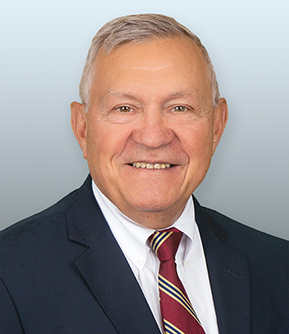


Retired federal judge John E. Jones III, a Schuylkill County native, stands by his recent allegations that the Trump administration has created an atmosphere that’s exposing judges to harassment, personal harm and death threats.
“This is such a toxic environment, where people are taking arms and can identify where a judge lives, and can strike out against a judge or a judge’s family,” Jones said in a report aired last Sunday on CBS News 60 Minutes. “In very plain English, if we’re not careful we’re going to get a judge killed. It’s just that stark.”
Jones is a member of the Article III Coalition, a group of about 60 retired federal judges who have appealed to the White House to tone down incendiary rhetoric that’s putting judges’ lives in danger.
When court rulings have gone against the administration’s interest, such as in the case of birthright citizenship, the president has called judges lunatics, monsters and communists intent on assuming powers that belong to the president.
“It’s alarming to me, and to all judges, whatever their political background, to see the judiciary so misrepresented by the current administration,” Jones said in a recent telephone interview with the Republican Herald. “And, you have members of Congress doxing judges, revealing their family members and their names, and publicly calling them out in a way that I think can lead to those judges being targeted.”
“This is serious stuff, and I would be remiss in not speaking out,” he added. “I meant what I said.”
‘Not an R or D issue’
President George W. Bush appointed Jones to the U.S. District Court for the Middle District of Pennsylvania in 2002. He was chief judge of the court when, in 2021, gave up a lifetime appointment to become president of Dickinson College.
John G. Roberts, chief justice of the U.S. Supreme Court, appointed Jones to the Judiciary Security Committee of the Judicial Conference of the United States.
As a member of the principal policy-making body of the federal court system, Jones said, he was intimately familiar with the threats facing judges.
Asked by 60 Minutes’ reporter Bill Whitaker what the president was up to when he characterized judges as deranged and corrupt, Jones said he thinks Trump is out to “delegitimize” the courts.
“It’s a presidency sort of on steroids,” Jones said. “And you have, I think, a very dormant United States Congress and a president who means to really say what the law is.”
Jones, a Republican, said the issue transcends political affiliations.
Retired judge John Coughenour of Washington state, appointed by President Ronald Reagan, received bomb threats after overturning the president’s executive order denying birthright citizenship, Jones noted.
“I don’t see this as an R or D issue,” he said. “Party affiliation is not an impediment to speaking out on issues I feel are important, no matter who is president.”
Judge Thomas I. Vanaskie was chief judge of the federal court for the Middle District of Pennsylvania when Jones was named to the court in 2002.
A Lackawanna County resident and fellow member of the Article III Coalition, Vanaskie served on the federal court for 16 years and the U.S. Court of Appeals for the Third Circuit for eight years before retiring in 2019.
“I’m impressed by what Judge Jones had to say,” Vanaskie said Friday after viewing a clip of the 60 Minutes report. “I admire him for doing that.”
He is also familiar with judges John Coughenour and Ester Salas, with whom he participated in legal affairs programs.
Both of Coughenour and Salas spoke out in the 60 Minutes report.
“I’m glad they’re standing up,” said Vanaskie, who chaired a statewide task force on the impact of the COVID-19 pandemic on legal services. “There’s some scary stuff going on out there.”
Vanaskie was especially supportive of Jones, a long-time defender of an independent judiciary.
“Judge Jones applies the law as he sees fit,” Vanaskie said, “which is what a judge’s role is.”
Schuylkill Connection
Jones, now 70, grew up in Orwigsburg.
A Blue Mountain High School graduate, he attended Mercersburg Academy for two years and entered Dickinson College in 1977. After graduating from Dickinson Law School in 1980, he clerked for then-president judge Guy Bowe in the Schuylkill County Courthouse.
Gov. Tom Ridge named him a trustee of the Pennsylvania Liquor Control Board in 1995, where he subsequently became chairman.
He continued practicing law in Pottsville until 2002, when he was named to the federal bench.
In 2006, Time Magazine named Jones one of its 100 most influential people in the world. He also received a Rave Award for Policy from Wired Magazine and was the first recipient of the John Marshall Judicial Independence Award presented by the Pennsylvania Bar Association.
As a federal judge, Jones presided over several high-profile cases.
In 2003, he struck down portions of Shippensburg University’s speech code on the basis it violated the First Amendment’s free speech guarantee.
In Kitzmiller v. Dover School District, a 2005 case, he found that it was unconstitutional to teach intelligent design within a public school science curriculum.
In accepting the American Humanist Association’s Religious Liberty Award in 2008, Jones revealed how he was “blasted” by Bill O’Reilly, Phyllis Schlafly and Ann Coulter for his ruling in Kitzmiller v. Dover School District.
In Whitehead v. Wolf, a 2014 case, Jones ruled Pennsylvania’s ban on same-sex marriages infringed on the plaintiff’s rights to due process and equal protection under the 14th Amendment to the Constitution.
Long Road Traveled
Sitting in a studio in London some years ago, waiting to be interviewed by the BBC, Jones was struck by the course his life journey has taken.
London is a long way from Orwigsburg, he thought, wondering how it all had happened.
“I never lost that sense of wonderment about how my life has taken me in these different directions,” he said. “I really appreciate that.”
No matter how far he traveled, Jones bears the indelible mark of growing up in Schuylkill County.
“I think what Schuylkill County teaches you is to stay as humble as possible, it’s kind of in our DNA,” he said. “You don’t want to get too high in the saddle because that’s just not our way.”
Whatever job he’s had, Jones said, he’s been privileged to have had.
“I’ve kind of remained a regular guy,” he said, “and I’m proud of my coal region roots.”
 PREVIOUS ARTICLE
