


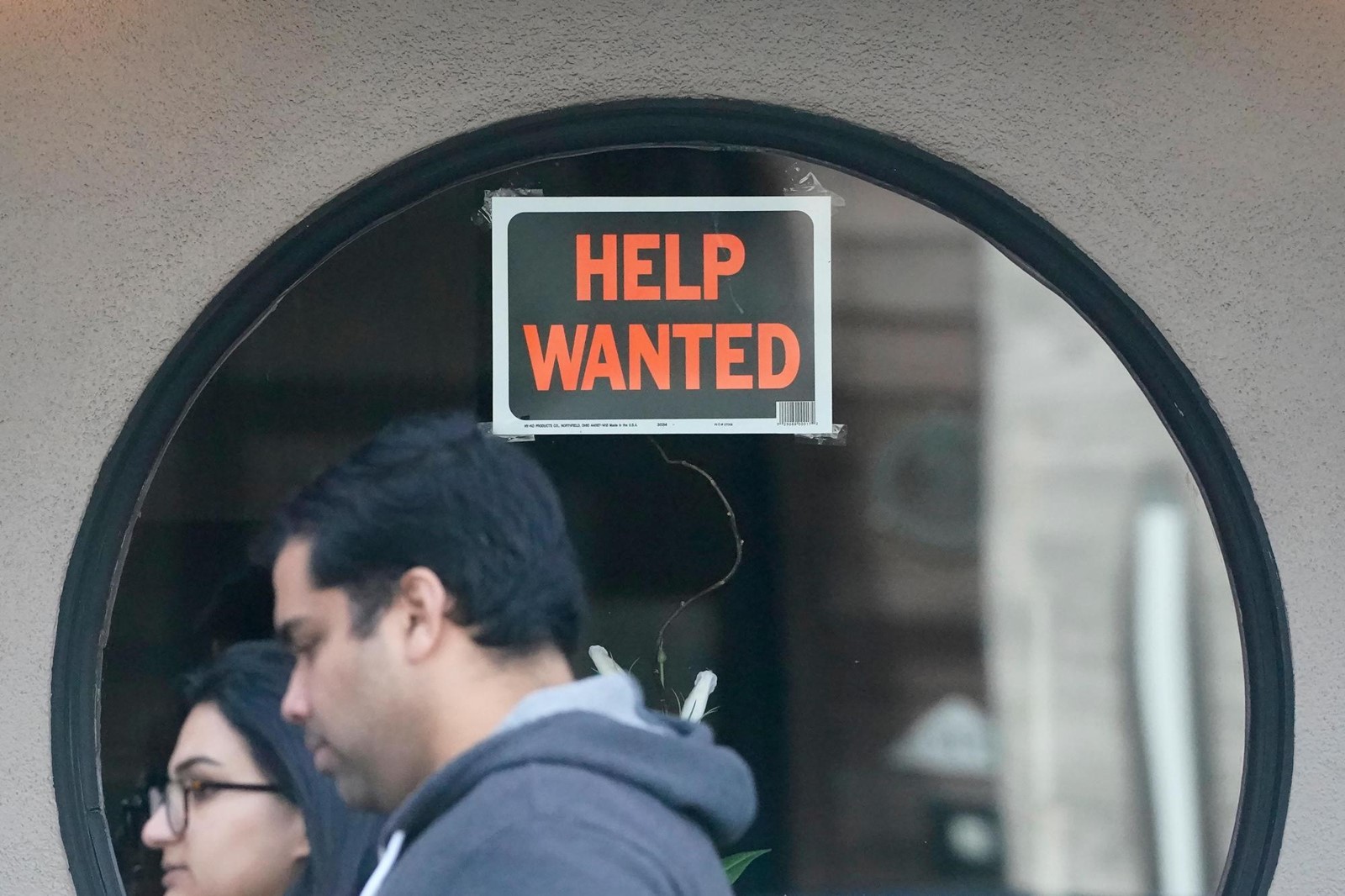


U.S. employers posted far fewer jobs in November than the previous month, a sign that employers aren’t yet ramping up hiring even as growth has picked up.
Businesses and government agencies posted 7.1 million open jobs at the end of November, the Labor Department said Wednesday, down from 7.4 million in October. Layoffs also dropped, however, as companies appear to be holding onto workers even as they are reluctant to add staff.
The report suggests that the “low-hire, low-fire” job market remains in effect, with workers enjoying some job security but those out of work struggling to find new jobs. The moribund labor market stands in contrast with data showing solid economic growth, which topped 4% at an annual rate in last year’s July-September quarter, the latest data available. Economists forecast growth slowed but remained solid in the final three months of 2025.
A key question for this year is whether hiring will pickup to match healthy growth, or whether sluggish job gains will eventually drag down the economy. There is a third possibility: Automation and artificial intelligence could enable steady economic growth without creating many jobs.
The number of postings in November was the fewest since September 2024. But outside that month, it was the lowest in nearly five years.
More Americans file for jobless benefits
U.S. filings for jobless benefits rose in the last week of 2025 but remain historically low, despite signs that the labor market is weakening.
The number of Americans filing for jobless claims for the week ending Jan. 3 rose by 8,000 to 208,000, up from 200,000 the previous week, according to the Labor Department. The figure was right in line with what analysts surveyed by the data firm FactSet were expecting.
Applications for unemployment aid are viewed as a proxy for layoffs and are close to a real-time indicator of the health of the job market.
Last month, the government reported that the U.S. gained a decent 64,000 jobs in November but lost 105,000 in October as federal workers departed after cutbacks by the Trump administration. That helped to push the unemployment rate up to 4.6%, the highest since 2021.
no global minimum tax for u.S. companies
U.S. multinational corporations will be exempted from paying more corporate taxes overseas in a deal finalized by the Organization for Economic Cooperation and Development.
The OECD said that nearly 150 countries have agreed on the plan, initially crafted in 2021, to stop large global companies from shifting profits to low-tax countries, no matter where they operate in the world.
The amended version excludes large U.S.-based multinational corporations from the 15% global minimum tax after negotiations between President Donald Trump’s administration and other members of the Group of Seven wealthy nations.
OECD Secretary-General Mathias Cormann said in a statement that the agreement is a “landmark decision in international tax co-operation” and “enhances tax certainty, reduces complexity, and protects tax bases.”
Treasury Secretary Scott Bessent called the agreement “a historic victory in preserving U.S. sovereignty and protecting American workers and businesses from extraterritorial overreach.”
The most recent version of the deal waters down a landmark 2021 agreement that set a minimum global corporate tax of 15%. The idea was to stop multinational corporations, including Apple and Nike, from using accounting and legal maneuvers to shift earnings to low- or no-tax havens.
Public Broadcasting group dissolves
Leaders of the Corporation for Public Broadcasting voted to dissolve the organization that was created in 1967.
CPB had been winding down since Congress acted last summer to defund its operations at the encouragement of President Donald Trump. Its board of directors chose Monday to shutter CPB completely instead of keeping it in existence as a shell.
“CPB’s final act would be to protect the integrity of the public media system and the democratic values by dissolving, rather than allowing the organization to remain defunded and vulnerable to additional attacks,” said Patricia Harrison, the organization’s president and CEO.
Many Republicans have long accused public broadcasting, particularly its news programming, of being biased toward liberals but it wasn’t until the second Trump administration — with full GOP control of Congress — that those criticisms were turned into action.
President Donald Trump said that he wants to block large institutional investors from buying houses, saying that a ban would make it easier for younger families to buy their first homes.
Compiled from Associated Press and Bloomberg reports .
 PREVIOUS ARTICLE
