


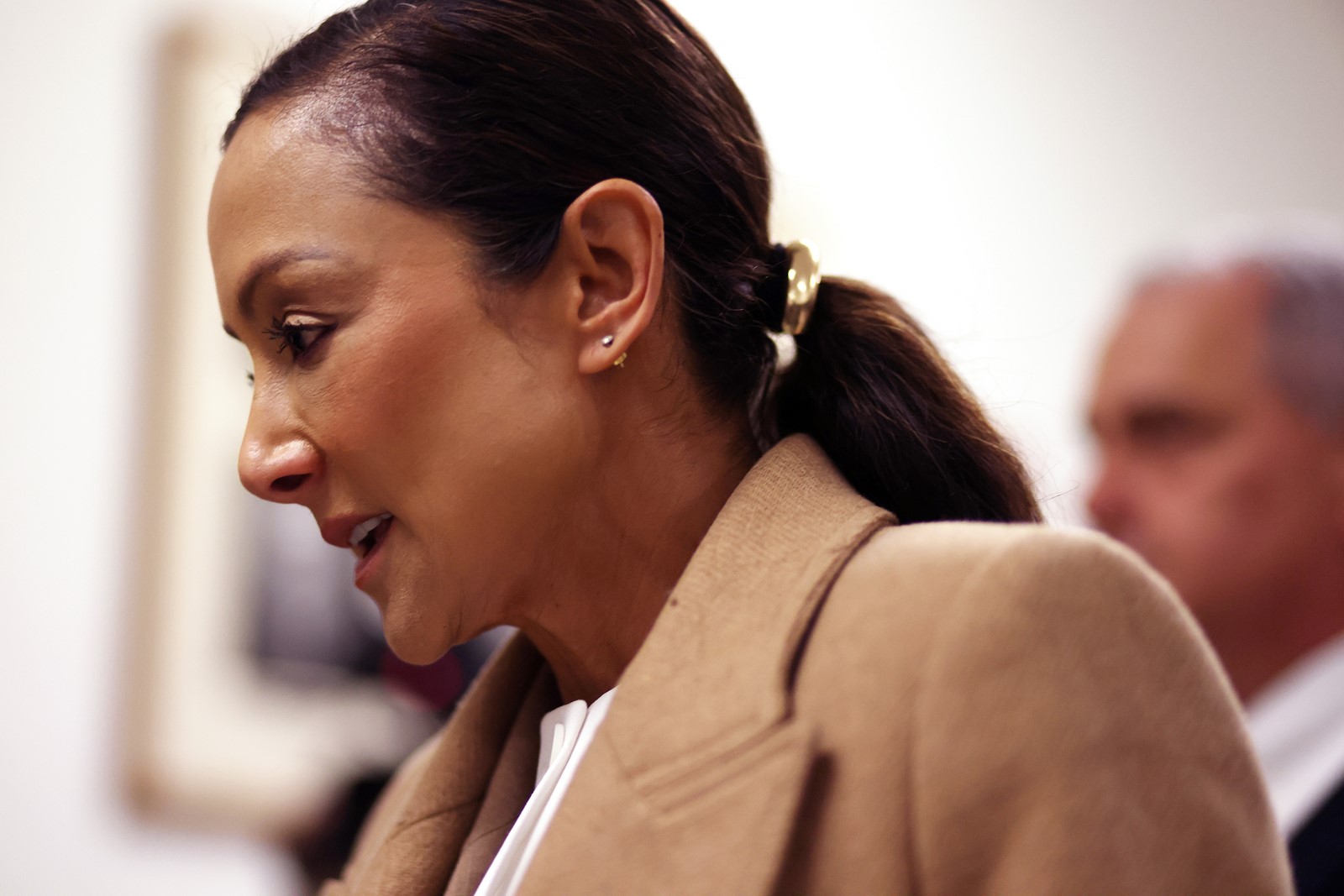


San Mateo County Sheriff Christina Corpus, who faces multiple efforts to remove her from office, said Thursday she now supports having her upcoming removal hearing be “open to the public” — reversing an earlier request to close the proceedings. County officials confirmed Friday that the hearing will be open.
In a statement released Thursday, Corpus’ office described her decision as one made “with firm conviction.”
“The people of San Mateo County deserve to hear the truth directly, not filtered through political agendas, biased narratives, erroneous reports or closed-door deliberations,” the statement said.
The shift comes weeks after the First Amendment Coalition, a free speech advocacy group, urged the county and sheriff to keep the removal hearing open — warning that closing it could expose the county to legal action. The county said earlier this week it supported opening the process to the public but, under the adopted removal procedures, could not overrule the sheriff’s request to close the hearing.
San Mateo County confirmed Friday that Corpus’ attorneys have formally withdrawn their objection to holding the upcoming removal hearings in public.
County spokesperson Effie Milionis Verducci said the hearings, scheduled for late August, will now be open to all.
“The county has consistently advocated openness and welcomes the sheriff’s agreement to open the hearing — an important step that follows a letter this week from the First Amendment Coalition to the sheriff urging public access and threatening legal action to require a hearing open to the public,” Verducci told this news organization.
However, some portions of the hearing may still be sealed.
“Under the procedures established by Measure A, the hearing officer has the authority to issue protective orders to keep certain documents, testimony, or other evidence confidential — especially when necessary to protect the privacy rights of third parties or address legal privileges,” Verducci said. “The hearing officer also has broad discretion to manage the conduct of the removal hearing, including removing disruptive individuals or sequestering witnesses who have not yet testified.”
Corpus had previously asked the court to close the hearing, citing the Peace Officer Bill of Rights, which shields certain personnel records. In a June 27 filing, her legal team argued the hearing should be closed “to avoid public dissemination of materials exempt from disclosure.” A document posted by the San Mateo County Superior Court confirmed her request.
The hearing, scheduled for Aug. 18-29, follows the Board of Supervisors’ June vote to remove Corpus from office — a power granted by voters in March through Measure A. The decision came after a closed-door preremoval hearing led by Chief Probation Officer John Keene.
Retired Santa Clara County Judge James Emerson will preside over the August hearing as the mutually selected officer.
Corpus, the county’s first Latina sheriff, faces two separate efforts to remove her from office over allegations of corruption and misconduct — one through the Board of Supervisors and another through a civil grand jury accusation recently filed in San Mateo County Superior Court. She has denied any wrongdoing and refused to resign.
On Thursday, Corpus said she has withheld a full public response to her accusers “out of respect for employee privacy and a desire to maintain the integrity of the internal processes.”
“But the time has come to bring the truth to light,” she said. “The community deserves to understand the sheriff’s decisions, the leadership challenges she has faced, violations of her constitutional rights, violation of state and federal laws, and the deliberate and misleading actions taken by a small group of individuals to remove her from elected office.
“This proceeding is not just about me,” she added. “It’s about exposing the deeply rooted double standards and inequities that persist in our county government — where power, influence and political alliances too often overshadow fairness, due process and accountability.”
In response to Corpus’ statement, the First Amendment Coalition said it was encouraged by the move, but emphasized the need for full transparency throughout the process.
“We welcome and appreciate the sheriff’s statement that she does not oppose holding the hearing open to the public,” David Loy, the coalition’s legal director, told this news organization. “That is as it should be. The public has an overwhelming interest in seeing for itself the evidence and allegations against the sheriff and the sheriff’s defense.”
Loy added that the coalition would seek confirmation from the county and the sheriff’s legal team that “the entire hearing will be open and all related records will be available to the public.” If either party attempts to close any portion, he said, “we want to ensure that it is done in full compliance with First Amendment standards.”
In a Monday letter to the coalition, County Attorney John Nibbelin said the county agreed the hearing should be public — but under the procedures adopted, the county cannot override the sheriff’s decision if she requests a closed session.
“While I cannot grant your request, the county agrees, as has been noted many times, that the removal hearing … should be open to the public,” Nibbelin wrote. He added that if the coalition chose to file a lawsuit, the county attorney’s office would not oppose it.
Allegations of workplace misconduct and abuse of power were first raised by two sheriff’s unions last year. Those accusations prompted a more than 400-page investigation led by retired Judge LaDoris Cordell. The report intensified calls for Corpus’ removal and led to the voter-approved Measure A, which authorized the board to be able to remove an elected sheriff by four-fifths vote until 2028 — the end of Corpus’ term.
Another report detailing similar allegations — by San Francisco law firm Keker, Van Nest & Peters and commissioned by the county — was made public last month by a San Mateo County court.
Corpus commissioned her own rebuttal report, published in April by former Riverside County Superior Court Judge Burke Strunsky, who criticized Cordell’s reliance on anonymous sources and unrecorded interviews.
 PREVIOUS ARTICLE

