


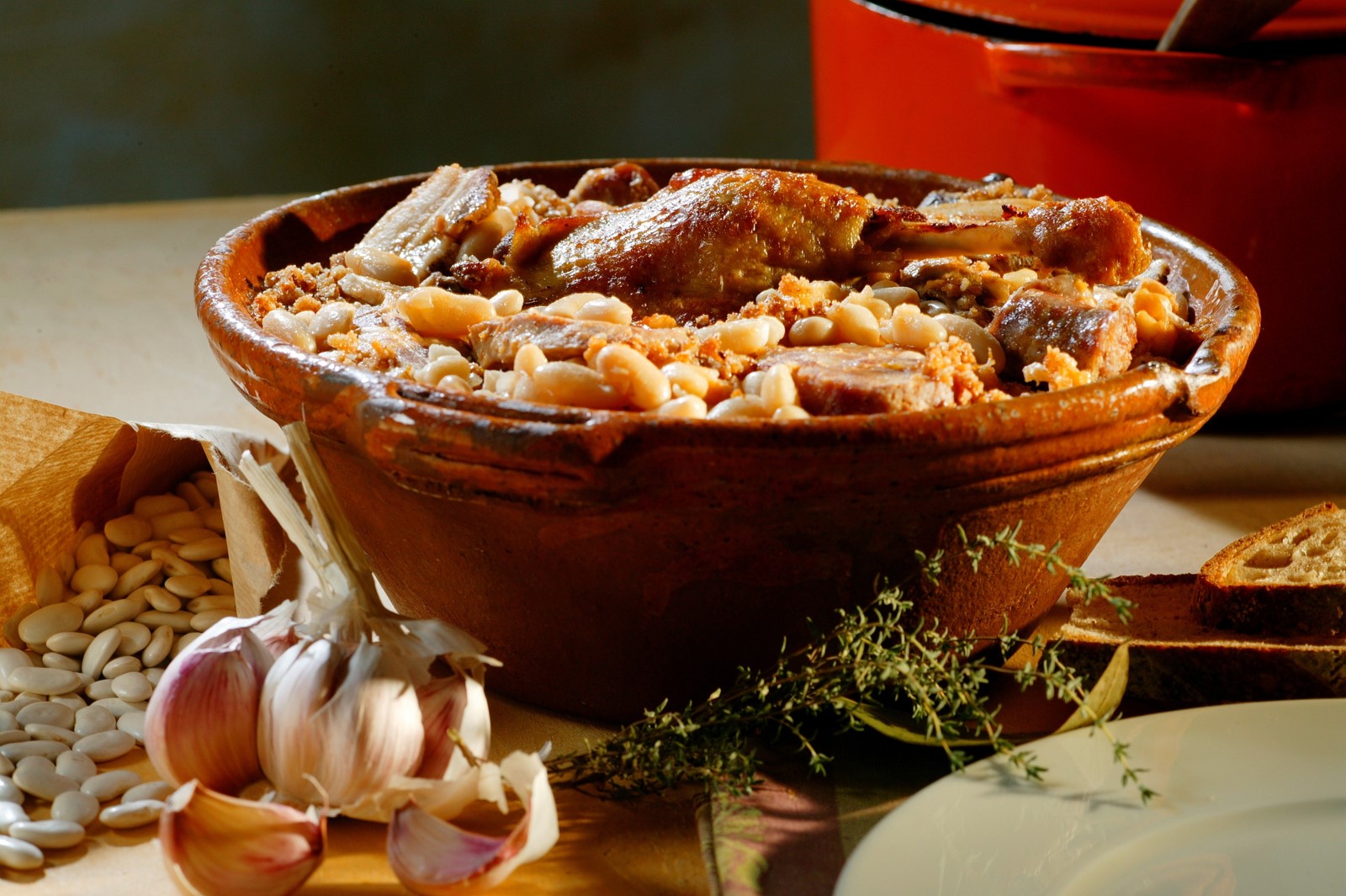


When winter heads our way, bringing chilly temperatures and close, dark nights, my thoughts turn to cassoulet, the iconic comfort food from southwestern France. It has it all — juicy beans, duck leg confit, sausages and sometimes pork or lamb, slowly simmered in well-seasoned broth, then baked in a wide-mouthed, glazed terra-cotta dish called a cassole.
Like any truly traditional dish, there are multiple versions, all claiming to be the “authentic one.” Cassoulet originated in southwestern France. Toulouse claims it — and so does Castelnaudary and Carcassonne — and the recipes vary.
In most restaurants, cassoulets are served in an individual cassole, bubbling with hot juices, and with a bit of duck leg peeking through the top. But at Hostellerie Etienne, a vast indoor- outdoor restaurant on the edge of a forest near Castelnaudary, the cassoulets come to the table in family-size cassoles, big enough to serve two, four, six or even 10 people, so you can share the dish with your dining companions.
Here in the Bay Area, we have our own go-to restaurants for cassoulets. Some, like the Left Bank Brasseries in San Jose, Menlo Park, Oakland and Larkspur, and Reve Bistro in Lafayette, only serve it during the winter months as a special. (Reve will be serving cassoulet Dec. 10-14, for example, and Jan. 7-11; reserve it when you reserve your table.)
Others, such as Bistro Jeanty in Yountville and Le Central in San Francisco, always have it on the menu.
Both Reve Bistro and Bistro Jeanty use cassoles made by potter Kathy Kernes at her Crockett Pottery in Crockett, and they are every bit as beautiful and as practical as those you’ll find in southwestern France. Kernes’ makes cassoles in six sizes ($38-$210), ranging from individual to “extra large plus,” which is very large indeed. (Browse the possibilities at www.crockettpottery.com.)
Le Central’s cassoulet is one of the more elaborate around, with lamb, pork shoulder and boudin blanc, as well as the all-important duck leg confit and slightly garlicky Toulouse sausage. Left Bank uses chef-owner Roland Passot’s recipe (see below) and keeps it simple, limiting the meats to duck leg confit and Toulouse sausages. (Don’t panic. If you’re making this at home, some specialty markets sell duck confit.)
The beans are key to cassoulet. Once cooked, they should not be mushy, but hold their shape after the long cooking. In France, tradition calls for either Tarbais beans, a plump, white bean, or lingot beans — a strain of cannellini beans — in making cassoulet. As Passot suggests in his recipe below, you can substitute cannellini beans or Great Northern beans. Rancho Gordo produces a variety called cassoulet, a West Coast-grown bean from the Tarbais strain.
Left Bank Brasserie Cassoulet
Serves 6 to 8
INGREDIENTS
Beans:
4 cups dried lingot beans (white kidney, cannellini or Great Northern, will all work)
1 small carrot, peeled and chopped
1 small onion, diced (about ¾ cup)
1 clove garlic, chopped
1 pound slab bacon or extra thick-cut bacon, cut into 1-inch cubes
2 sprigs of thyme
1 bay leaf
Cassoulet:
¼ cup duck fat (lard will do in a pinch)
2 pounds pork butt cut in 2-inch cubes
1 cup onions, diced small
4 cloves garlic, chopped
¼ cup tomato paste
1 small can diced tomatoes
1½-2 cups reserved bean water
6 Toulouse sausages
1 small garlic sausage
4 confit duck legs, purchased or homemade (see note below)
1 cup panko bread crumbs
1 teaspoon garlic, chopped
1 tablespoon parsley, chopped
¼ teaspoon fresh thyme, chopped
1 tablespoon extra virgin olive oil
DIRECTIONS
The night before, place the beans in a deep pot and add enough water to cover by 2 inches. Let beans soak overnight.
The next day, rinse the beans well. Add the rinsed beans, carrots, onions, garlic, bacon, thyme and bay leaf to cold water and cook, over low heat, until the beans are tender. Strain the beans, saving the water, and set aside the beans.
In a large braising pan, melt the duck fat over medium high heat. Once the pan is hot, brown the pork butt pieces without stirring. When beginning to brown, start stirring, making sure you scrape the bottom if it starts to caramelize. The pork doesn’t need much color, but it does need to cook in the duck fat for a while. Add lots of salt and pepper. This is not a shy dish.
When the pork is nice and brown on all sides, add the 1 cup onions and garlic, and sauté until the onions are soft and cooked through. Add the tomato paste, diced tomatoes and reserved liquid from the beans. Stir, using a rubber spatula to clean the side of the pot.
Preheat your oven to 250 degrees.
Bring the heat under the braising pan up to high. Once at a rolling boil, turn down to low heat and add all the sausages. When they are cooked through, remove and set aside. Slice the garlic sausage in half and cut into 1-inch pieces. Return the whole and sliced sausages back to the pot along with the cooked beans. Continue to cook on low heat until the pork is cooked through. Taste for seasoning; add more salt and pepper if needed.
Transfer the beans and pork to a heavy, wide mouth, earthenware, clay or cast iron baking dish that can hold 5 to 6 quarts. Bake at 250 degrees for about 1½ hours, checking at least every 30 minutes. It may require a bit more time. If the dish is starting to look too dry, add a small amount of reserved bean broth or chicken stock.
Add warmed duck legs to the cassoulet and make a breadcrumb topping by combining the panko, garlic, parsley, thyme and extra virgin olive oil. Return the dish to the oven and continue baking until the crumbs brown on the top.
— Courtesy Roland Passot, Propriétaire, Chef Culinary Officer, Vine Hospitality
 PREVIOUS ARTICLE

