


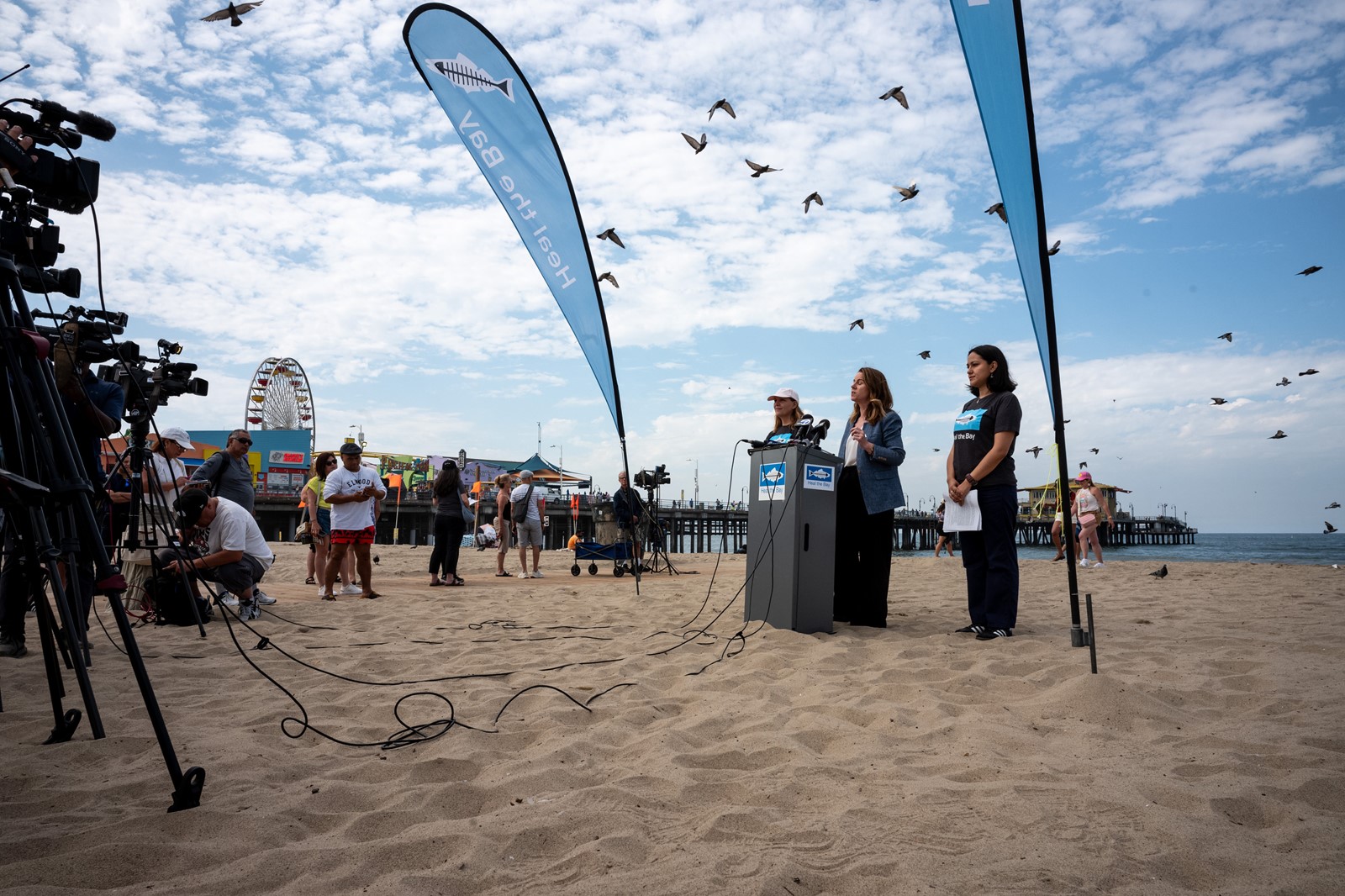


On a recent Sunday, Tracy Quinn drove down the Pacific Coast Highway to assess damage wrought upon the coastline by the Palisades fire.
The water line was darkened by ash. Burnt remnants of washing machines and dryers and metal appliances were strewn about the shoreline. Sludge carpeted the water’s edge. Waves during high tide lapped onto charred homes, pulling debris and potentially toxic ash into the ocean as they receded.
“It was just heartbreaking,” said Quinn, president and CEO of the environmental group Heal the Bay, whose team has reported ash and debris some 25 miles south of the Palisades burn area west of Los Angeles.
As crews work to remove potentially hundreds of thousands of tons of hazardous materials from the Los Angeles wildfires, researchers and officials are trying to understand how the fires on land have impacted the sea. The Palisades and Eaton fires scorched thousands of homes, businesses, cars and electronics, turning everyday items into hazardous ash made of pesticides, asbestos, plastics, lead, heavy metals and more.
Since much of it could end up in the Pacific Ocean, there are concerns and many unknowns about how the fires could affect life under the sea.
“We haven’t seen a concentration of homes and buildings burned so close to the water,” Quinn said.
On Thursday, the Los Angeles County Department of Public Health extended its ocean water advisory from Las Flores State Beach to Santa Monica State Beach, which will remain in effect until further notice.
Beachgoers may recreate on the sand but are continued to be advised to stay away from visible fire debris and to stay out of the ocean water during any posted ocean advisory, according to the department.
The department also issued the following non-fire-related beach area warnings due to bacterial levels exceeding health standards when last tested:
• Lagoon at Surfrider Beach: 100 yards up and down the coast from the public restrooms
• Santa Monica Pier in Santa Monica: 100 yards up and down the coast from the pier
• Pico-Kenter storm drain at Santa Monica Beach: 100 yards up and down the coast from the storm drain
• Ashland Avenue storm drain in Santa Monica: 100 yards up and down the coast from the storm drain
• Windward storm drain at Venice Beach: 100 yards up and down the coast from the storm drain
• Dockweiler State Beach, Culver Boulevard Storm Drain: 100 yards up and down the coast from the storm drain
• Dockweiler State Beach, Westchester Storm Drain; 100 yards up and down the coast from the storm drain
• Puerco Canyon Storm Drain at Puerco Beach, 100 yards up and down the coast from the storm drain
• Escondido Creek at Escondido State Beach; 100 yards up and down the coast from the creek
• Marie Canyon Storm Drain at Puerco Beach; 100 yards up and down the coast from the storm drain
• Sweetwater Canyon Storm Drain at Carbon Canyon Beach, 100 yards up and down the coast from the storm drain
• Rose Avenue Storm Drain at Venice Beach: 100 yards up and down the coast from the storm drain
• Mothers Beach in Marina Del Rey: entire swim area
Fire debris and potentially toxic ash could make the water unsafe for surfers and swimmers, especially after rainfall that can transport chemicals, trash and other hazards into the sea. Longer term, scientists worry if and how charred urban contaminants will affect the food supply.
The atmospheric river and mudslides that pummeled the Los Angeles region last week exacerbated some of those fears.
When the fires broke out in January, one of Mara Dias’ first concerns was ocean water contamination. Strong winds were carrying smoke and ash far beyond the blazes before settling at sea, said the water quality manager for the Surfrider Foundation, an environmental nonprofit.
Scientists on board a research vessel during the fires detected ash and waste on the water as far as 100 miles offshore, said marine ecologist Julie Dinasquet with the University of California, San Diego’s Scripps Institution of Oceanography. Things like twigs and shard. They described the smell as electronics burning, she recalled, “not like a nice campfire.”
Runoff from rains also are a huge and immediate concern. Rainfall picks up contaminants and trash while flushing toward the sea through a network of drains and rivers. That runoff could contain “a lot of nutrients, nitrogen and phosphate that end up in the ash of the burn material that can get into the water,” said Dias, as well as “heavy metals, something called PAHs, which are given off when you burn different types of fuel.”
Mudslides and debris flows in the Palisades Fire burn zone also can dump more hazardous waste into the ocean. After fires, the soil in burn scars is less able to absorb rainfall and can develop a layer that repels water from the remains of seared organic material. When there is less organic material to hold the soil in place, the risks of mudslides and debris flows increase.
Los Angeles County officials, with help from other agencies, have set thousands of feet of concrete barriers, sandbags, silt socks and more to prevent debris from reaching beaches. The L.A. County Board of Supervisors also recently passed a motion seeking state and federal help to expand beach clean ups, prepare for storm runoff and test ocean water for potential toxins and chemicals, among other things.
Beyond the usual samples, state water officials and others are testing for total and dissolved metals such as arsenic, lead and aluminum and volatile organic compounds.
They also are sampling for microplastics, polycyclic aromatic hydrocarbons, or PAHs, that are harmful to human and aquatic life, and polychlorinated biphenyls, or PCBs, a group of man-made chemicals shown to cause cancer in animals and other serious health effects. Now banned from being manufactured, they were used in products like pigments, paints and electrical equipment.
County public health officials said chemical tests of water samples last month did not raise health concerns, so they downgraded one beach closure to an ocean water advisory. Beachgoers were still advised to stay out of the water.
Dinasquet and colleagues are working to understand how far potentially toxic ash and debris dispersed across the ocean, how deep and how fast they sunk and, over time, where it ends up.
Forest fires can deposit important nutrients like iron and nitrogen into the ocean ecosystem, boosting the growth of phytoplankton, which can create a positive, cascading effect across the ecosystem. But the potentially toxic ash from urban coastal fires could have dire consequences, Dinasquet said.
“Reports are already showing that there was a lot of lead and asbestos in the ash,” she added. “This is really bad for people so its probably also very bad for the marine organisms.”
A huge concern is whether toxic contaminants from the fire will enter the food chain. Researchers plan to take tissue fragments from fish for signs of heavy metals and contaminants. But they say it will take a while to understand how a massive urban fire will affect the larger ecosystem and our food supply.
Dias noted the ocean has long taken in pollution from land, but with fires and other disasters, “everything is compounded and the situation is even more dire.”
City News Service contributed to this report.
 PREVIOUS ARTICLE
