




By Ross Eric Gibson
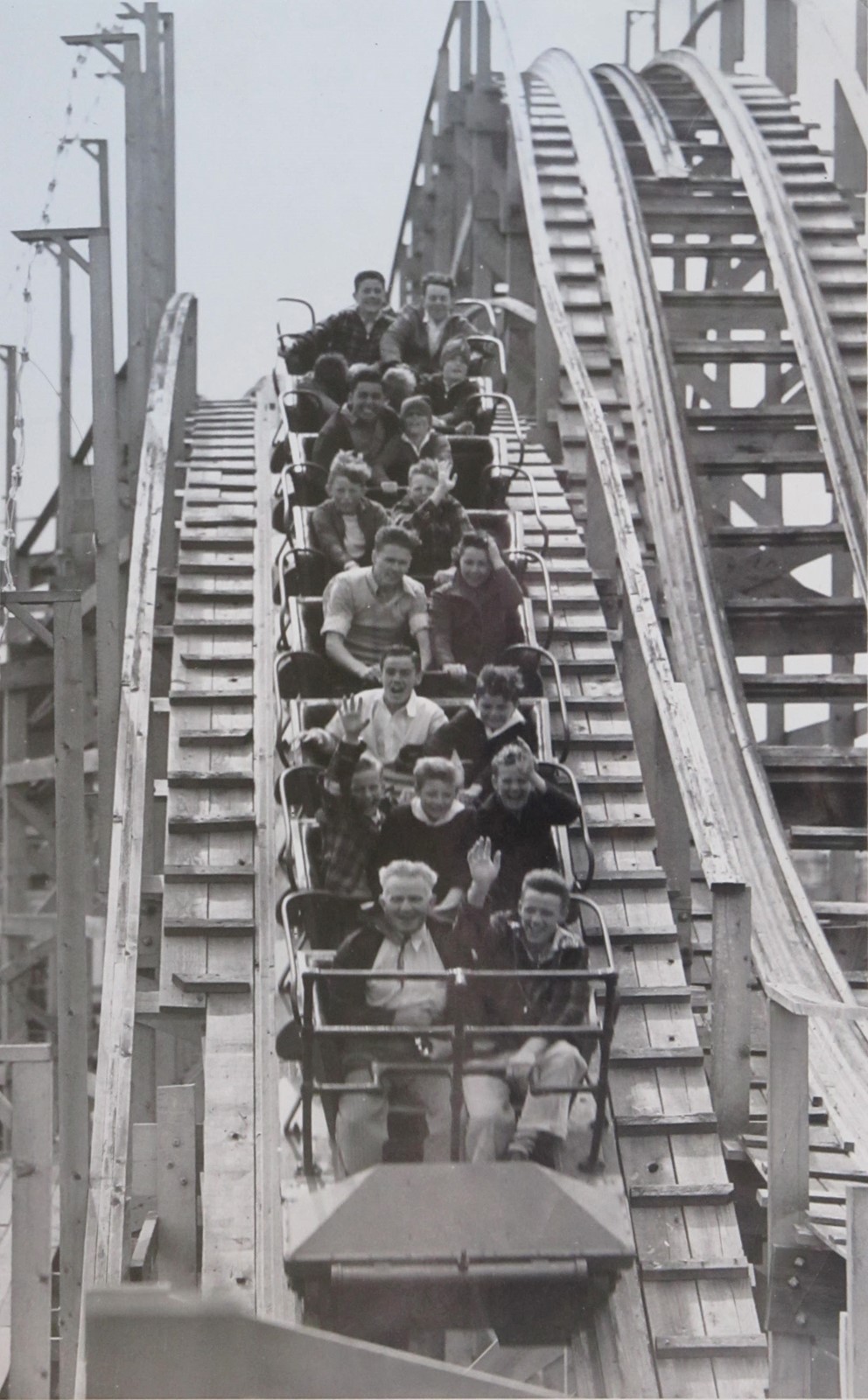
It’s the 100th anniversary of the Boardwalk’s Giant Dipper roller coaster, an astounding milestone for local coaster history. Our earliest designers of Santa Cruz coasters were L.A. Thompson, Arthur Looff and Frederick Church, each noted for being soft spoken, teetotaling tinkerers.
Mule coaster
The original American roller coaster was made to give mules a ride. It was Pennsylvania’s Mauch Chunk Switchback Railway, built 1827 as the second permanent American railroad, and first American switchback. Not built for amusement, it moved coal and mules from the mine to the shipping canal by gravity, with the mules pulling the cars back up the hill. In the depression of 1872, the mine closed down, but the railroad became a tourist attraction for its exciting ride. In 1872 and 1878, the first two U.S. coaster patents were for “incline railways.” Then Allison Wood invented the Circular Incline Railroad in 1884, improved by Philo M. Stevens four months later, who named his business the Roller Coaster of America Company. The term defined a railway-wheeled vehicle that “coasts,” using unpowered gravity motion. (Jeffrey Stanton “History of Early Roller Coasters,” westland.net, 2013).
Snowless sledding
Two men from Oakland arrived in Santa Cruz in 1885 and rented a lot on Pacific Avenue (south of our recently demolished bus station), where they built a mysterious skeletal framework 24 feet at its tallest, completed in 10 days. It cost $600 to build, plus rolling stock, mechanicals and a generator, totaling $3,900. On a circular railroad track stretching 500 feet over uneven framework “hills,” the “California Toboggan Ride” enticed customers with a banner to “Slide Down Hill Without Snow!” Because the Sentinel called it a “roller coaster, or gravity railroad,” it suggests it may have been using Philo M. Stevens’ patent, which was probably franchised. Yet the excitement was not just the coaster, but seeing it at night, outlined in electric lights, four years before Santa Cruz got electricity.
The ride was described as having “all the sensation of being carried away by a cyclone,” and that “The screams of the timid add to the excitement, but almost before a person is aware of it, he or she had reached the end of the track.” Yet if you felt you might lose your life on this fearsome contraption, the music was performed by the Holiness Band, which would supposedly save your soul before you risked your life. Folks must have debated whether a dime spent for a one-hour Vaudeville show was equal to a dime spent for 14 seconds of sheer terror!
Due to the novelty of a roller coaster and its cheap construction, the ride promoter could often recoup his money in a short time. The only known roller coasters built on the West Coast in 1884-1885 were in San Francisco, Los Angeles, Stockton and Santa Cruz. The local sensation would have continued at least two years, but the Santa Cruz sheriff served a writ of attachment for a debt of $140 in August 1886. The owner found a new thrill, that of skipping town, while his toboggan coaster was sold for scrap. His 14 seconds of fame were over.
L.A. Thompson
After Fred Swanton’s Boardwalk Casino burned in 1906, he rebuilt it grander in 1907, and sought to extend the Boardwalk. Swanton wanted to build the longest and fasted roller coaster yet made. He looked to Coney Island, the Amusement Mecca of America, where the most prolific coaster developer there was mild-mannered Sunday School teacher L.A. Thompson. He’d invented toys and improved farm equipment by the age of 12. He must have ridden on the Mauch Chunk Switchback Railway, for he patented his own switchback railway in 1885. His scenic railway patents used an oval loop track, with an unobstructed view of the topography, and his theme dioramas. Where others tried to increase coaster speeds at any cost, Thompson felt slower was safer and gave a longer ride, and he discovered if he placed tunnel walls and dioramas close to the track, it gave the illusion of faster speed as they flashed by.
Thompson loved Swanton’s challenge, and for $35,000 built the longest scenic railway of its day, plunging down the first peak at top speed of 25 miles per hour, when horse-and-buggies traveled at 10 miles an hour. In spite of its popularity, maintenance was becoming an issue due to frequent waterfront flooding, so four years after construction, Thompson sold the scenic railway to Swanton for $1. In 1911, the Charles Looff’s carousel was installed at the Boardwalk, with 73 dramatically carved horses galloping at 10 miles an hour, while riders caught a brass ring. Around 1912, a group of young men bicycled over the scenic railway’s plank hills, which included a future Seaside Company (Boardwalk) President Lawrence Canfield. In 1915, with Fred Swanton running the Midway at San Francisco’s World’s Fair, L.A. Thompson contributed a Midway scenic railway, with part of the track supported by giant elephant statues.
Jazz age
Women left the workforce as World War I ended and Prohibition began, producing a restless generation, unwilling to go back to a Victorian lifestyle. Battle-scarred veterans drove their “voting Valentines” in a Tin Lizzy at top speed, out to speakeasies, to dance to scandalous Jazz music. Old thrills were now “yawners.” Oakland’s “Idora Park” unveiled a daring roller coaster called the Big Dipper, with dips up to 100 feet. Arthur Looff (the merry-go-round maker’s son) wanted to outdo it, and designed and built his own Giant Dipper at San Francisco’s Ocean Beach (later Playland). Its debut in 1922 drew the attention of the Santa Cruz Beach Boardwalk.
Boardwalk management told Looff they wanted him to create the longest and fastest coaster in the world to replace the scenic railway. So Looff sold his San Francisco amusement interests to his partner and moved to Santa Cruz to make history.
Looff wanted to combine all the most thrilling sensations in one ride. He and engineer Frederick Church decided it would begin with a plunge down a dark mine shaft, a twisting earthquake, a slow balloon ascent 80 feet to the top of the tallest tower, a parachute jump free-falling at 55 miles an hour, a flying curve like an airplane roll, then pitching like a ship on a stormy sea, a tight cyclone curve, an inner track with barn-storming airplane maneuvers, then toboggan hills before entering the station. Except for the slow lift to the top, the entire ride is gravity powered. The Boardwalk was so pleased, they wouldn’t name it another Big Dipper, but the GIANT DIPPER! Learning from structural issues with the scenic railway, it was better built in 47 days for $50,000, sprawling out on the sand like a beached leviathan! It opened May 17, 1924, to mobs of eager riders.
While popular, Looff still hadn’t made back his money in September 1929, seeking adjustments to boost his profits. A month later the stock market crash brought on the Great Depression, with a downturn in patronage. The Boardwalk centralized its attractions for easier access. Revenues grew worse every year, until Looff (who still hadn’t made a profit) declared in a March 1933 letter, he would let his lease expire that year, and tear down the Giant Dipper to sell the materials for salvage. (Ted Whiting, “Saving the Giant Dipper” 5/16/2019.)
Boardwalk management was shocked. Given the economy, it would be a long time before they could afford to build an attraction of this quality, prestige and fame. On June 5, 1933, the boardwalk purchased Looff’s Giant Dipper company and stock, and took over operation of the ride. Poor Looff had been so worried in March 1933, that he hadn’t seen the signs of recovery. On March 4, Franklin Delano Roosevelt was inaugurated as president, ended Prohibition, and instilled a new sense of optimism as the nation got back on its feet. Right after Looff sold it, the Giant Dipper had a financial resurgence.
Sister Dipper
John D. Spreckels, eldest son of Aptos resident Claus J. Spreckels the Sugar King, fell in love with San Diego in 1887, and in 1892 acquired the Hotel Del Coronado, and the trolley line. He made a number of San Diego improvements, then in 1925, to promote his Mission Beach development, he built his version of the Santa Cruz Beach Boardwalk as the “Amusement Center,” which included a new Giant Dipper, designed and constructed by Frederick Church. Spreckels died a year later in 1926, leaving the amusement park to San Diego.
The park was renamed Belmont in 1955, then closed in 1976 due to maintenance issues. The city decided to tear down the San Diego coaster soon after, so a “Save the Coaster” group was formed. They obtained rights to the coaster, got it declared a national landmark in 1978, gaining a preservation grant in 1981, yet still lacked sufficient funding for restoration. In 1988, developers of an adjoining shopping center partnered with San Diego to repair the coaster and park. And who best to help restore the coaster than the Santa Cruz Beach Boardwalk, which had the experience of daily and hourly maintenance of the world’s first Giant Dipper.
Back in Santa Cruz, maintenance man Marshall Wade was working on the Giant Dipper track, when suddenly the track started to rumble, indicating there was a coaster coming his way fast. He quickly jumped aside off the track, curious since no coasters were supposed to be running that day. When nothing came, he concluded it was an earthquake that Oct. 17, 1989, day. The Giant Dipper was closed down for two months of meticulous examination, checking for any possible damage or safety hazard, but found none. The coaster’s constant upkeep and improvements over the years were as sturdy for twisting coaster cars, as they were for Mother Nature’s dancing! (Amanda Barlett, SFGATE, 5/16/24). The San Diego Giant Dipper restoration concluded in 1990 and it reopened to the public.
In 1987, the Santa Cruz Giant Dipper along with the Looff Carousel were declared National Historic Landmarks by the National Park Service; the New York Times said the Giant Dipper was one of the top 10 wooden coasters, while the Giant Dipper was given the ACE Coaster Landmark award in 2007. This year we can be proud to celebrate the centennial of the first Giant Dipper, and in 2025 will be the centennial of our sister coaster, the second Giant Dipper! So beware the mild-mannered scream makers!
 PREVIOUS ARTICLE
