




The CEOs who accompanied President Donald Trump to a meeting and grand banquet in China last week were seeking to curry favor with the Trump administration and the Chinese government, keenly aware that the support of either could make or break their businesses.
But the delegation — which included executives from Boeing, Apple, Nvidia, Cargill and other firms — arrived in Beijing with a variety of commercial complaints about doing business in China, some of which are public, some of which have not been previously reported.
In recent weeks, the Chinese government has blocked exports of high-end solar manufacturing equipment from a Chinese supplier, Suzhou Maxwell Technologies, to Tesla, the Elon Musk-led automaker, according to a person familiar with the matter who was not authorized to speak publicly. As part of its solar and energy storage business, Tesla had been looking to buy nearly $3 billion worth of manufacturing equipment from Suzhou Maxwell to build products that would further enable the transition to sustainable energy and bring about 100 gigawatts of solar capacity to the United States.
Tesla also has major business interests in China — its Shanghai factory is its largest — but Musk visited China with the hope of unblocking those solar manufacturing exports, the person said. There’s no indication yet that his efforts were successful. Musk and Tesla did not respond to requests for comment.
Other companies in attendance had their own complaints. Coherent, a Pennsylvania semiconductor firm that was included in the delegation, has been struggling to obtain indium phosphide, a material exported by China that is necessary to make photonic chips for data centers, other people said. China has also not yet approved purchases of Nvidia’s H200 chips, though earlier this year, the U.S. government approved of the company selling them to major Chinese tech firms including Alibaba, Tencent and ByteDance.
Last year, China lifted an export ban it had placed on Illumina, a biotech company present in the delegation, after Trump imposed tariffs on China last year. But the company is still on China’s “unreliable entity list,” meaning some of its products cannot be purchased in China without government approval.
Chinese officials have ordered that Meta, also in attendance, unwind its acquisition of the artificial intelligence firm Manus, over concerns about AI expertise flowing out of China. It opened an antitrust investigation last year into the chip company Qualcomm. And the Chinese government has deemed products made by Micron, a semiconductor maker in attendance, to be a security risk, meaning Micron can’t sell to certain Chinese companies engaged in critical infrastructure.
Other issues have persisted longer. Boeing had not had a meaningful sale in China for roughly a decade, a result of geopolitical tensions and the company’s safety issues.
“They were there to solve specific bottlenecks,” Alison Szalwinski, vice president at the Asia Group, a Washington consulting firm, said of the CEOs.
“Some of those companies were dealing with licensing issues, market access and supply chain approvals, all being done on a case-by-case basis,” she said. “Many of them expect to be able to move the ball forward on several of those issues.”
In the lead-up to the summit, U.S. officials debated whether doing more business with China would help the United States or increase its vulnerabilities. But with Trump and the Chinese president, Xi Jinping, set to meet multiple times this year, some companies are hoping for steadier relations.
So far, it’s not clear much has changed. After the meeting last week, the U.S. and China announced sales of American agricultural goods and airplanes to China — though the 200 Boeing airplanes that China committed to buying was lower than what some expected before the summit. Chinese regulators also appeared to have moved in recent days toward approving an application by Citi to set up its own securities firm in China. On other issues, nothing has yet been announced.
Industry executives say that many of the companies that were included in the trip had expressed their interest in joining or been contacted by David Perdue, the U.S. ambassador to China, as well as Scott Bessent, the treasury secretary, and Jamieson Greer, the trade representative.
But a week before the high-level visit between Trump and Xi, no CEOs had yet received an invitation.
On Monday, two days before the president departed, the White House announced a list of 17 attendees.
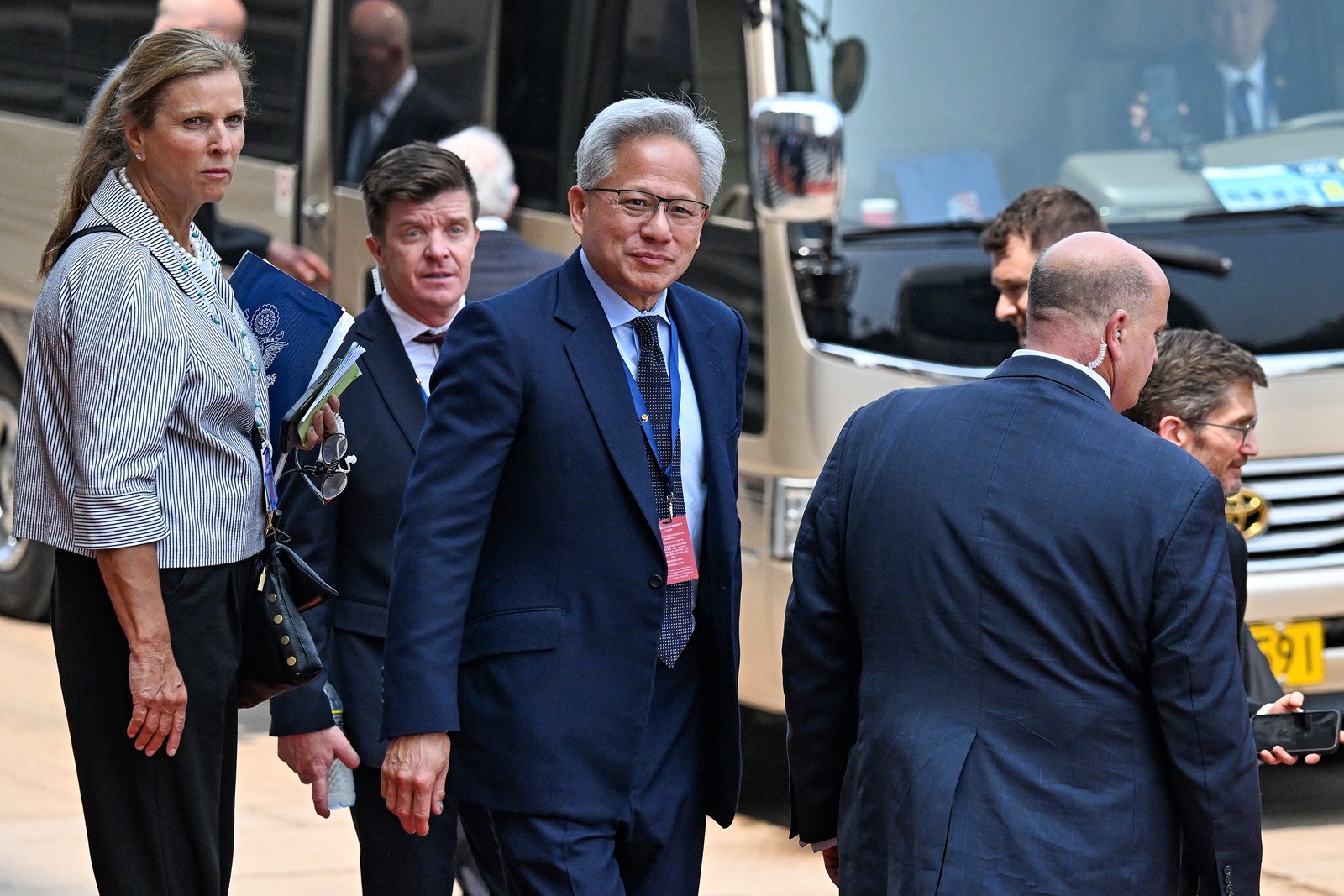
Noticeably absent was Jensen Huang, the CEO of Nvidia, whose chip sales to China have been a source of controversy inside and outside the administration. But Trump noticed his omission and put in a last-minute call to Huang on Tuesday. Huang then met Air Force One as it refueled in Alaska.
While all of the companies that attended the summit have important commercial business in China, those familiar with the trip cautioned that many came simply to generate goodwill with the Chinese and U.S. governments or to act as a friend to the president — including Huang and Steve Schwarzman of the private equity firm Blackstone Group.
Most were on the ground in China for less than 48 hours, but the events were not without drama. The CEOs in the delegation had been planning to attend a meeting Thursday afternoon with a Chinese official, Li Qiang, then proceed straight to the grand banquet hosted in the Great Hall of the People in Tiananmen Square.
But Thursday morning, just hours before Trump was set to meet Xi in the heart of Beijing, assistants to some of America’s most powerful CEOs received a surprise late-night phone call from the White House.
The White House informed them that plans had changed: Trump wanted the CEOs to accompany him the next morning to his welcome ceremony meeting with Xi in the morning as well.
The next morning, Tim Cook, Musk and others stood on the steps of the Great Hall of the People, just behind the secretaries of state and treasury and other officials, as they shook hands with Xi, then filtered into the great hall. Seated at a giant rectangular table, Trump said that he had brought “the greatest businessmen, the biggest, and I guess the best, in the world.”
“I didn’t want the second or the third in the company; I wanted only the top, and they’re here today to pay respects to you and to China,” Trump told Xi. “And they look forward to trade and doing business.”
Because their attendance was arranged last-minute, the executives were held up as they tried to enter the hall. The White House wanted to bring them into the meeting in groups, and officials from Boeing, GE Aerospace and Cargill were brought in first. Then, the rest of the executives were unexpectedly summoned together, a request that necessitated some being rushed from a separate waiting room.
There weren’t enough chairs for all of them, so the executives had to stand. Each spoke in turn about their company and their issues. Xi responded with comments about the companies and their history, people with knowledge of the meeting said.
Back in Washington, Peter Navarro, the White House adviser, said in an interview on CNBC that “the Schwarzmans and the Finks and the Musks and the Apple guys that go over there on that trip, I mean, that was, that was embarrassing for those guys. I mean, they weren’t even let into the room at one point.”
“The Chinese do not view those folks as anything more than useful idiots,” he added. “They don’t have that kind of self-awareness, but that’s how they’re viewed, and it’s fraught when we take our technology over there.”
 PREVIOUS ARTICLE
