


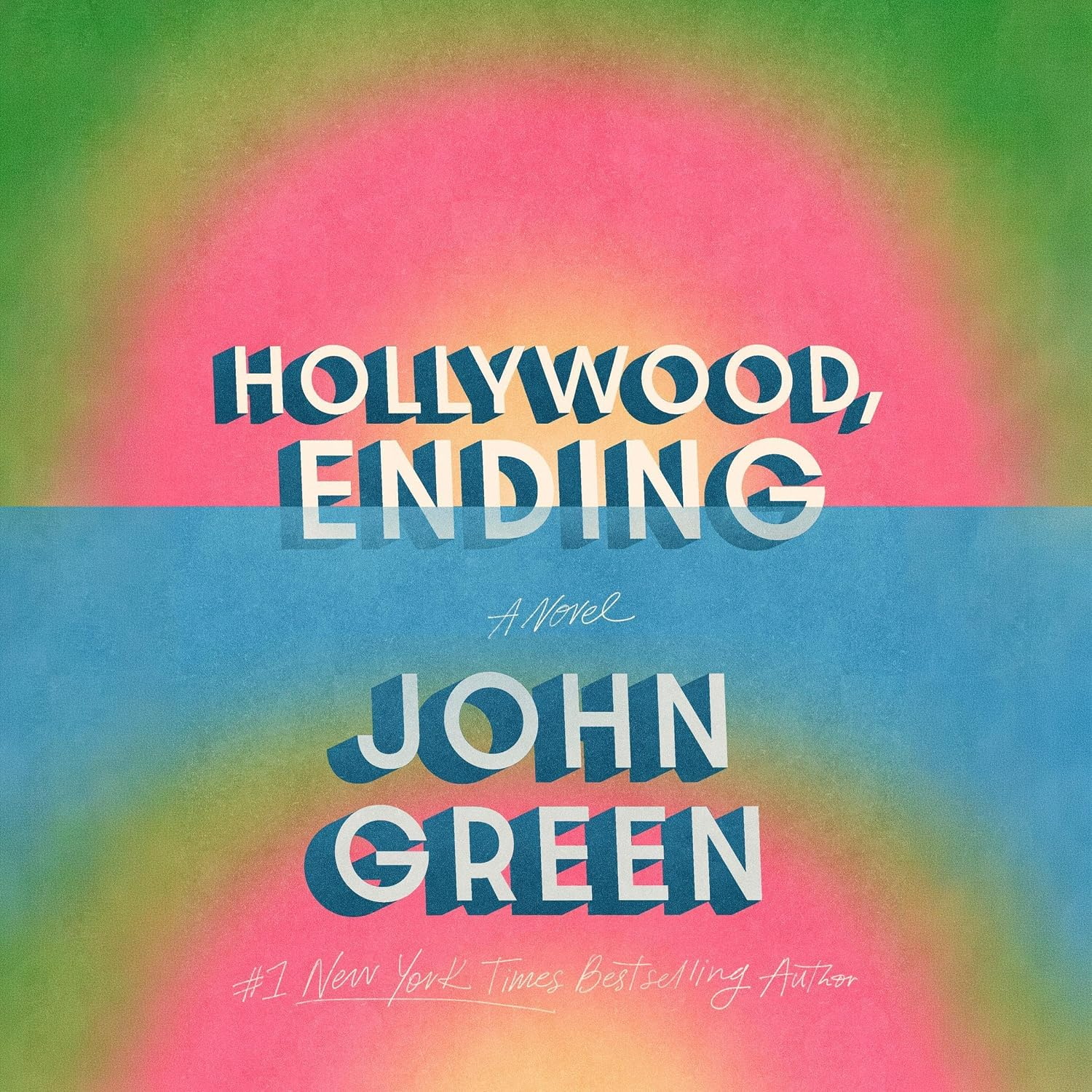


John Green’s first novel in nearly a decade, “Hollywood, Ending,” opens on a former child star, Juniper Castillo, entering into the big, brave world of movies for adults. She’s landed a plum role in an art-house film, “Andy Warhol Never Gets Old,” a biopic top-lined by a blockbuster A-lister on the hunt for his first Oscar nomination.
As the book begins, Juniper traces the making of the movie in anxious, hyper-focused narration. Day by day, she strains to prove herself as more than a teen idol, musing early on, “I was building a different kind of credibility with an eye toward being a grown-up actor.” Later, she says, “I needed to prove I could be an adult.”
Green surely sees himself in Juniper. The 49-year-old author and content creator — or vlogger, as the term once went — has, until now, spent his entire fiction career in the young adult realm. His novels, wrenching tales of teen heartbreak imbued with his trademark wit and emotional immediacy, helped define that literary market and propel its boom. (His 2012 tear-jerker, “The Fault in Our Stars,” has alone sold tens of millions of copies; it’s one of several of his books to be adapted for the screen.)
But recently, he has indicated his plan to move away from Y.A., stating he felt “emotionally and intellectually distant” from teenagers. Since his last Y.A. novel, 2017’s “Turtles All the Way Down,” he has released two nonfiction books for adults, but “Hollywood, Ending” marks his first official foray into the world of adult fiction.
It feels like more of a soft pivot, however, because “Hollywood, Ending” is also a coming-of-age story, just one of a different stripe. This time, Green’s heroes are in their early 20s, navigating an imposing landscape of film-industry veterans including exacting directors, weary publicists, cunning agents and prying journalists. The Tinseltown setting proves dramatically canny: The spotlight always seems to find the young, but it is not for the weak.
Set in 2019, the book examines the life cycle of “Andy Warhol Never Gets Old” from production to post-release, through the alternating perspectives of Juniper and her co-star, an Indiana transplant named Kai Laramie. In the film, Juniper portrays Carly, a scrappy young reporter assigned to profile Warhol, while Kai is Jude, Warhol’s intern who goes on to “share a byline and a bed” with Carly after the eponymous artist’s abrupt passing. Over the course of the Pittsburgh shoot, they pull off striking performances and develop a close bond.
After filming wraps, Kai begins narrating, detailing the sprint to the glitzy movie premiere. In his chapters we see the dizzying media junkets and media-training sessions, as well as his will-they-or-won’t-they romantic tension with Juniper. Through it all, he faces the demands of sudden celebrity, jetting between New York and Los Angeles while hardly fluent in the language of either: “Everyone knew more than me about everything,” he thinks. “I was always behind in every conversation.”
Kai emerges vividly on the page. Green, who knows a thing or two about being devoured by fame, depicts the young man’s bewilderment with radiant empathy. In a deeply private moment with Juniper, Kai catches each of their publicists snapping candid photos of them, bolstering romance rumors to build interest in the film. While changing for a fancy event, he marvels: “They even send me nice socks. Who wears Prada socks? Me, I guess.”
Reality and fantasy blur. Glamour and isolation go hand in hand. When a traumatic incident from Kai’s past leaks to the press, he finds a devastatingly apt metaphor for the ruthless Hollywood machine dictating his every move.
“Maybe it doesn’t matter who leaked it. Maybe it’s like one of those Chinese dragons where a lot of people are under the dragon costume, some in the tail and some in the head and some in the middle,” Kai says. “Maybe I don’t need to know which person inside the dragon told the world, because really, the dragon did it.”
Relative to Kai, Green approaches Juniper too tentatively. Early on, her voice verges on robotic, as she reflects on the cauldron of child stardom in stray, broad observations: “I can’t help but associate success with being loved; I was trained to do it.” It’s only through Kai’s doe-eyed lens that she comes fully into view, barely of drinking age yet as hardened by the industry as any wrinkled pro. Kai comes to see Juniper more wholly than she can see herself — which, if hardly flawless in its handling, may be just what Green is getting at here.
In the author’s anguished portrait of modern fame, the most challenging performance is that of an authentic self. And so, as “Hollywood, Ending” evolves into a love story of a familiar scope for Green, it still reveals itself as far thornier and subtler than what he’s delivered before — indeed, far more grown-up.
Author: John Green
Pages: 291
Publisher: Dutton
 PREVIOUS ARTICLE

