


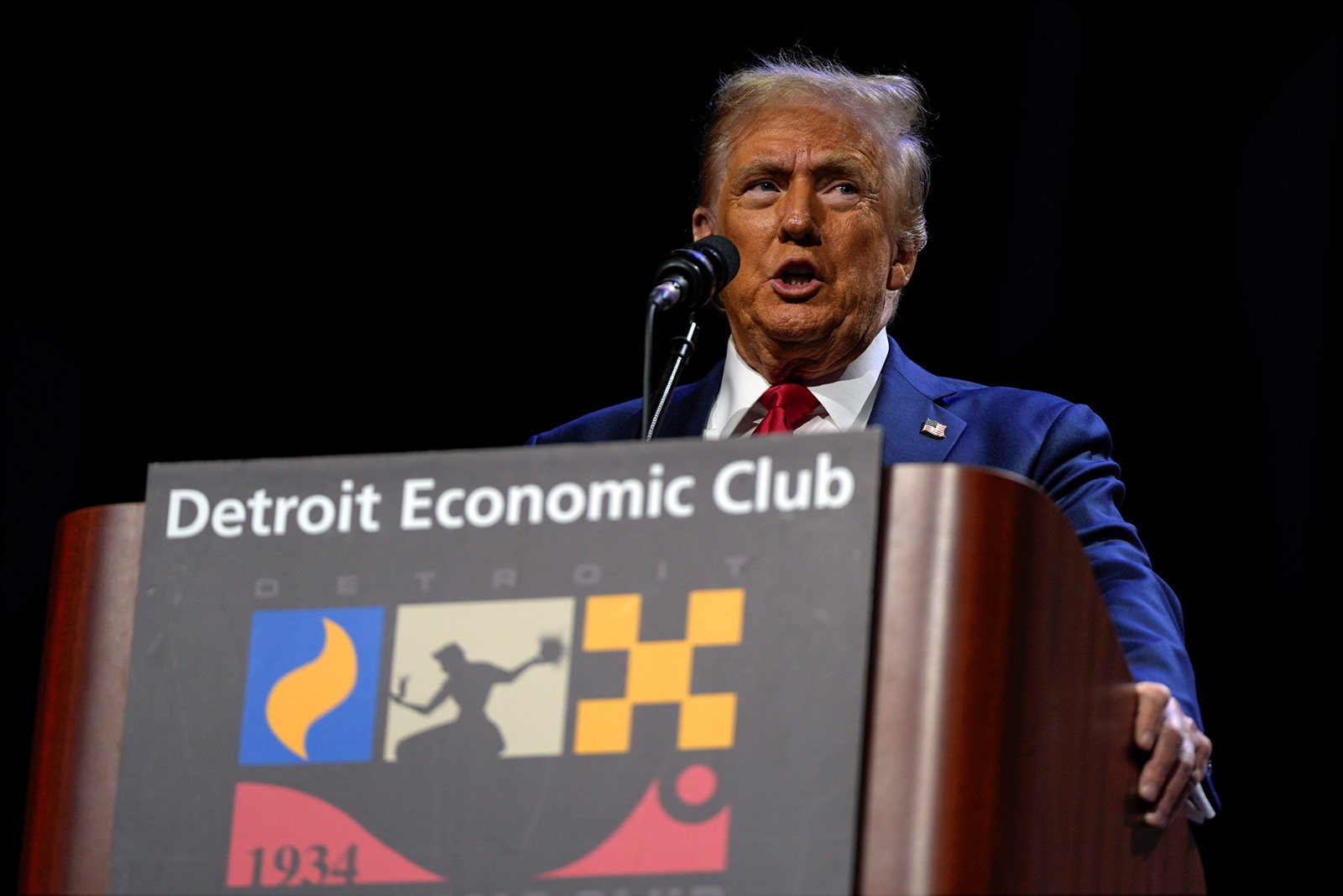


For more than a decade, former President Donald Trump fueled his political rise with dark appeals to White Christian voters, warning of immigrants coming for their jobs and nefarious efforts to undermine what he describes as the country’s true heritage.
Now, facing a neck-and-neck race against the first Black woman to win her party’s nomination, Trump is branching out.
He has repeatedly accused migrants of poaching “Black jobs” and “Hispanic jobs,” which is inaccurate, according to labor statistics. He told Latino voters in Las Vegas that immigrants in the country illegally were “totally destroying our Hispanic population.” He promised women in Pennsylvania he would “be their protector” and that they would no longer be “abandoned, lonely or scared” — a vow based on the hyperbolic premise that criminals who also happen to be immigrants are lurking around every corner.
For all the frequent laments about how left-leaning politicians divide the country through “identity politics,” it appears to be Trump who is making the most explicit identity-based arguments for voters to support his policies.
“He’s way more explicit than most prior candidates with these explicit appeals to Black voters and Latino voters that pit their various identity groups against each other,” said Michael Tesler, a professor of political science at UC Irvine, who cowrote a book about how Trump wields white identity politics. “There’s a unified grievance.”
Many of Trump’s blunt and dire entreaties have been greeted with condemnation, even mockery, for their clumsy invocation of race, gender and religion. Yet, in this final, frenetic stretch of the contest, they also represent a striking effort to expand the tent of economic, racial and cultural grievances that propelled him to the White House eight years ago.
Trump is seeking to win over Black and Latino voters by pitting them against immigrants in the country illegally, whom he has long blamed for a litany of economic, public safety, national security and social problems.
Appeals to subsets of the U.S. electorate have been part of presidential races for decades, often entwined with shifting racial and gender politics. In 1960, John F. Kennedy campaigned in Harlem in New York City, promising to advance civil rights. Nearly a half-century later, George W. Bush sprinkled some Texas-twanged Spanish in campaign speeches from Iowa to California.
But Trump’s foray into such targeted campaigning has gone far beyond the traditional political stops at Black churches and taco stands.
 PREVIOUS ARTICLE
