


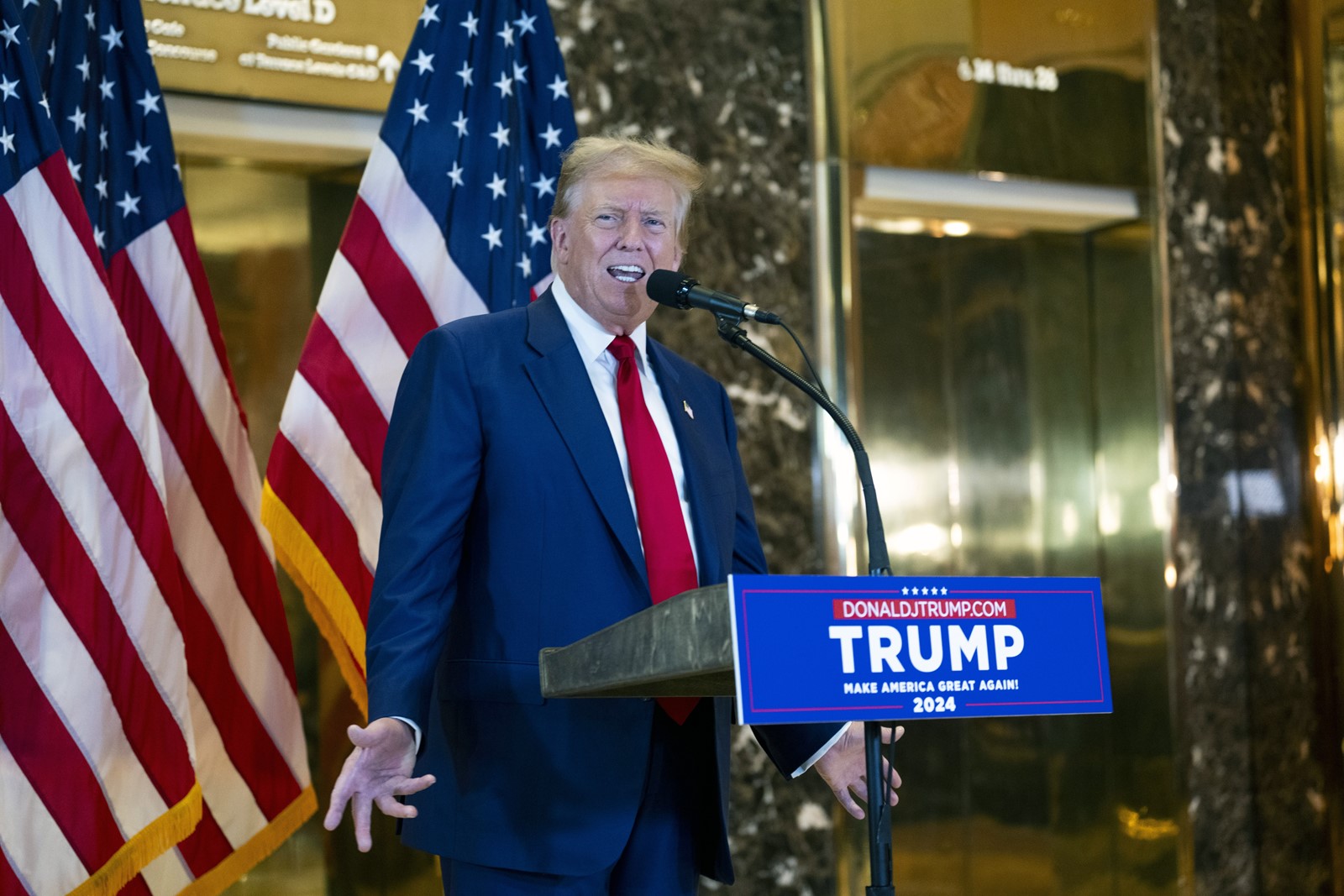


A felony, as Associate Justice Clarence Thomas once wrote in a 1994 Supreme Court opinion, is “as bad a word as you can give to man or thing.” When Donald Trump was found guilty of 34 felonies in May, by a jury in a New York City courtroom, the nation was confronted with a historical novelty: a felon who once held the highest office in the land.
The question now is whether the label will actually tarnish Trump, as it has so many people over the centuries.
President Joe Biden seems to be betting that it will.
For weeks on the campaign trail, and more recently during the first presidential debate, he has called Trump a “convicted felon.”
Felon is a word with 900 years of historical baggage, a remnant of the harsh punishments and routine discrimination that were the norm during the Middle Ages. But in a sense, its power derives from its elastic boundaries: Unlike specific crimes, which hinge on the defendant’s behavior, the felony category is defined only by its punishments.
“We don’t have a positive definition,” said Elise Wang, a historian who has traced the word’s origins back to medieval literature. “We only have a tautology.”
A felon, in other words, is simply anyone who has been found guilty of a felony, and a felony is any crime punishable by a year or more in prison — “the most serious crimes,” according to a Justice Department handbook.
Many felonies — like Trump’s and Hunter Biden’s — amount to lying on official paperwork.
“This is one of the places where there’s a gap between the popular understanding of the term, and the law on the books,” said Alice Ristroph, a professor at Brooklyn Law School. “Ordinary understandings of ‘felony’ associate it with violent conduct, like murder.
But in practice, almost anything that is criminal in any way can be charged as a felony.”
The label “felon” is now carried by an estimated 20 million Americans, or 8% of the adult population. For Black men, the share is far greater: Thirty-three percent, according to one study, have a felony conviction.
Many felons, despite having served out their sentences, have been permanently barred from receiving food stamps, living in public housing, holding some forms of employment or the right to vote — what legal scholars call “collateral consequences.”
When Thomas wrote that felony was “as bad a word as you can give to man or thing,” he was quoting from an older opinion, which in turn quoted an old history of English law. That text identified in the usage of “felon” a subtle undercurrent of praise.
The electorate seems tuned into this ambiguity.
After Trump was found guilty, initial polls pointed to a slight dip in support for him among independent voters, but the number of Republicans who said the convictions were a “good thing” for Trump’s campaign outnumbered dissenters by a ratio of 7-to-5.
This wasn’t the first time someone called Trump a bad name. It wasn’t the first time he was the target of a criminal investigation, nor the first time he was taken to court. But after the jury announced its verdict, he seemed to recognize that being a felon would be something different. It would be a new frontier of disgrace for him, and for the presidency.
While his lawyers make a last-ditch effort to fight the verdict in court, Trump is engaged in a second line of effort, experimenting with ways to turn his new status into a badge of honor. If his attempts to peel off the label don’t work, it seems he will try to flaunt it instead. The inversion of 34 felony convictions into a reason to vote for Trump, were it to succeed, would perhaps be his most audacious transgression of all.
At first, the felony crime was a kind of feudal insubordination — the offense of a serf or servant who had failed to carry out his prescribed duties to his lord. Around 1300, it began showing up in English criminal law as the equivalent of a botleas, a serious crime that could not simply be settled through an atonement payment or bot — and then as a crown offense, a crime that could entail capital punishment.
Almost as soon as the category was created, it began to grow.
During the early period of common law in England, there were nine kinds of felonies: Murder, mayhem, manslaughter, rape, arson, robbery, burglary, larceny and sodomy. By 1765, according to William Blackstone, Parliament had specified 160 felonies. There is no definitive count of how many crimes are designated as felonies in the United States today, between state and federal law.
Legal scholars have mounted a vigorous critique of the American felony system, arguing that it is essentially an extension of Jim Crow, one that serves to deprive millions of Black people of the right to vote.
“It’s about creating a permanent racial underclass,” Wang said.
Twenty-five states bar at least some individuals with felony convictions from voting. Florida, where Trump lives, is among them, but the fact that Trump was convicted in a New York state court means that he will probably be allowed to vote in November. If necessary, Gov. Ron DeSantis has promised to smooth the way for him.
Trump has insisted that his conviction reflects less on his own conduct than on the legitimacy of the entire legal order. If that argument sounds familiar, it should. He has used it many times before.
Trump’s former campaign manager (Paul Manafort), his former chief strategist (Steve Bannon) and a longtime adviser and friend (Roger Stone) have been convicted of felonies. For Trump, “felon” was just a word, at least when it came to his own associates: He gave all three men presidential pardons.
Trump has repeatedly invoked infamous mob boss Al Capone, comparing his legal travails to Manafort’s and, later, to his own. Ignoring the fact that Capone spent eight years in federal prison, Trump has tried to argue that he and his allies received harsher treatment from the government in their own criminal cases than Capone did.
In Wang’s view, Trump’s Capone comparison could be another attempt to turn his convictions to his advantage by presenting himself as an outlaw, a pro-wrestling-style archvillain.
“It adds fodder to his argument that he gets to be outside the system,” she said. “We do love villains. There’s something very attractive about them. But I don’t think the law should be in the business of talking about villains. That’s for stories. That’s for literature.”
 PREVIOUS ARTICLE

