




Like birthdays and “Baby Shark,” summer break is viewed in starkly different ways by parents and their children. For us adults, these 11 weeks are a nightmare of improvisatory child care, day camps with absurdly abbreviated schedules and purgatorial attempts at working from home. For children, they mean glorious, precious, fleeting freedom. But both parties can agree there is a boogeyman hovering over them: boredom.
Precipitator par excellence of tantrums, and spark plug of whining, boredom is proof that human nature, like all nature, abhors a vacuum. On long sticky afternoons cries of “I’m boooooored” rise like heat waves or malign calls to prayer from homes across the country. No plaint is more frustrating for a parent to hear. My own inevitable response arises less out of a genuine desire to find a solution than out of general exasperation at the state of humanity: “Then for Chrissakes do something!” It often seems that the only solution to boredom is to fight about being bored.
So universal a condition is boredom — or, as the French call it, ennui — among children that a robust subgenre of books about it already exists. Some are explicitly about boredom, such as Michael Ian Black’s predictably witty “I’m Bored” and Shinsuke Yoshitake’s conceptually rigorous “The Boring Book.” Others tackle the subject obliquely. “Where the Wild Things Are” is as much about boredom as it is about rage. (The adult canon too is full of books about boredom — try Alberto Moravia’s “La Noia” on for size.)
Now two new picture books — one recent and one forthcoming — add their perspectives on this desultory state of being that Soren Kierkegaard called the “root of all evil.” Both admirably resist the common adult suggestion of dealing with boredom by doing things differently in favor of the more challenging process of seeing things differently.
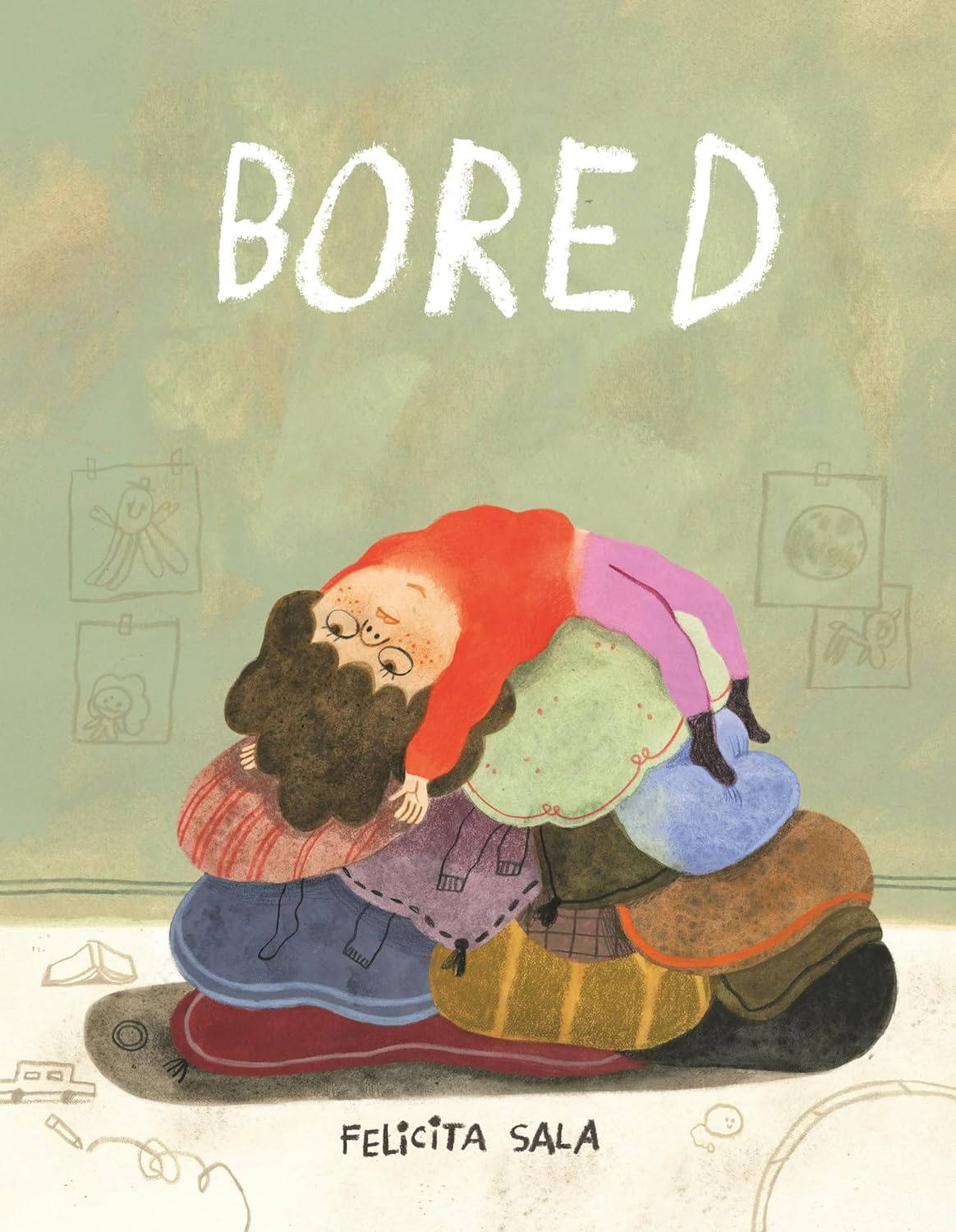
“Bored,” by the Aussie-Italian author-illustrator Felicita Sala, uses boredom as a portal to imagination. It follows Rita, its freckled protagonist — so bored she can’t read or draw or think — as she embarks on a fantastic and fantastical journey to the distant Sendakian shores of Bored Island, which, as it turns out, is anything but boring.
A housewife from Florence, Italy, builds a castle from driftwood; a trio of grandmothers from Sydney, Australia, form a band; a teenager from Bangalore, India, turns her yawn into “a long weird yodel” and, in so doing, accidentally figures out how to communicate with whales. These are just a few of the lively, wonderful illustrations in the book. Sala combines the best of Henri Rousseau, Maira Kalman and Remy Charlip.
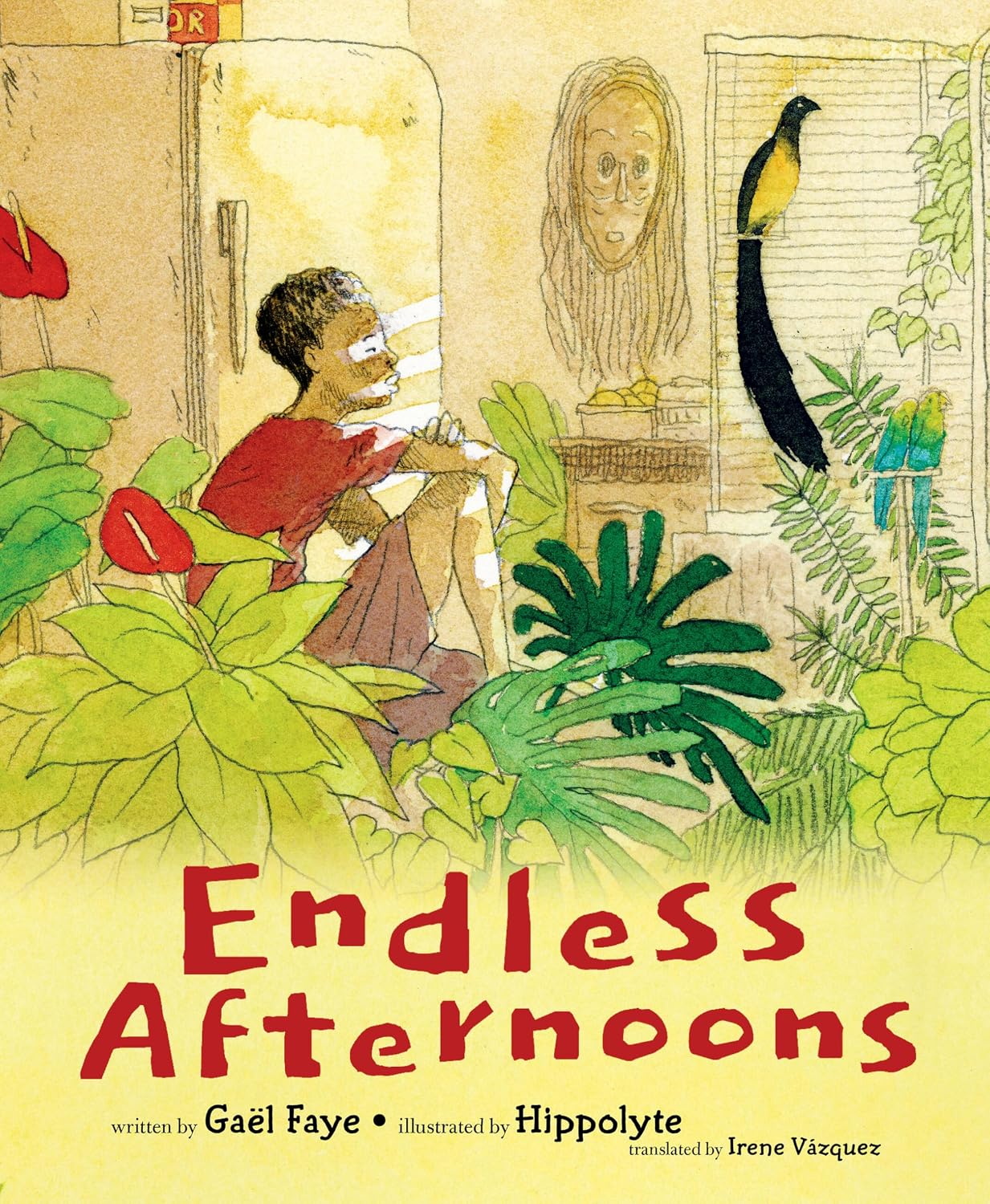
For most readers, Rita’s world will likely seem familiar: a vaguely suburban (or exurban) universe with wainscoted living rooms and armchairs to disagreeably slouch over. “Endless Afternoons,” by the Rwandan-French singer Gaël Faye, with illustrations by the mononymic Frenchman Hippolyte, unfolds in the author’s childhood home in Burundi. Faye, the son of a herpetologist (his father studied reptiles), grew up in what we might imagine to be boredom-proof circumstances: “A mask thrown here, a gecko there, the furniture’s a jumble./Inside a hippo’s skull, my superheroes raid the jungle.” This is perhaps part of the lesson: Boredom can strike anywhere, but it needn’t be a burden.
Unlike “Bored,” “Endless Afternoons” stays rooted in the real world, which Faye embroiders and illuminates with metaphor and the music of language. This makes sense. The book is an adaptation of Faye’s song “L’Ennui des l’Après Midi Sans Fin,” and its rhyming couplets have been preserved in the Black Mexican American poet Irene Vázquez’s translation: “A graveyard of mosquitoes lies beneath my window screen./The pained drip of the faucet’s like the runoff from the stream.” Though this rhyming style is not exactly comme il faut these days, the novelty of the words and the images they conjure does intrigue: “In my garden of Eden, I see serpents from all angles./Without a golden apple, I betray God with a mango.” A striking thought, even for those young readers who are not biblically inclined.
But just as frequently, one feels the rhyme is the tail wagging the dog, in some instances literally: “On top of our Volkswagen lies the windsurf board we sailed/in yellowed photos with the dog that we knew as Amstel.” Ruff! This, I fear, is a result of the intermedia adaptation. A song has a melody to propel it forward, and while Hippolyte’s spirited illustrations fill the same purpose, the book’s insistence on rhyming threatens to weaken the corpus.
At their best, books about boredom don’t just dissolve the condition temporarily but offer existential relief. As Walker Percy wrote in his 1956 essay “The Man on the Train,” an exploration of suburban boredom (which he called alienation), “There is a great deal of difference between an alienated commuter riding a train and this same commuter reading a book about an alienated commuter riding a train. … The nonreading commuter exists in true alienation, which is unspeakable; the reading commuter rejoices in the speakability of his alienation and in the new triple alliance of himself, the alienated character and the author.” By giving voice to their characters’ boredom, Sala and Faye offer both a way out and a sense of bonhomie.
One wonders, however, if books like these are anything more than futile sorties, Band-Aids on a gash. How can we expect our children to brook boredom when we can’t stand it ourselves? After all, it is a distaste for boredom that fuels the $7 trillion dollar “attention economy,” harvesting our focus at great peril and for great profit. Another equally ineffective, frequently deployed parental axiom might be of use here: “Do as I say, not as I do.” Until we as parents rend back from the attention merchants our precious moments of boredom, the chances that our children will find Sala or Faye (or Kierkegaard or Percy) are astonishingly slim.
 PREVIOUS ARTICLE
