


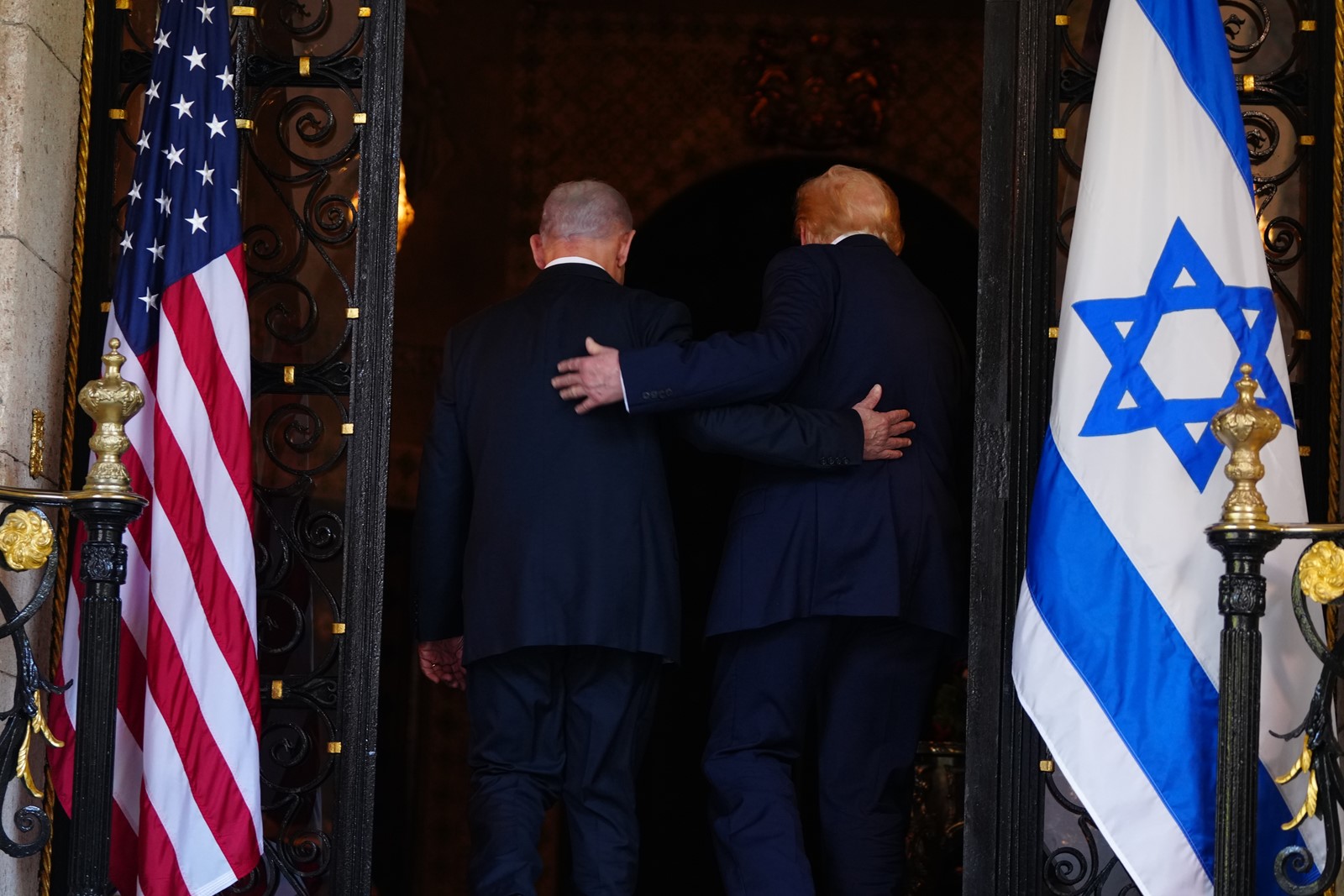


The black SUV carrying Prime Minister Benjamin Netanyahu arrived at the White House just before 11 a.m. Feb. 11. The Israeli leader, who had been pressing for months for the United States to agree to a major assault on Iran, was whisked inside with little ceremony, out of view of reporters, primed for one of the most high-stakes moments in his long career.
U.S. and Israeli officials gathered first in the Cabinet Room, adjacent to the Oval Office. Then Netanyahu headed downstairs for the main event: a highly classified presentation on Iran for President Donald Trump and his team in the White House Situation Room, which was rarely used for in-person meetings with foreign leaders.
Trump sat down, but not in his usual position at the head of the room’s mahogany conference table. Instead, the president took a seat on one side, facing the large screens mounted along the wall. Netanyahu sat on the other side, directly opposite the president.Appearing on the screen behind the prime minister was David Barnea, director of Mossad, Israel’s foreign intelligence agency, as well as Israeli military officials. Arrayed visually behind Netanyahu, they created the image of a wartime leader surrounded by his team.
Susie Wiles, White House chief of staff, sat at the far end of the table. Secretary of State Marco Rubio, who doubled as the national security adviser, had taken his regular seat. Defense Secretary Pete Hegseth and Gen. Dan Caine, chairman of the Joint Chiefs of Staff, who generally sat together in such settings, were on one side; joining them was John Ratcliffe, the CIA director. Jared Kushner, the president’s son-in-law, and Steve Witkoff, Trump’s special envoy, who had been negotiating with the Iranians, rounded out the main group.
The gathering had been kept deliberately small to guard against leaks. Other top Cabinet secretaries had no idea it was happening. Also absent was the vice president. JD Vance was in Azerbaijan, and the meeting had been scheduled on such short notice that he was unable to make it back in time.
The presentation that Netanyahu would make over the next hour would be pivotal in setting the United States and Israel on the path toward a major armed conflict in the middle of one of the world’s most volatile regions.
And it would lead to a series of discussions inside the White House over the following days and weeks, the details of which have not been reported previously, in which Trump weighed his options and the risks before giving the go-ahead to join Israel in attacking Iran.
This account of how Trump took the United States into war is drawn from reporting for a forthcoming book, “Regime Change: Inside the Imperial Presidency of Donald Trump.” It reveals how the deliberations inside the administration highlighted the president’s instincts, his inner circle’s fractures and the way he runs the White House. It draws on extensive interviews conducted on the condition of anonymity to recount internal discussions and sensitive issues.
The reporting underscores how closely Trump’s hawkish thinking aligned with Netanyahu’s over many months, more so than even some of the president’s key advisers recognized. Their close association has been an enduring feature across two administrations, and that dynamic — however fraught at times — has fueled intense criticism and suspicion on the left and the right of American politics.
And it shows how, in the end, even the more skeptical members of Trump’s war Cabinet — with the stark exception of Vance, the figure inside the White House most opposed to a full-scale war — deferred to the president’s instincts, including his abundant confidence that the war would be quick and decisive. The White House declined to comment.
In the Situation Room on Feb. 11, Netanyahu made a hard sell, suggesting that Iran was ripe for regime change and expressing the belief that a joint U.S.-Israeli mission could bring an end to the Islamic Republic.
At one point, the Israelis played for Trump a brief video that included a montage of potential new leaders who could take over the country if the hard-line government fell. Among those featured was Reza Pahlavi, the exiled son of Iran’s last shah, now a Washington-based dissident who had tried to position himself as a secular leader who could shepherd Iran toward a post-theocratic government.
Netanyahu and his team outlined conditions they portrayed as pointing to almost certain victory: Iran’s ballistic missile program could be destroyed in a few weeks. The regime would be so weakened that it could not choke off the Strait of Hormuz, and the likelihood that Iran would land blows against U.S. interests in neighboring countries was assessed as minimal.
Besides, Mossad’s intelligence indicated that street protests inside Iran would begin again, and — with the impetus of the Israeli spy agency helping to foment riots and rebellion — an intense bombing campaign could foster the conditions for the Iranian opposition to overthrow the regime. The Israelis also raised the prospect of Iranian Kurdish fighters crossing the border from Iraq to open a ground front in the northwest, farther stretching the regime’s forces and accelerating its collapse.
Netanyahu delivered his presentation in a confident monotone. It seemed to land well with the most important person in the room: the American president.
Sounds good to me, Trump told the prime minister. To Netanyahu, this signaled a likely green light for a joint U.S.-Israeli operation.
Netanyahu was not the only one who came away from the meeting with the impression that Trump had all but made up his mind. The president’s advisers could see he had been impressed by the promise of what Netanyahu’s military and intelligence services could do, just as he had been when the two men spoke before the 12-day war with Iran in June.
Earlier in his White House visit Feb. 11, Netanyahu had tried to focus the minds of the Americans assembled in the Cabinet Room on the existential threat posed by Iran’s 86-year-old supreme leader, Ayatollah Ali Khamenei.
When others in the room asked the prime minister about possible risks in the operation, Netanyahu acknowledged these but made one central point: In his view, the risks of inaction were greater than the risks of action. He argued that the price of action would only grow if they delayed striking and allowed Iran more time to accelerate its missile production and create a shield of immunity around its nuclear program.
Everyone in the room understood that Iran had the capacity to build up its missile and drone stockpiles at a far lower cost and much more quickly than the United States could build and supply the much more expensive interceptors to protect U.S. interests and allies in the region.
Netanyahu’s presentations — and Trump’s positive response to them — created an urgent task for the U.S. intelligence community. Overnight, analysts worked to assess the viability of what the Israeli team had told the president.
‘Farcical’
The results of the U.S. intelligence analysis were shared the following day, Feb. 12, in another meeting for only U.S. officials in the Situation Room. Before Trump arrived, two senior intelligence officials briefed the president’s inner circle.
The intelligence officials had deep expertise in U.S. military capabilities, and they knew the Iranian system and its players inside out. They had broken down Netanyahu’s presentation into four parts. First was decapitation — killing the ayatollah. Second was crippling Iran’s capacity to project power and threaten its neighbors. Third was a popular uprising inside Iran. And fourth was regime change, with a secular leader installed to govern the country.
The U.S. officials assessed that the first two objectives were achievable with U.S. intelligence and military power. They assessed that the third and fourth parts of Netanyahu’s pitch, which included the possibility of the Kurds mounting a ground invasion of Iran, were detached from reality.
When Trump joined the meeting, Ratcliffe briefed him on the assessment. The CIA director used one word to describe the Israeli prime minister’s regime change scenarios: “farcical.”
At that point, Rubio cut in. “In other words, it’s (expletive),” he said.
Ratcliffe added that given the unpredictability of events in any conflict, regime change could happen, but it should not be considered an achievable objective.
Several others jumped in, including Vance, just back from Azerbaijan, who also expressed strong skepticism about the prospect of regime change.
The president then turned to Caine. “General, what do you think?”
Caine replied, “Sir, this is, in my experience, standard operating procedure for the Israelis. They oversell, and their plans are not always well-developed. They know they need us, and that’s why they’re hard-selling.”
Trump quickly weighed the assessment. Regime change, he said, would be “their problem.” It was unclear whether he was referring to the Israelis or the Iranian people. But the bottom line was that his decision on whether to go to war against Iran would not hinge on whether parts 3 and 4 of Netanyahu’s presentation were achievable.
Trump appeared to remain interested in accomplishing parts 1 and 2: killing the ayatollah and Iran’s top leaders and dismantling the Iranian military.
Caine — the man Trump liked to refer to as “Razin’ Caine” — had impressed the president years earlier by telling him the Islamic State could be defeated far more quickly than others had projected. Trump rewarded that confidence by elevating the general, who had been an Air Force fighter pilot, to be his top military adviser. Caine was not a political loyalist, and he had serious concerns about a war with Iran. But he was very cautious in the way he presented his views to the president.
As the small team of advisers who were looped into the plans deliberated over the following days, Caine shared with Trump and others the alarming military assessment that a major campaign against Iran would drastically deplete stockpiles of U.S. weaponry, including missile interceptors, whose supply had been strained after years of support for Ukraine and Israel. Caine saw no clear path to replenishing these stockpiles quickly.
He also flagged the enormous difficulty of securing the Strait of Hormuz and the risks of Iran blocking it. Trump had dismissed that possibility on the assumption that the regime would capitulate before it came to that. The president appeared to think it would be a quick war — an impression that had been reinforced by the tepid response to the U.S. bombing of Iran’s nuclear facilities in June.
Caine’s role in the lead-up to the war captured a classic tension between military counsel and presidential decision-making. So persistent was Caine in not taking a stand — repeating that it was not his role to tell the president what to do, but rather to present options along with potential risks and possible second- and third-order consequences — that he could appear to some of those listening to be arguing all sides of an issue simultaneously.
He would constantly ask, “And then what?” But Trump would often seem to hear only what he wanted to hear.
Caine differed in almost every way from a prior chairman of the Joint Chiefs of Staff, Gen. Mark A. Milley, who had argued vociferously with Trump during his first administration and who saw his role as stopping the president from taking dangerous or reckless actions.
One person familiar with their interactions noted that Trump had a habit of confusing tactical advice from Caine with strategic counsel. In practice, that meant the general might warn in one breath about the difficulties of one aspect of the operation, then in the next note that the United States had an essentially unlimited supply of cheap, precision-guided bombs and could strike Iran for weeks once it achieved air superiority.
To Caine, these were separate observations. But Trump appeared to think that the second most likely canceled out the first.
At no point during the deliberations did Caine directly tell the president that war with Iran was a terrible idea — although some of Caine’s colleagues believed that was exactly what he thought.
Trump the hawk
Distrusted as Netanyahu was by many of the president’s advisers, the prime minister’s view of the situation was far closer to Trump’s opinion than the anti-interventionists on the Trump team or in the broader “America First” movement liked to admit. This had been true for many years.
Of all the foreign policy challenges Trump had confronted across two presidencies, Iran stood apart. He regarded it as a uniquely dangerous adversary and was willing to take great risks to hinder the regime’s ability to wage war or to acquire a nuclear weapon. Furthermore, Netanyahu’s pitch had dovetailed with Trump’s desire to dismantle the Iranian theocracy, which had seized power in 1979, when Trump was 32. It had been a thorn in the side of the United States ever since.
Now he could become the first president since the clerical leadership took over 47 years ago to pull off regime change in Iran. Usually unmentioned but always in the background was the added motivation that Iran had plotted to kill Trump as revenge over the assassination in January 2020 of Gen. Qassem Soleimani, who was seen in the United States as a driving force behind an Iranian campaign of international terrorism.
Back in office for a second term, Trump’s confidence in the U.S. military’s abilities had grown. He was especially emboldened by the spectacular commando raid to capture Venezuelan leader Nicolás Maduro from his compound on Jan. 3. No American lives were lost in the operation — more evidence to the president of the unmatched prowess of U.S. forces.
 PREVIOUS ARTICLE

