


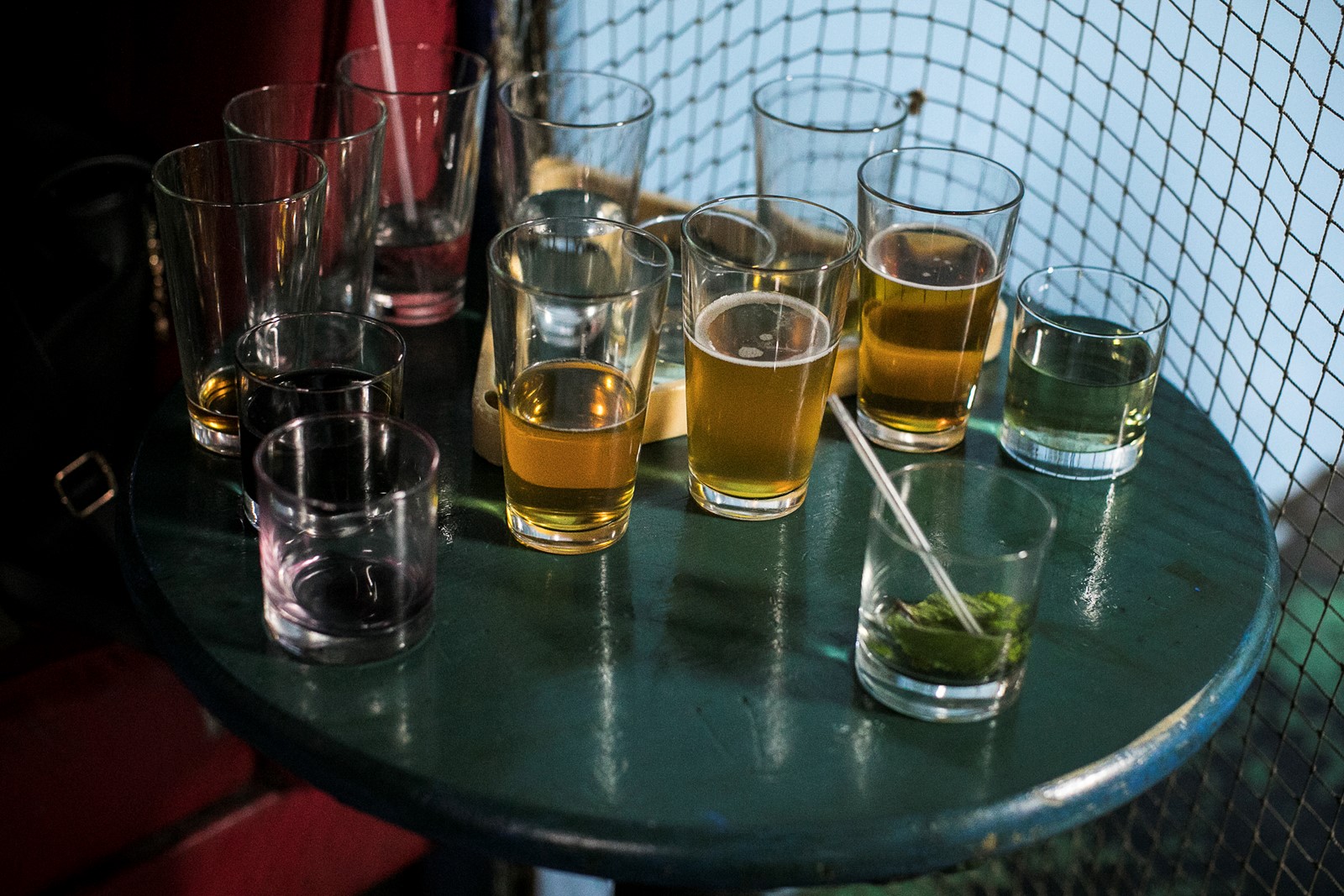


The psychologist first became intrigued by the phenomenon decades ago, while he was setting up an experiment about the effects of drinking on anxiety and heart rate.
Women had been excluded from many such studies, so Michael Sayette, a professor of psychology at the University of Pittsburgh, asked five female volunteers to come into the lab and drink, allowing him to set blood alcohol benchmarks for his experiment.
The women, who were in their 20s, didn’t know one another and were subdued — at first. But as they sipped their drinks, they started chatting, and soon, chuckling. An hour later, Sayette recalled, their conversation was lively, punctuated by peals of laughter.
“They went from being professional and barely speaking to, an hour later, seeming like they were the best of friends,” Sayette said in a recent interview. “You didn’t need fancy statistics to notice what was happening.”
In January, as federal officials unveiled the government’s new dietary guidelines, Dr. Mehmet Oz, the physician who oversees the Centers for Medicare & Medicaid Services, talked about the role that alcohol can play in bringing people together.
The updated recommendations told Americans to drink “less” for better health. But they no longer advised capping drinks at one daily for women and two for men, despite evidence that the harms, including cancer risks, increase at very low levels of consumption.
Oz explained why the government had abandoned the limits: “Alcohol is a social lubricant that brings people together,” he said.
“In the best case scenario, I don’t think you should drink alcohol,” he continued.
Oz later told TMZ that the original caps on daily alcohol had probably been set too high: “I think based on the guidelines, you should be drinking less than two drinks per day for men and one for women.”
He added that there was no data showing that drinking alcohol contributed to health, and that the only benefit was that it “helps you enjoy time with your friends.”
nuanced research
Yet the research into social drinking is considerably more nuanced and complicated than that, experts say. It is true that solitary drinking is a red flag. But drinking with others is not risk-free, either.
Most alcohol consumption actually takes place in social settings, and people tend to drink more in the company of others. Social drinking is also linked to violence and accidents.
“Dr. Oz is right — it is really about talking and smiling and connecting,” said Kasey G. Creswell, an associate professor of psychology at Carnegie Mellon University in Pittsburgh. “This is why alcohol probably becomes so addictive for some people.”
“They’re not just craving the drink; they’re craving this rapid sense of belonging that is so important to humans at a fundamental level,” she added. “And alcohol can certainly help with that.”
Most research examining the effects of alcohol in laboratory settings has ignored the social context, Creswell argued in an editorial in the journal Addiction in 2024, which he wrote with Catharine E. Fairbairn, an associate professor at the University of Illinois Urbana-Champaign.
They reviewed papers published through 2023, identifying almost 1,000 studies in which participants received alcohol. Just over 90% of those studies focused on people drinking alone, even though most people — young and old, occasional as well as heavy drinkers — drink socially most of the time.
Solitary drinking studies therefore are missing a key contributor to alcohol use disorder, Creswell and Fairbairn argued, because they “do not permit the examination of alcohol’s socially reinforcing effects.”
Golden Moments
Inspired by the women’s lively conversation during the setup, Sayette went on to carry out one of the largest studies ever to focus on social drinking among strangers within a controlled, laboratory environment.
“A lot of research was documenting the problems with alcohol, including violence and aggression,” Sayette said. “But it didn’t answer the question: Why are people doing it? What are people getting out of consuming alcohol?”
Sayette and his team recruited 720 social drinkers between ages of 21 and 28, half of them men and half women, and invited them to come to the lab at the University of Pittsburgh.
None of the participants knew the others, which was important because the study aimed to look at bonding among strangers. Prior friendships or even acquaintanceships could muddy the data.
The men and women were divided into three groups. One was randomly assigned a vodka cocktail with cranberry juice, while the second received an alcohol-free placebo served in a glass smeared with vodka to make it seem more like a cocktail. The third group got plain cranberry juice.
The participants were asked to drink one-third of their drink every 12 minutes and were told that they would be recorded on video.
Their blood alcohol levels were measured during the experiment; afterward the subjects were asked whether their two drinking buddies had been interested in what they had to say and whether they liked them. The scientists used the videotapes to analyze the participants’ facial expressions and speech patterns.
The results, published in 2012, were striking. Participants in the groups drinking spent significantly more time talking than those who did not. They smiled longer, and they scored higher on group bonding questions than those who did not drink alcohol.
Those who drank also were much more likely to engage in conversation in which all three spoke in succession, compared with the groups given placebos. And drinkers experienced more of what Sayette called “golden moments,” when all three members of the group exhibited big, genuine smiles, called Duchenne smiles, in which the cheeks are raised and there are crow’s feet crinkling around the eyes.
A more recent study of 393 young adults who were heavy drinkers came to similar conclusions: groups assigned to drink alcohol spoke more and engaged in more three-way conversations.
They also demonstrated more rapid increases in the frequency of those Duchenne smiles, and reported more social bonding.
Understanding social drinking is important, experts said, because it can identify people who are at the greatest risk for developing alcohol use disorder.
‘pregame’ plans
Julia Buckner, a professor of psychology at Louisiana State University in Baton Rouge, Louisiana, has studied what motivates “pregaming,” or “prepartying” — the drinking that occurs before a main event.
“We know that socially anxious people have anxiety not only when they’re in the social situation,” Buckner said, “but they also have anticipatory anxiety when they are just thinking about going to a social event, and wondering, ‘What if I say something stupid? Will people judge me?’”
She found that pregaming in order to blunt anticipatory jitters set socially anxious people up to drink even more during the main social event. This may be one reason that people with social anxiety disorder are four times as likely than others to develop alcohol-use disorder, she said.
Alcohol enhances social interactions largely because it reduces the anticipation of rejection, a source of stress that is not limited to people with social anxiety disorders. People who are drinking talk more and divulge more personal information, leading to more feelings of social connection.
“You have a reduction in your heart rate, and you sweat less,” said Todd Kashdan, a professor of psychiatry at George Mason University in Virginia. It gives you a kind of myopia — you get tunnel vision. You’re in the moment.”
But Kashdan was critical of Dr. Oz’s message, saying that it “made it seem that alcohol is the cure to social problems and loneliness.
“But it’s also predictive of more problematic behavioral problems,” he continued
“That duality is really important, and it was missing from his message,” he added. “Yes, it’s a social lubricant, and if you rely on it, you’re inclined to develop more alcohol problems.”
Fairbairn agreed. “Most of the harm that comes from alcohol, certainly in the aggregate societal level,” she said, is “due mostly or mainly to drinking with their buddies.”
Among problem drinkers, 3 in 4 drinking occasions occur in social settings, she noted.
Asked for comment, Emily G. Hilliard, a Health and Human Services spokesperson, reiterated Oz’s statement and referred to the updated guidelines saying Americans should drink less for better health, and that some people — including pregnant women and those prone to alcohol use disorders — should avoid alcohol altogether.
Addiction specialists don’t dispute that social connection contributes to overall health, but have long stressed that a good time with friends does not require alcohol.
“Fifty percent of the population doesn’t drink anything in any given year, but those people still socialize,” said John Kelly, a professor of psychiatry and addiction medicine at Harvard University.
 PREVIOUS ARTICLE

