


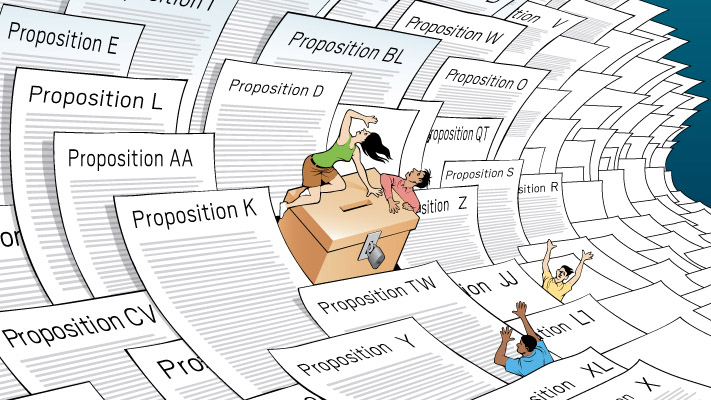


From taxes and spending to elections, from healthcare to housing, California voters have a variety of issues to decide on their November ballot.
Fourteen statewide propositions qualified to appear on the general election ballot this fall.
That includes a one-time tax on billionaires, a controversial effort meant to offset federal funding cuts by the Trump administration, as well as a Republican-backed measure to require voters to present a government-issued ID when voting in future elections.
There are two ballot measures meant to offset or void the billionaire tax. Still others are proposed to help more people buy a home or spearhead more housing for lower-income residents, especially veterans.
One measure would overhaul the powerful California’s Environmental Quality Act, in an effort to speed up the environmental impact review process and subsequent lawsuits. Another seeks to increase the amount of money California tucks away in its “rainy day” fund.
These measures are statewide, meaning they will appear on every California voter’s ballot in the fall. Voters may also have local measures to weigh in on this year.
Here’s a look at all the statewide ballot measures that qualified for the 2026 November ballot.
Proposition 1: The Veterans and Affordable Housing Bond Act of 2026 is a proposed $11.25 billion affordable housing bond measure to help not only people who have served in the military but also other low- and moderate-income households.
Proposition 1 would authorize the issuance and sale of general obligation bonds to fund affordable housing and home ownership programs, speed up housing production and preserve affordable housing.
Specifically, $1.25 billion would go to the CalVet Home Loan Program. These bonds would be repaid through mortgage payments and, therefore, would not cost regular taxpayers money.
Another $10 billion would fund other affordable housing projects, including the construction, rehabilitation, acquisition or preservation of housing units, and provide for affordable rental housing as well as interim and supportive housing for people facing homelessness.
Targeted investments would be made to help Californians with the greatest housing needs, including farmworkers, tribal communities, college students, homeless and at-risk youths, lower-income households and moderate-income first-time homebuyers.
The proposal was hammered out between Gov. Gavin Newsom and Democratic legislative leaders during this year’s budget negotiations.
According to the governor’s office, the bond would provide down payment assistance, affordable mortgage financing and other supports that would enable over 40,000 Californians to become homeowners.
In addition, the measure would result in the creation or preservation of tens of thousands of affordable homes, as well as tens of thousands of high-paying construction jobs, according to Newsom’s office.
According to an analysis of a bill introduced by Senate President Pro Tem Monique Limón, D-Santa Barbara, to place Proposition 1 on the November statewide ballot, the total cost, including principal and interest, to taxpayers for the $10 billion portion of Proposition 1 that would not go toward the CalVet program is estimated to be $17.39 billion.
Proposition 2: The “Save for California’s Future Act” would increase the cap on the state’s reserve fund from 10% to 20%.
Money for the state’s Budget Stabilization Account, known as the rainy day fund, comes from capital gains and income tax revenues.
About $15.1 billion was in California’s rainy day fund heading into the 2026-2027 fiscal year, according to the state budget. At the beginning of the previous fiscal year, it held about $11.2 billion.
Assembly Democrats touted the effort as a way for California to set aside more money when times are good, increasing the amount that can be saved during years when revenues from these tax sources reach especially high levels, so the state has more of a cushion when economic downturns hit.
Republican leaders, however, have said Proposition 2 does not rein in what they see as chronic overspending by legislative Democrats or require payments to address California’s outstanding federal loan balance.
According to Assembly Speaker Robert Rivas, D-Hollister, passing Proposition 2 would shore up funding for public schools across the state and expand the types of liabilities that can be paid down. Gov. Gavin Newsom’s office says Proposition 2 would reduce unemployment insurance trust fund liabilities to protect schools and businesses, proponents said.
But Sen. Tony Strickland, R-Huntington Beach, said passing Proposition 2 would be like taking out a credit card to pay off an old one “while continuing the same reckless spending habits that created the problem in the first place.” He said Democrats are asking taxpayers to bankroll their spending.
Introduced in the Assembly on June 25 as ACA 20, the bill passed the Legislature, largely along party lines.
Proposition 2 would exclude deposits into the BSA from the Gann Limit, which is the amount of money that the state and local governments in California can legally spend.
In 1979, California voters approved the Gann Limit to keep real, inflation-adjusted, per-person government spending under 1978-79 levels.
Proposition 3: California voters will decide whether to keep the state’s highest income tax rates in place indefinitely.
Proposition 3 would extend the income tax rates originally approved by voters in 2012, then extended in 2016. Those rates are set to expire in 2031 if the measure fails.
Dubbed the California Children’s Education and Health Care Protection Act, the measure would continue the top marginal income tax rates of up to 12% for single filers who earn over $360,000 per year, joint filers earning at least $721,000 and heads of households who earn more than $490,000, if passed by voters. Those thresholds would be adjusted for inflation.
Tax revenues would be deposited into the Education Protection Account, which provides local education institutions with general-purpose state funding; 89% of what is generated would be allocated to K-12 schools, while the remainder would go to community colleges. Proposition 3 would allow school boards to decide how those revenues are spent, but it prohibits funds from being used on administrative costs.
The California Teachers Association and the California Federation of Teachers, both in support of the measure, said passing Proposition 3 would prevent billions of dollars in cuts to schools.
The income tax revenue going toward local school districts and community colleges would free up state funding “for a Rainy Day Fund to prevent cuts to healthcare for children and their families; services for seniors, working families, and small businesses; wildfire prevention; and other critical needs even when revenues decline,” the petition said.
The state’s Legislative Analyst’s Office estimated that extending the tax rates would maintain $5 billion to $15 billion in annual income tax revenues collected.
Proposition 4: Voters will be asked in November whether to allow the expansion of public campaign financing programs to better level the playing field between candidates who don’t have an abundance of resources and those backed by wealthy donors.
Called the California Fair Elections Act of 2026, Proposition 4 would lift a ban prohibiting counties, districts, most cities and the state from providing public funds to help candidates finance their campaigns. Presently, only charter cities, such as Los Angeles and Long Beach, can offer such programs.
The ballot measure would not mandate public campaign financing programs but would give voters and more local governments the option to decide whether to have such programs. Since campaigns can be costly, supporters say these programs give candidates greater access to funds to compete more fairly, thus lessening the influence of “big money” by wealthy donors and special interests in elections.
But to qualify for the money, candidates must agree to certain terms, including limiting how much their campaign spends, and cannot use the funds to cover legal defense fees or fines or to repay personal loans they made to their campaigns.
Proposition 4, which would amend the Political Reform Act of 1974, would also increase penalties related to the influence of a foreign government or foreign principal on elections.
Current law bans such foreign entities from donating or spending money to support or oppose a candidate for state or local office, or any state or local ballot measure. Violation of this law is a misdemeanor, and a person found guilty of this may face a fine equal to the amount they contributed or expended.
Should the measure pass, a person guilty of this misdemeanor would, at minimum, be fined an amount at least equal to the amount contributed or expended, and they could be fined up to three times that amount.
Proposition 4 was placed on the ballot through a bill by state Sen. Tom Umberg, D-Santa Ana, which Gov. Gavin Newsom signed in October.
California Clean Money Action Fund, California Common Cause and the League of Women Voters of California sponsored SB 42 while the California Taxpayers Association opposed it.
Opponents raised concerns that it would force taxpayers to finance political speech they don’t support and that candidates could fraudulently seek public financing, leading to abuse and corruption, according to an analysis of the bill.
Proposition 5: If an elected state official is successfully recalled, that office would remain vacant until a new person is either elected or the next-in-line person steps into the role — should voters approve this ballot measure.
Proposition 5 essentially removes the second question posed to voters during a recall attempt, what’s called the successor question, making a recall effort just a simple yes-or-no choice for voters.
State-level recall elections in California ask voters two questions: Should the officeholder be removed, and who should replace them?
Spearheaded in 2024 by former Sen. Josh Newman — an Orange County Democrat who himself was recalled from office before winning his seat back — the effort seeks to eliminate that second question. And it would also allow the recalled official to run for that office again in the special election to fill the vacancy.
When it comes to the governor, if that person is recalled, the lieutenant governor would fill the role for the remainder of the term, Proposition 5 says. But if the governor is removed from office before the close of the nomination period for the next statewide election during the first two years of their term, a special election would be called to elect someone to finish out the term.
For other state offices, a vacancy would be filled according to state statute.
Newman was successfully recalled in 2018 after voting to raise the gas tax to help pay for future transportation projects and road improvements, but won his seat back in 2020. He pitched bills to tighten the recall process while in the Legislature as well.
Proposition 5 has the support of Secretary of State Shirley Weber and the League of Women Voters of California.
It’s opposed, though, by the nonprofit Election Integrity Project California.
Proposition 37: A proposal aimed at making homeownership more affordable, and therefore attainable, for middle-income earners will appear on the November statewide ballot.
Proposition 37, the California Middle-Class Homeownership and Family Home Construction Act of 2026, is a proposed $25 billion bond measure to provide home loans to middle-income earners by offering fixed-rate mortgages up to 17% of the purchase price of a qualifying home.
A “qualified new home” is defined as new construction or the first sale of converted nonresidential property priced below about $1 million to $1.5 million, depending on the county. The cap would be adjusted annually.
To qualify for the loan, a borrower must have lived in California for at least one year, have plans to live in the home, earn less than 200% of the area median income and make at least a 3% down payment.
The bonds would be repaid by the borrowers through their mortgage payments and not by the state.
The goal of Proposition 37 is to make the purchase of single-family homes more affordable, at no cost to taxpayers, and to encourage the construction of new single-family homes.
Bob Hertzberg, California’s former Assembly speaker and state Senate majority leader, is the measure’s main proponent. The California Association of Realtors also supports the measure.
Proposition 38: Proposition 38 would authorize $8.4 billion in state general obligation bonds for immunology and immunotherapy research, which are treatments that use the body’s own immune system to treat disease.
The funding would be allocated equally to a University of California-affiliated nonprofit medical research institute — to be chosen by the California Department of Public Health — and a grant program for public or nonprofit universities and institutions.
Half of the research funding must go to cancer, heart disease and Alzheimer’s disease research, with the other half slated for discretionary use for other diseases and illnesses. Any technology or drugs derived from the research must be sold in California at 20% below the national average price.
The bonds would be repaid through the general fund, with estimated costs of $500 million annually for 25 years. Some of that money could be recouped if the research leads to discoveries that create revenue.
The measure — called the “California Immunology Research and Cures Initiative” — is meant to fund California-based medical research that has the possibility to lower future healthcare costs and ensure California is a world leader in immunotherapy research and innovation.
Supporters include an array of healthcare-related groups, including Alzheimer’s Los Angeles, Alzheimer’s Orange County, City of Hope, Prostate Cancer Foundation and the ALS Association.
Proposition 39: Proposition 39, the California Voter ID Initiative, calls for additional identification and U.S. citizenship verification requirements when voting.
When a person registers to vote in California currently, they must attest under perjury that they are a U.S. citizen and verify their identity by providing information such as their birthdate, a driver’s license number or Social Security number.
Voters typically don’t have to show ID when casting their ballots in person — although the secretary of state advises that voters may need to do so if they’re voting for the first time after they registered to vote by mail and did not provide their driver’s license number or last four digits of their Social Security number on their registration form.
But if Proposition 39 passes, requiring ID would become standard protocol.
Under this proposal, all voters would also have to present a government-issued ID when voting in person or provide the last four digits of a government-issued ID number when voting by mail. An individual could request, at no cost, a state-issued voter ID card for this purpose.
In addition, the measure would require election officials to annually report the percentage of each county’s voters whose citizenship has been verified.
Proposition 39 is estimated to cost state and local governments tens of millions of dollars in one-time expenses to implement. In addition, the increased annual costs to state and local governments to administer elections could range from tens of millions of dollars to low hundreds of millions, according to the legislative analyst’s office and the director of finance.
Proponents of the measure include Assemblymember Carl DeMaio, R-San Diego; state Sen. Tony Strickland, R-Huntington Beach; and businessman Don DiCostanzo of Californians for Voter ID.
A coalition of civil or voting rights groups and community organizations opposes the measure. They include the American Civil Liberties Union (both the Northern and Southern California chapters), League of Women Voters of California, California Common Cause, Asian Law Caucus and Disability Rights California.
Critics of voter ID say it could hinder communities that already face obstacles to voting and could potentially expose sensitive information if people have to write their ID numbers on their mailed ballots.
Proposition 40: In one of the most talked-about ballot measures this election, California labor unions are asking voters to approve a one-time, 5% tax on individuals and trusts with a net worth exceeding $1 billion.
Proposition 40, the first-of-its-kind, would be levied on people and trusts with more than $1 billion in “covered assets,” including businesses, securities, art, collectibles and intellectual property.
However, it excludes real property assets, such as land and real estate owned directly by an individual, as well as some pensions and retirement accounts.
If approved by voters, 90% of the revenues generated by what’s been dubbed the billionaire tax would go toward healthcare-related programs, primarily to fund Medi-Cal, the state’s Medicaid system. The remainder would be allocated to food assistance and education-related programs.
This measure — expect this to be an expensive one this year — is backed by the Save California Health Care and Public Education PAC, sponsored by Service Employees International Union Healthcare Workers West. The group said cuts to federal funding will cost California’s healthcare programs $100 billion over the next five years. The tax, they said, is a way for the state’s billionaires to “step up” and prevent a collapse of the state’s healthcare system.
The Legislative Analyst’s Office said the state would probably collect tens of billions of dollars through the tax, temporarily increasing state tax collections “spread across several years beginning in 2027.”
However, the office said, there’s a good chance income tax revenues collected would decrease more per year as “it is likely that some billionaires decide to leave California” along with the income taxes they currently pay — a fear among opponents of Proposition 40.
One of those opponents is Gov. Gavin Newsom, who has argued the extra tax is only a temporary fix for an ongoing problem and could force an exodus of the state’s ultrawealthy.
At the same time, Newsom called for a nationwide billionaire tax.
Proposition 41: California voters will decide whether voter-initiated special taxes should undergo consistent audits and be prohibited from state spending limit exemptions.
Proposition 41 would require a preelection audit of programs that would receive funding from a voter-approved special tax. It would also require recurring audits on taxes enacted after Jan. 1, 2026.
The measure — dubbed the “Improving Transparency, Effectiveness, and Efficiency in California Government Act of 2026” — would prevent special taxes from being exempt from the state spending cap.
In 1979, California voters approved an appropriations limit on the state to keep real, inflation-adjusted, per-person government spending under 1978-79 levels. Proposition 41 would ensure that this cap — the Gann Limit — is upheld when it comes to special taxes.
The stated purpose of the measure is to ensure that taxpayer dollars are not being lost to inefficiency, waste, or abuse by determining if extra funding is actually needed.
The preelection and recurring audits would be completed by the California state auditor. The estimated cost of this measure depends on how many initiatives for special taxes are introduced each election.
Proposition 41 is sponsored by Building a Better California, a nonprofit advocacy group focused on California’s affordability crisis, alongside Proposition 42, which will prevent the state from levying retroactive taxes. The two ballot measures supported by the organization are an effort to curb the impact that Proposition 40, the billionaire tax, would have if passed.
Building a Better California is primarily backed by the co-founder of Google, Sergey Brin.
Proposition 41 will apply to any special tax approved after Jan. 1, 2026, including the measures that appear on the November 2026 ballot.
Proposition 42: California voters are being asked to prohibit new personal property taxes and some retroactive taxes — another foil to the billionaire tax also on the ballot.
If approved by voters, Proposition 42, the Retirement and Personal Savings Protection Act would prohibit taxes enacted after Jan. 1, 2026, from being imposed on retirement holdings, individually owned assets and other forms of personal savings.
That essentially voids the billionaire tax on this year’s ballot, Proposition 40, since it would apply retroactively.
If both were to pass, whichever measure garnered the most votes would beat the other.
Proposition 42 is sponsored by Building a Better California, a nonprofit advocacy group focused on California’s affordability crisis.
The group said the state’s high cost of living and existing tax rates make it difficult for people to save money. It argued that politicians need to manage public resources responsibly “without imposing new taxes on our retirement savings.”
Individual supporters of the initiative include Brin, the co-founder of Google; Stripe CEO Patrick Collison and Affirm CEO Max Levchin, to name a few.
The constitutional amendment carves out exceptions for taxes enacted by the legislature if the governor declares an emergency as a result of a national disaster, civil disorder “or actual or imminent attack by a foreign enemy,” or if the governor declares a fiscal emergency.
In either instance, revenues from the tax enacted by the legislature would have to be “expressly” for the emergency declared by the governor.
Proposition 43: Proposition 43 asks voters to set the threshold for new, extending or increasing special taxes to two-thirds approval by the electorate — whether the proposed tax was placed on the ballot by the local government or a citizen-driven effort.
It would raise the threshold to pass local taxes placed on the ballot through the signature-gathering process from 50%.
This was a late addition to the slate of ballot measures before voters this year — an 11th-hour compromise between legislators and the Howard Jarvis Taxpayers Association, which supports this measure.
“It’s a tremendous turnaround. In 2024, the California Legislature sought to make it easier to raise taxes with Proposition 5, which the Howard Jarvis Taxpayers Association defeated at the ballot,” Jon Coupal, president of the Howard Jarvis Taxpayers Association, said after the deal was reached.
“Today the legislature voted to make it harder to raise taxes by advancing a constitutional amendment, ACA 22, to close a loophole that had allowed some special taxes to pass with less than the two-thirds vote required by Proposition 13,” Coupal said.
If approved by voters, Proposition 43 would begin in 2027.
Proposition 44: California’s safety-net health clinics must spend 90% of revenue on providing services to underserved people, rather than on management or overhead, should voters approve Proposition 44.
Patients at these federally qualified health centers have insurance through Medi-Cal, the state’s Medicaid program that provides coverage for low-income residents. The clinics serve regions or populations that generally don’t have great access to medical care, and offer services ranging from counseling and family planning to preventive screenings and vaccinations.
Clinics that fail to adhere to this spending requirement, should voters approve Proposition 44, could face monetary penalties. The fine could be returned if the clinic becomes compliant within five years, the measure says.
More than 1,000 of these health clinics operate in California, according to the Legislative Analyst’s Office, and many are nonprofits. Others are operated by counties.
The fiscal impact to the state is estimated to be in the low tens of millions of dollars annually to enforce the requirement. But the Legislative Analyst’s Office estimated that most of the cost could be made up by the fees and penalties charged to noncompliant clinics.
This measure is backed by the Service Employees International Union-United Healthcare Workers West. Backers said the effort is a way to ensure community clinics are spending tax dollars on patient care — particularly amid federal healthcare funding cuts.
Proposition 45: Should California expedite the environmental impact review process for certain projects like housing, transportation or clean energy infrastructure?
Proposition 45 would amend California’s landmark environmental law, called CEQA, to limit the scope of environmental review and set deadlines for public agencies to complete the review process.
The measure — called the “Building an Affordable California Act” — would also establish deadlines for filing and resolving lawsuits and limit the evidence courts may consider and the relief available.
Its stated purpose is to “make California more affordable by streamlining and speeding approval of essential projects” to reduce costs, create jobs and improve the quality of life for Californians while maintaining environmental protections.
Backers of Proposition 45 said California has an outdated environmental review process that increases costs and works against public health goals for essential infrastructure projects.
The expedited review would apply to the following project categories:
Water
Hospitals and clinics
Clean energy and electricity
Housing of all types
Roads, bridges and transit
Wildfire prevention and resilience
Public schools and educational facilities
Broadband and telecommunications infrastructure
Proposition 45 is sponsored by the California Chamber of Commerce. Top funders include nonprofit public policy advocacy group Building a Better California, clean energy advisory firm Edison International & Affiliated Entities and the California Building Industry Association.
More than 200 public health and environmental organizations signed a letter to the California Legislature earlier this year opposing the initiative. Included among these organizations are the California Environmental Justice Alliance and the Surfrider Foundation, a San Clemente-based ocean preservation nonprofit.
The letter said that instead of streamlining project approvals, Proposition 45 would “fundamentally undermine the public health and environmental protections” that the extensive CEQA review process provides.
The estimated cost to implement Proposition 45 is tens of millions of dollars annually for the first several years, with net savings expected over time due to reduced administrative and legal workloads, according to the California Legislative Analyst and the director of finance.
 PREVIOUS ARTICLE
