


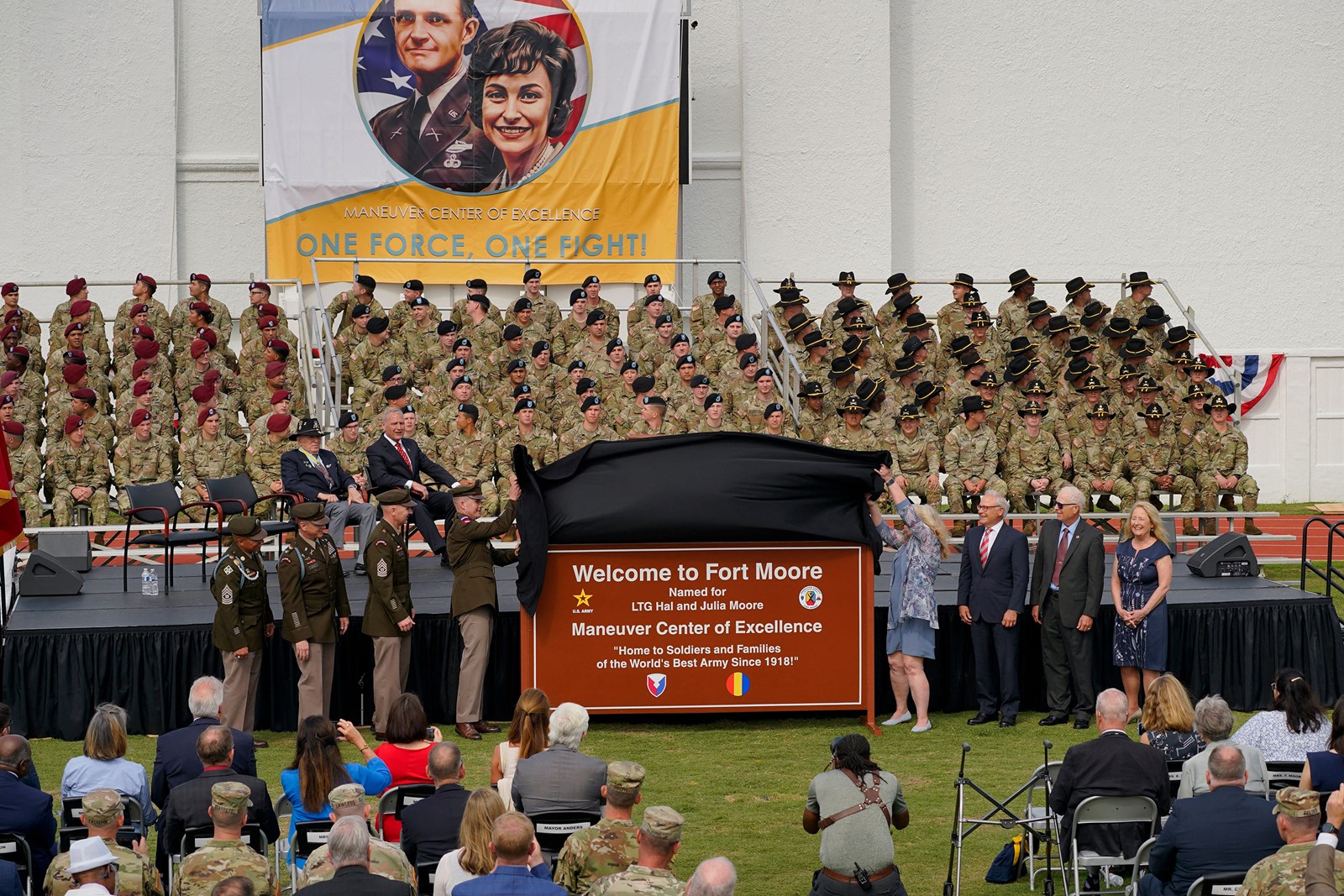


FORT MOORE, Ga. >> Lt. Gen. Harold G. Moore commanded troops in the first major battle of the Vietnam War, a role depicted in a book and a movie. His wife, Julia, was a champion for military spouses and changed the way next of kin are notified when a service member is killed.
In their honor, Fort Benning in Georgia officially became Fort Moore on Thursday as the Defense Department removes Confederate names and symbols from military property. Fort Moore is the only base named for a married couple.
“Together, Hal and Julie Moore embody the very best of our military and the very best of our nation,” Maj. Gen. Curtis Buzzard, Fort Moore’s commander, said at a ceremony marking the change, using Harold Moore’s nickname.
“By honoring them, Fort Moore recognizes the sacrifices of all veterans, especially highlighting those from Vietnam,” he added. “It also reinforces the important role Army spouses and families play in the success of our military.”
The protests over the police killing of George Floyd in 2020 led to broader conversations about racism, and calls to rename sites that honored Confederate officers who fought to preserve slavery and White supremacy. A committee created by Congress to recommend new names for nine U.S. bases selected Fort Moore for Fort Benning, which had been named for a pro-slavery general more than 50 years after the end of the Civil War.
In his remarks, Buzzard reflected on Moore’s contribution to the Army’s integration. “As the commanding general of Fort Ord, California, during a time of high racial tension, Hal instituted an equal-opportunity policy banning discrimination,” he said.
After graduating from West Point, Moore served in the military for more than 30 years, with assignments around the world. But he is perhaps best remembered for his leadership as a lieutenant colonel at the beginning of the Vietnam War.
In November 1965, the military leader took his outnumbered troops into the valley of Ia Drang, and a bloody fight ensued. The North Vietnamese troops retreated in what was considered a tactical victory for the United States. But casualties were heavy. Within 72 hours, 79 U.S. soldiers were killed and 121 were wounded.
On the homefront, military families stationed at Fort Benning began receiving Western Union telegrams bearing news of the losses of these young husbands, fathers and sons. Unaccustomed to notifying so many families at once, the Army hired taxi drivers to deliver the telegrams.
Julie Moore saw that this practice lacked compassion and humanity.
She and other spouses accompanied the taxi drivers and consoled the wives upon notification. Because of her work, the Defense Department started requiring that an officer and a chaplain are present when a family is notified.
Her dedication to military families led to the development of Army Community Service, which offers educational programs and resources to help soldiers and their families.
 PREVIOUS ARTICLE
