




When a filmmaker makes a semi-autobiographical movie that’s also a story about growing up, it’s very often about learning to see. In “The Fabelmans,” Steven Spielberg’s youthful stand-in becomes obsessed with looking at the world through a camera lens, and the film functions almost as an apology for a lifetime of always inserting the camera between himself and the world. “Roma” re-creates Alfonso Cuarón’s Mexico City in the 1970s; “The Souvenir” re-creates Joanna Hogg’s northern England in the 1980s; “The Cathedral” re-creates Ricky D’Ambrose’s American suburbs in the 1990s. In each case, we’re given a glimpse of memories the way the directors remember seeing them, often half-captured or framed in a way that proves meaningful to the protagonist’s maturing perspective.
What we realize, watching these movies, is that any self-reflective adult restaging youthful memories will see them from a new angle, understanding them in a way their younger self never could. That’s what Sean Wang accomplishes with “Didi,” a film about a Taiwanese American boy named Chris stumbling through the summer in Fremont, Calif., before he starts high school. Chris (Izaac Wang, no relation to the director) lives with his grandmother (Chang Li Hua, the director’s grandmother), his mother Chungsing (Joan Chen), and his older sister Vivian (Shirley Chen, no relation to Joan), with whom he fights viciously.
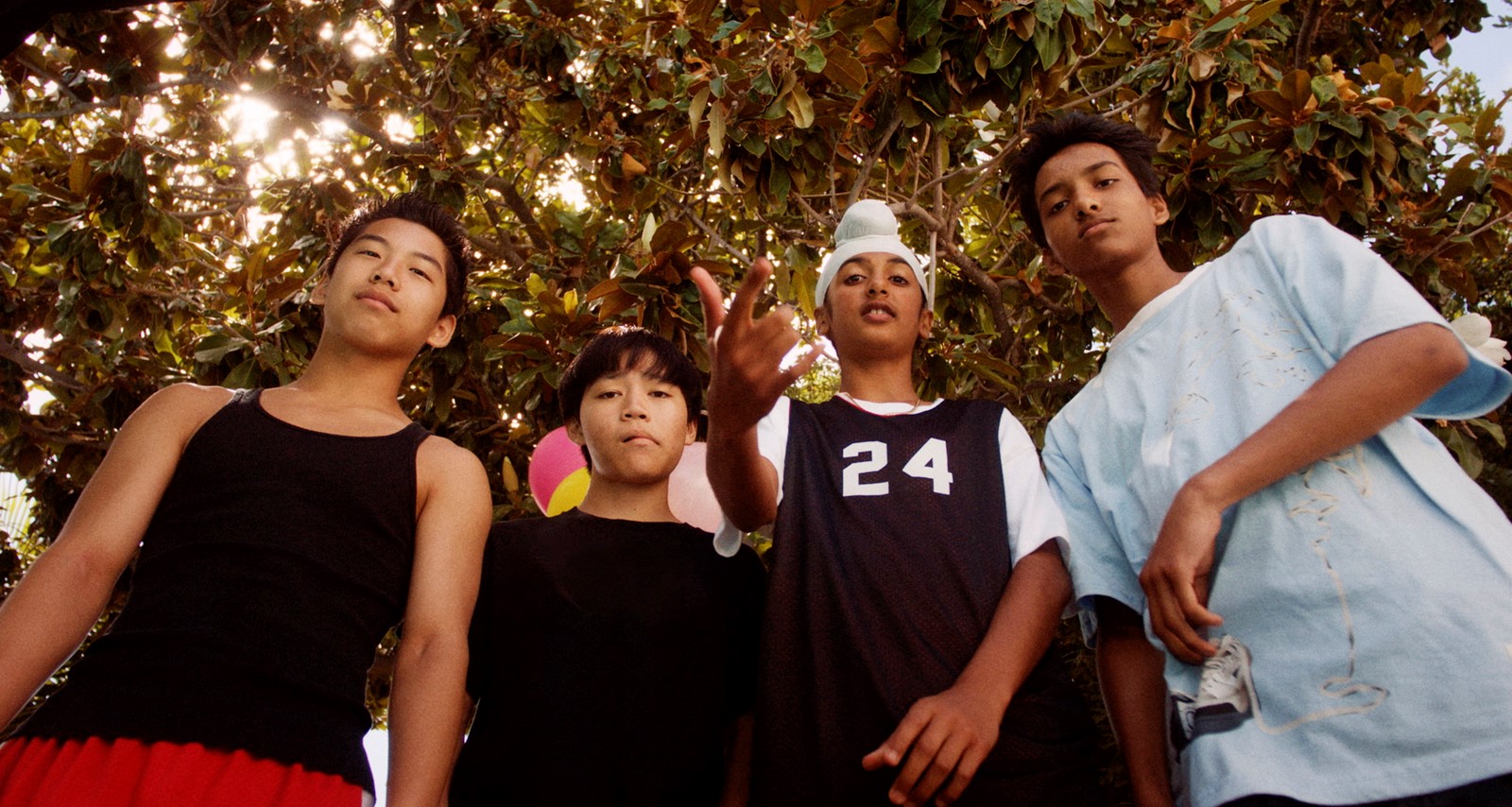
Like this summer’s “Janet Planet,” which recalls the excruciating nature of being bored and 11 in the summertime, “Didi” leans hard into the exact variety of aimless discomfort that comes with being 13. It’s 2008, so Chris spends a lot of time poking around YouTube, which back then was filled mostly with random, amateur drivel that occasionally went viral. He and his best friends, Fahad (Raul Dial) and a kid everyone calls “Soup” (Aaron Chang), play stupid pranks and film them, like blowing up an old lady’s mailbox. Chris has a MySpace account, but his friends are starting to move toward the cleaner, more sophisticated Facebook. He is obsessed with skateboarding, and with filming skateboarders on his little camcorder. And he has a massive crush on Madi (Mahaela Park), who’s a grade ahead of him.
Chris’ family calls him Didi, the Mandarin term for “little brother.” His friends call him Wang Wang. He isn’t quite sure who he is, and hesitates before introducing himself to new people. Entering his teen years, he’s stuck fast in that awkward stage where nothing quite makes sense, everyone is annoying and life is filled with an endless tug of war between immaturity and something more grown-up. Chris and his friends use crude slang to refer to sex and girls and anatomy, but they’re all virgins, and they know it; this is their time for posturing, for trying on personas for size, figuring out who they’re going to be next.
Chris is a stand-in for Sean Wang, who built the movie on top of his own memories. So while those recollections are highly specific to the setting and the time period — Chris uses all the AOL Instant Messenger acronyms, chats with the SmarterChild chatbot and checks a friend’s MySpace page to see if he’s still in their Top 8 list — they feel universal, too. When Chris flubs a first kiss, we feel his embarrassment. When he flips out at his mother, and friends look at him askance for his behavior, we feel his confused shame. “Didi” is as much about realizing how others see you as it is about learning to see them for who they really are.
And when Chris starts to see Chungsing in a new light, he feels the dawning of some new feeling, something we might call maturity. Chris’ father isn’t around, for reasons that don’t become clear till the end of the movie. He and his sister take out most of their pent-up rage on their mother, who absorbs both that and the constant criticism from her mother-in-law wordlessly. Chungsing is a painter, with dreams she keeps to herself. Her life revolves around caring for her family.
That sort of role is two-dimensional to a teenager. Parents don’t have inner lives, when we’re immature. They’re just a means to an end: someone to drive you around, cook you dinner and annoy you by coming into the room when you have friends over. They are tools at best, obstacles at worst.
But all parents are people. From the distance of a couple decades, Wang slowly builds a film that lets us come to see Chungsing that way at the same time that Chris does. As he’s confronted with a handful of character-building moments — humiliations you don’t forget, but you do move past — Chungsing grows, too, her image in Chris’ eyes developing into the film’s arc. Wang lets us watch her more, observe the emotions rippling across her face. And Joan Chen, a bona fide star, turns her into a finely-drawn woman with complexities Chris can only dream of.
You get the sense watching “Didi” that this is a bit of an apology from Wang to his own mother for not seeing her as a real person when he was young. But that isn’t all it is: It’s a funny, heartfelt movie, tapping into the audience’s latent memories as well as our great relief at no longer being 13. For a filmmaker, learning to see people for who they really are — to look again when we think we know someone — is an essential skill. Wang learned this just as Chris does. He grew up to make movies, after all.
 PREVIOUS ARTICLE
