




Alice Fennelly grew up in Loveland, surrounded by the Rocky Mountains and bronze sculptures.
Now, living in a suburb of Paris, she was inspired by the life story of Joséphine Baker — a woman filled with grace and courage, who lived the sort of life that best-sellers are made of, a Black American who moved to Paris at age 19 and set the world on fire. Baker was a dancer and performer, who was also much more, serving as a spy, adopting 12 children and speaking out for freedom.
Walking through Le Vésinet, Fennelly would pass Baker’s villa and learned of this woman, so incredible yet also somewhat unknown. She was famous, she accomplished so much, but there were no streets named for her, no plaza, no park, no monuments.
Fennelly decided to change that, and in doing so, she reached out from her home in France to a renowned sculptor in her hometown of Loveland — Jane DeDecker.
“I remember hearing that her inspiration was women — American woman — and giving them visibility, especially American woman who fought for equality,” Fennelly said.
The two women are working together to create a monument to Baker outside of her villa in Le Vésinet. Fennelly from her home in France has been working on fundraising and getting the needed approvals from different agencies, while DeDecker has been delving into the life of “an amazing” woman, working on creating a life-sized sculpture.
“It’s really, really special to have, whether you call it destiny or serendipitous, stumbled upon her story at such a milestone incredible moment in her life and to be able to honor that French-American life with a French-American team,” Fennelly said.
Who was Joséphine Baker?
Baker was born in 1906 in St. Louis and moved to France in 1925 at age 19 to escape the racism she was facing in the United States. She quickly became a celebrated performer, blossoming into an international sensation, well known for her unique dance style, and famously performing in a skirt made of artificial bananas.
“She was like Michael Jackson fame,” said Kyle Dallabetta, DeDecker’s husband. “She was in demand … She could get into any palace, but she couldn’t get a cup of coffee in Manhattan.”
She escaped that racism by moving to France and achieving stardom, but it was something she spoke out and fought against her entire life. (She died in 1975 at age 68.)
But she was so much more than the performer who became a wealthy superstar. She was also a spy for the French Resistance during World War II, writing messages in invisible ink on her sheets of music. She was a civil rights activist, spending her life fighting against racism and segregation, refusing to perform to segregated audiences; she was the only woman to give a full speech alongside Martin Luther King Jr. at the March on Washington in 1963.
She adopted and raised 12 children from across the world, calling them her “Rainbow Tribe,” became a pilot flying for the Red Cross, had a pet cheetah named Chiquita and lived a life of freedom, breaking barriers and living bravely.
“You would never assume those things would go together, and yet she did all of them,” said Fennelly, who graduated from Mountain View High School in 2010.
“I grew up in music and art. And she’s American, and I’d never heard of this woman before. How is it that someone who is so incredible, people know so little about her?”
“She was so gracious and so giving,” DeDecker said.
“She wanted to prove people could live together in harmony. She just lived life, so bold, so unafraid.”
Now, 100 years after Baker’s journey to France, DeDecker and Fennelly want to help ensure that people know her story.
Crafting a tribute
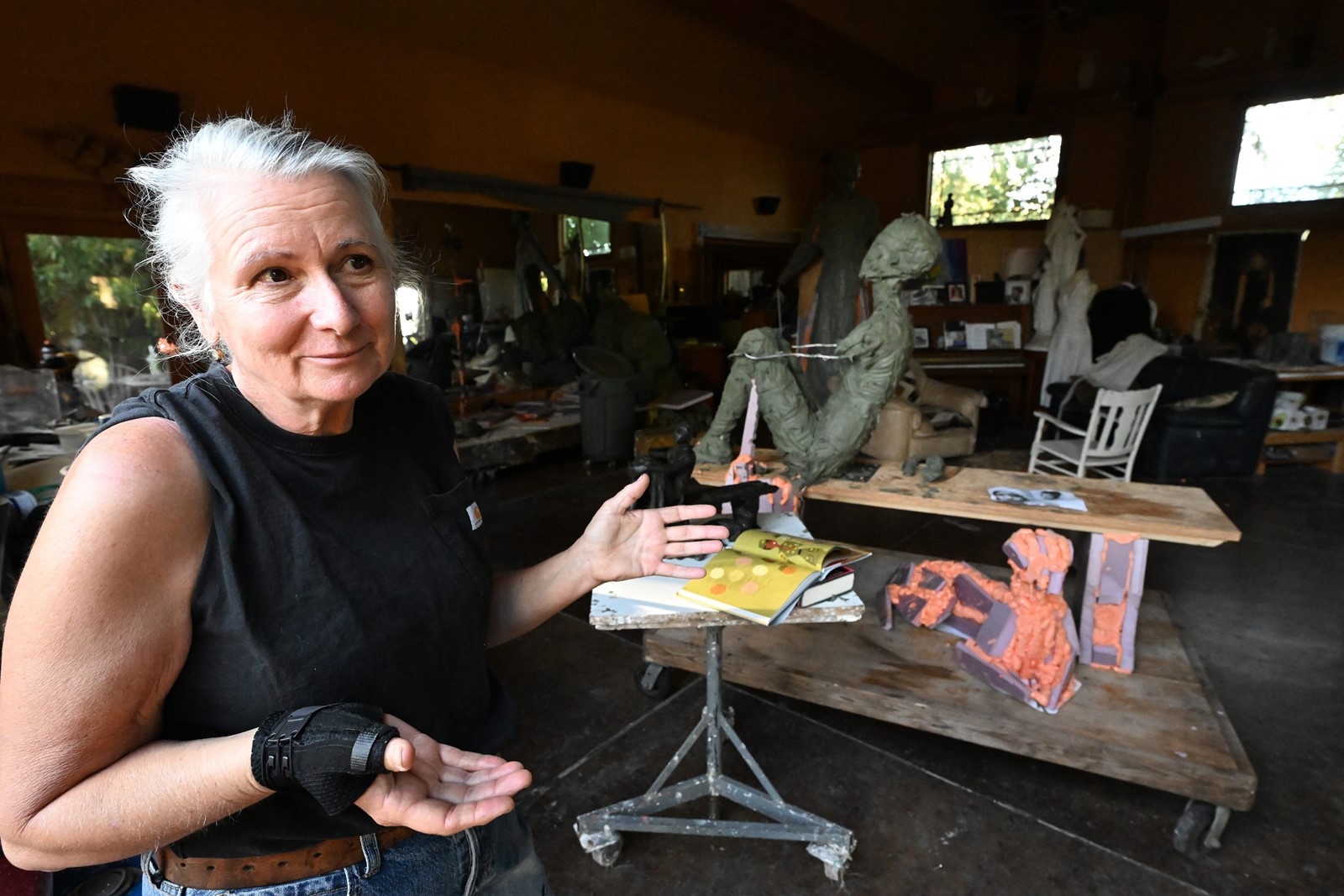
The beginnings of that tribute, a sculpture titled Timeless Grace, are coming together inside DeDecker’s studio in Loveland. A life-size mock-up reveals a bronze of the performer, activist and trailblazer sitting on a bench, her beloved pet cheetah by her side, to be placed outside of Baker’s villa in Le Vésinet.
DeDecker is a renowned sculptor with a talent for capturing the spirit, humanity and life of historic figures in bronze. She has featured trailblazers such as Harriet Tubman, Emily Dickinson, Amelia Earhart and Sojourner Truth, and now she has molded the beauty, class and grace of Baker, who seems very much alive and full of spirit, sitting on her bench, ready to dance, to act, to conquer the world.
People will be able to sit on the bench behind, or even back to back with Baker; they will be able to feel her spirit, her bravery and her accomplishments.
“She was ethereal,” said DeDecker. “She was like lightness of being. Even though she’s seated (in the sculpture), there’s still activity.”
A second bench also will be placed nearby with bronze depictions of items that speak to Baker’s life — pilot goggles, sheet music and a bouquet of flowers. (She was known for placing flowers on the bicycles of Tour de France participants as they passed through her town.)
The sculpture itself and the fundraising are underway with a goal to have it placed next September.
To make this monument a reality, Fennelly and DeDecker are working with two key nonprofits, the Fondation pour le Vésinet and the French-American Cultural Foundation.
Spearheaded by Fennelly, the fundraising effort so far has taken in about 40% of the total $190,000 needed to place the bronze of Baker outside her villa.
Donations are being accepted online at adtkvlyv.donorsupport.co/page/josephine-baker or by contacting info@frenchamericancultural.org.
 PREVIOUS ARTICLE
