




Just north of the old shopping center in Windsor (old being relative and meaning not the “new” downtown and not the Walmart shopping mecca south of the town itself) is the dense network of suburbs that marks Windsor’s bedroom-community.
But within a subdivision named Alden Wood is an actual piece of historical Windsor.
“If I had a dollar for every time someone says they didn’t know we existed, we would never have to hold another fundraiser,” said Steve Lehmann, president of the Windsor Historical Society.
The Hembree House Museum, with its small patch of historic hops and whose front door still faces down the ghost of its cypress-lined driveway that used to stretch all the way to where modern-day Oliver’s Market sits, is an unlikely holdout from when Windsor was an important prune and hop-growing region.
Windsor’s hop history
“There used to be walls of green and yellow that lined the Russian River, causing River Road to be canyon-like,” Lehmann said of the the hop industry’s past.
The industry peaked in the ’50s, before a variety of reasons drove it first to the Central Valley and eventually up into Washington state.
It may seem ironic that in a county that prides itself on our craft breweries and the quality of beer we produce, hops are not widely grown here. However, some brewers are working to bring them back.
“Russian River Brewery has been commissioning some ranches to grow hops for them.” Lehmann said. “There is nothing like fresh hops.”
If sampling fresh hops and/or brewing your own craft beer is something you would like to try, the Hembree House has an exciting opportunity coming up. For the past 14 years, the house has hosted its own hop harvest.
This year’s Hop Harvest & Heritage Day will be held from noon to 3 p.m. on Saturday, Sept. 5. A baked ham lunch will be available for $20 and includes some local beer sampling.
“During the peak of the hops industry,” Lehmann said, “The Wohler Ranch (where Wohler Bridge gets its name) was a 1,500-acre hop ranch with an 8-stack kiln. Every year at harvest they would hire 1,400 workers.”
Lehmann said that with that many people during the harvest, the ranch would set up a mini town in the middle of the fields. There would be housing, of course, but also stores and everything that someone would need.
“The town butchers used to load up their wagons and drive to the camps every day to sell their wares,” Lehmann said. “It’s why we offer a traditional lunch. That’s authentic to what the experience would have been.”
Hops at Hembree House
There are two patches of hops at Hembree House. One is the heritage patch that grows in the garden that faces the road.
“I’m not a great gardener,” Lehmann said. “Otherwise these would be much fuller.”
Their heritage hops come from a plant that was originally planted sometime in the 1940s and had accompanied its owner to every home he had. Behind the house, beside a concrete pad, are the “store bought” hops — so-called because they were originally ordered from a nursery in Washington instead of being from one of the local growers.
These are growing much lusher than the heritage hops, and though they are not interwoven into a full wall like the hops crops of the past, the fact that they exist is in itself a story of tenacity.
The museum used to have many more hops behind it, but when they added the cement slab that now backs onto the house, they tore out all the hops.
Except they missed one. That hop continued growing right at the edge of the concrete, unwilling to give up. So the museum split it into multiple plants, and now the single plant has bountiful fruit waiting to be harvested.
To answer the number one question they get: yes, you can keep hops you harvest during the Hembree House event, and the historical society just asks that if you use them to make beer, you bring a sample the next time you stop by.
“We’ve had people from up and down the state come to get the fresh hops,” Lehmann says, “It’s always great when they bring us samples of their beer.”
“That sounds great,” said Nancy Hazen, a recent transplant to Windsor and the person behind the museum’s newest addition to its educational offerings — the “Hands on History” series.
Hands-on History
The series will be geared toward giving people a sense of what day-to-day life was like in Windsor. Unlike the harvest, however, Hands on History is mainly tailored for kids.
The series begins on Sept. 19 with “Wash Day.”
“We’re going to do laundry,” Hazen said. “The first event is going to be focused on traditional washing methods.”
Hazen has rounded up washboards and basins for the experience, which she plans to hold on the porch (or portico, depending on who you ask) of the Hembree House. The location is strategic both for its large open space that is sheltered from the sun and for its proximity to the well with its old-fashioned water pump.
“We are going to use well water,” Hazen said.
The second event on Oct. 17 will be just as educational and labor-intensive, when Hazen will lead a traditional butter-making day.
“We have traditional milk cans,” Hazen said. “We’re hoping to get Clover Stornetta involved. But the best part is that the kids will get to eat the butter they made.”
If your interest in history is a little less hands-on, the final day will be an examination of clothing from the period during the Clothes to Quilt event on Nov. 21. Not just the traditional clothing, but how clothing was put together and the traditional recycling of valuable fabric that would occur.
“Most people don’t realize that people usually only had three sets of clothes,” Hazen said. “You would have two sets of work clothes and one set of nice clothes. If you were a school teacher, you were required to wear no less than three slips under your dress. Which of course begs the question: who checked?”
Hazen’s impish humor is indicative of the entire attitude of the house. Nothing here is stuffy or pretentious. This is history as it should be, a real examination of real people and their lives.
The Hembree House itself turns 100 this year. Originally built as a vacation home for Dr. Hembree and his wife, Clara, in 1926, it was considered palatial even at the time. The Hembrees originally named their home Mattapan, a derivative of the Mattahunt/Neponset people’s word “Mattappu,” which probably means a sitting-down place or a good place to gather.
When renovations started to bring certain parts of the home up to code, it was discovered that the upstairs bathroom had a thick cement floor under its tile solely to support the large antique bathtub. There are also custom closets with imported hardwood doors and an upstairs closet built entirely of cedar. There is also Clara Hembree’s large sunken garden that used to boast a fireplace, a pond, and a litany of ferns imported from her European travels. While these things may seem less extraordinary in this day of worldwide trade and fast freight, in 1926 things were not so simple.
historic crop
However, the Hembree House is not the only historical building on the site, and hops are not the only historic crop. Beside the house is an even older piece of Windsor history. Clara Hembree’s grandfather, Robert Cunningham, was one of the original settlers in the area, and in 1849 built a small timber house that would grow into the Cunningham House.
It was also Robert Cunningham who planted the cypress trees that still flank the ghost of the original driveway. Somewhere between Cunningham’s cabin and the Hembree summer house, 60 acres of prune trees were planted when that was the dominant crop in the area.
“Harvesting prunes was not fun,” Lehmann said. “The dipper box would be lit in the morning and run the whole harvest.”
The dipper was a heated tub of lye water that all the fresh fruit would be dipped in before being laid out to dry.
“The rule was that as soon as you got too big to fit in the box you had to help harvest,” He said. “The best part of being so connected to the community here is that it leads to moments such as when a mother and son that had been part of the industry came to visit. I told them that little tidbit and the son immediately turned and asked how his brother had continued to fit in the box until he was 28.”
On the path between the Hembree house and the Cunningham House is a traditional prune box. It is not recommended to measure your siblings by stuffing them inside, but especially at this time of the year it’s a sobering moment to stand unshaded from the August sun (when the prune harvest historically happens) and imagine the heat of the fire in front of you. Add into that fresh fruit being squished onto your clothes as you had to crawl around and get the fruit from the ground and as Lehmann suggested, nothing about it sounds like fun.
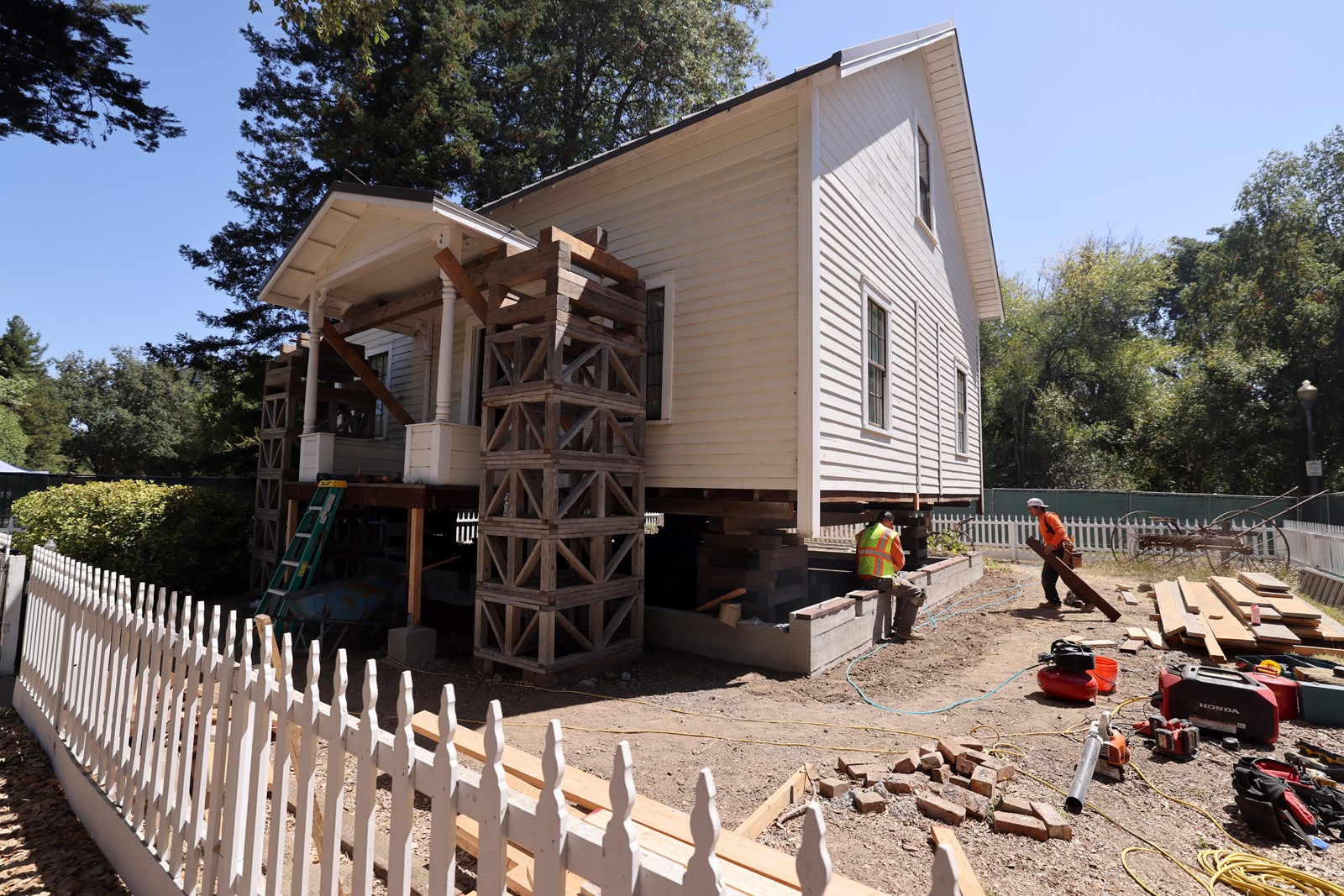
Over the years, the Cunningham House grew from a small cabin to a proper home, but 177 years later, the house’s primitive foundation was failing, and the house was literally cracking in two.
“We had to intervene,” Lehmann said as he led an impromptu tour through the worksite. Pointing to a deeply lined and pocked beam, he said, “That’s what’s left of one of the support beams.”
It’s easy to see why the building was in need of repair. The plan right now is to stabilize it, and a modern cement foundation is being carefully laid under the house, which currently rests on blocks waiting for its new base.
Amidst the rotten boards, blocks of old redwood saved from the foundation, and modern concrete laying equipment is an old broken chair on which rests an old clown statuette, looking merrily over the chaos around it.
“We found it in the creek,” Lehmann said. “We had grown pumpkins around the Cunningham House that year and so when I found that I thought it would be great to put it on one of the large pumpkins. Now it sort of follows me around. People are always putting it in random places.”
In any other historic place the moving clown statue might be seen as something malignant, but not at Hembree House. The entire place has an ease to it that is hard to describe. Maybe it’s that this was a family home for so long and that there are a lot of the family artifacts left.
Maybe it has to do with the years the house spent as a main office and home for Landmark Winery that purged any negativity that other old homes seem to store.
Or maybe it’s just the good-humored and welcoming volunteers that lend the house its atmosphere of normality and warmth.
Whatever it is, this is the rare piece of history that still feels vital and current instead of staid or locked in its era.
In their most recent newsletter, the Hembree House has a not-quite-desperate plea for docents. In the request, they say that the house is a ‘very comfortable building to spend time in.”
This isn’t hyperbole. If your experience of historical homes is General Mariano Vallejo’s claustrophobic home in Sonoma or the bare reconstructions at Fort Ross State Historic Park, or even the well-kept but frozen-in-time Beauty Ranch at Jack London State Historic Park, this is something entirely different.
And while almost all historic places have something akin to a hands-on history program, very few have the opportunity to make some good beer with your museum bounty.
There are some things you need to be aware of to participate in the harvest event. Mainly that you will smell like a craft brewery when you finish and that, when you cook the hops, it will fill your home with that warm hoppy scent so many people visit Sonoma County breweries for.
Obviously, like all harvesting, don’t wear flip-flops, and don’t forget the sunscreen. In case you’ve never seen hops growing before, they grow vertically, and the vines are hung high on wires and string, so this isn’t like picking grapes. It’s also not a crop that hangs down from overhead arbors, making it easy to pick like the pole beans that took over much of the hops-growing land before it all became vineyards.
Oh, and Lehmann has one more piece of advice if you’re coming to the harvest party: “Wear long gloves.”
 PREVIOUS ARTICLE
