


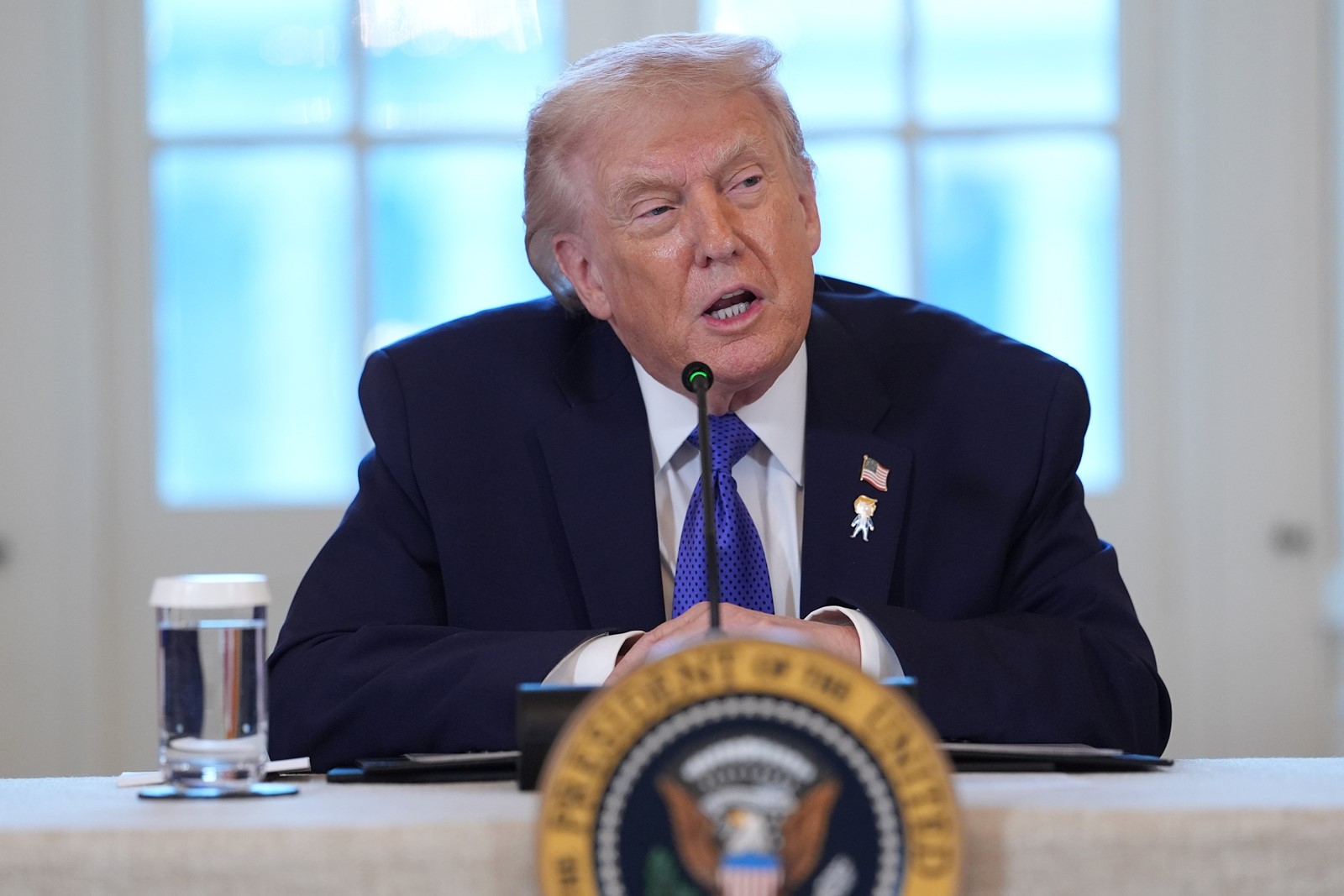


WASHINGTON — President Donald Trump on Friday called on oil executives to rush back into Venezuela as the White House tries to quickly secure $100 billion in investments to fix the country’s neglected infrastructure and fully tap into its expansive reserves of petroleum.
Since the U.S. military raid to capture former Venezuelan leader Nicolás Maduro last Saturday, Trump has quickly pivoted to portraying the move as an economic opportunity for the U.S. He has seized tankers carrying Venezuelan oil, has said the U.S. is taking over the sales of 30 million to 50 million barrels of previously sanctioned Venezuelan crude, and plans to control sales worldwide indefinitely.
At the White House meeting, major oil companies said they were interested in the opportunity but expressed caution given their past experience in the country. “If we look at the commercial constructs and frameworks in place today in Venezuela, today it’s uninvestable,” said Darren Woods, CEO of ExxonMobil, the largest U.S. oil company.
Trump used the meeting to publicly assure executives that they need not be skeptical, even though the South American country has a history of state asset seizures, ongoing U.S. sanctions and decades of political uncertainty.
“You have total safety,” Trump told the executives. “You’re dealing with us directly and not dealing with Venezuela at all. We don’t want you to deal with Venezuela.”
Trump added: “Our giant oil companies will be spending at least $100 billion of their money, not the government’s money. They don’t need government money. But they need government protection.”
The president said the security guarantee would come from working with Venezuelan leaders and their people, instead of deploying U.S. forces. He also said the companies would “bring over some security.”
The meeting came on a day when U.S. forces seized their fifth tanker over the past month that has been linked to Venezuelan oil, an action reflecting the determination of the U.S. to fully control the exporting, refining and production of Venezuelan petroleum.
It’s part of a broader push by Trump to keep gasoline prices low. The incursion in Venezuela melds Trump’s assertive use of presidential powers with an optical spectacle meant to convince Americans that he can bring down energy prices at a time when many voters are concerned about the cost of living.
Trump played up the potential for major oil companies to strike big, while acknowledging that the executives were sharp people who were in the business of taking risk, a nod to the reality that he’s asking for investments in Venezuela at a moment when the country is teetering and economic collapse is not out of the question.
ExxonMobil CEO Woods said his company would send a team to assess the situation, and noted its assets had been seized there — twice — in the past. “Significant changes have to be made to those commercial frameworks, the legal system, there has to be durable investment protections and there has to be change to the hydrocarbon laws in the country,” Woods said.
Other companies represented at the meeting included Chevron, which still operates in Venezuela, as well as ConocoPhillips, Halliburton, Valero, Marathon, Shell, Singapore-based Trafigura, Italy-based Eni and Spain-based Repsol.
Venezuela’s oil production has slumped below 1 million barrels a day. Trump, however, expressed confidence that Big Oil is ready to take the plunge.
“You know, these are not babies,” Trump said of the oil industry executives. “These are people that drill oil in some pretty rough places. I can say a couple of those places make Venezuela look like a picnic.”
After the meeting, Energy Secretary Chris Wright told reporters that the companies showed “tremendous interest,” adding that Chevron made a specific pledge. Wright said it could take eight to 12 years for daily production in Venezuela to triple to 3 million barrels a day.
The president also offered a new rationale for ousting Maduro and demanding the U.S. maintain oversight of the Venezuelan oil industry, saying, “One thing I think everyone has to know is that if we didn’t do this, China or Russia would have done it.”
 PREVIOUS ARTICLE

