




Drive along the backroads of Sonoma County, and it’s hard to miss the fallow ground where grapevines once stood.
It’s a sign of the wine industry’s continued downturn, as growers pull vines to address the oversupply of grapes amid declining consumer demand.
According to the California Association of Winegrape Growers’ 2025 Standing Winegrape Acreage Report, 2,711 acres of vines were removed in Sonoma County between October 2024 and August 2025.
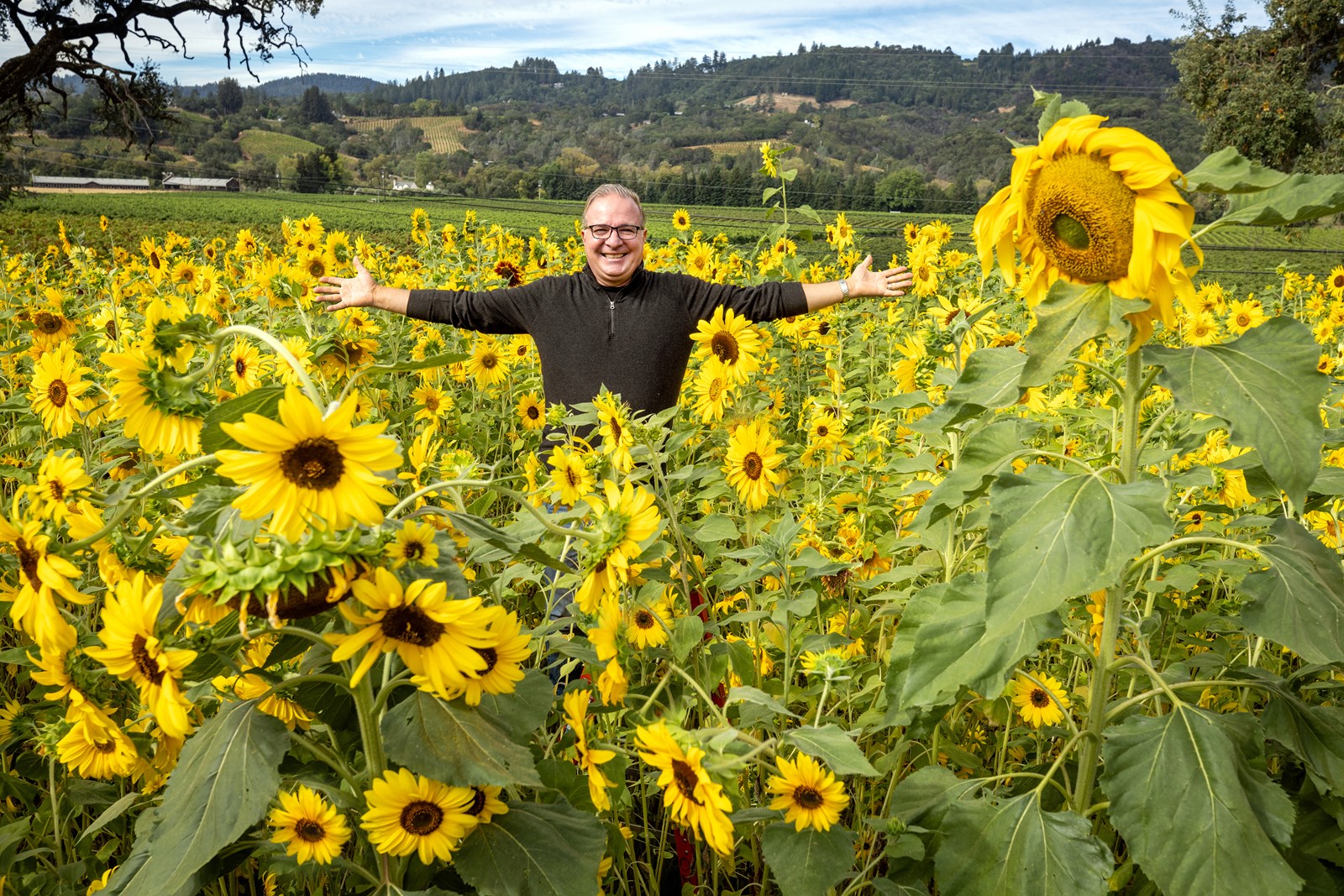
For Corey Manning, co-owner of Chateau Diana in Dry Creek Valley, the empty fields were a depressing sight. So when he learned that 1.25 acres of Zinfandel at Chateau Diana, the winery his parents founded in 1981, would be removed, he had an unusual idea.
“I didn’t want customers to pull up to the winery and see another empty field, so I thought, ‘Why not plant sunflowers?’” said Manning, who developed an appreciation for flowers from his mother, Diana. “I figured I would just try it out and see if they liked it. I’ve been shocked to see how excited people are to drink wine among the sunflowers.”
Manning is no stranger to putting unused land to work for the community.
Since 2008, he has grown about 10,000 pounds of fresh produce a year for Farm to Pantry, the Windsor-based nonprofit that provides food to those in need.
But the scale of his sunflower experiment is nevertheless striking.
He planted 3,000 sunflowers, representing 12 varieties, where the Zinfandel once grew. Fortunately, he already had plenty of heirloom seeds on hand, saved from a personal stash at his 20-acre sustainable farm in Dry Creek Valley.
“My wife, Emily, loves sunflowers, so we began planting all different kinds and saving the seeds in 2022,” Manning said. “Each year, we’d grow more and more, so the field got bigger and bigger. Last year, I had a bunch of extra seeds I didn’t use because the field would have been ginormous. They were perfect for the winery.”
During the planning phase, Manning mapped out where each variety would be planted. Smaller, more colorful blooms were placed near the main walkway, while taller varieties were planted toward the back.
Because the different varieties bloom at different times, the garden is designed to remain colorful throughout the season.
“I want people to get a really good experience when they enter the sunflower area,” he said. “It’s all about bringing joy to visitors’ lives, while being creative with the land and providing habitat for pollinators. I wish more people would do the same.”
 PREVIOUS ARTICLE
