


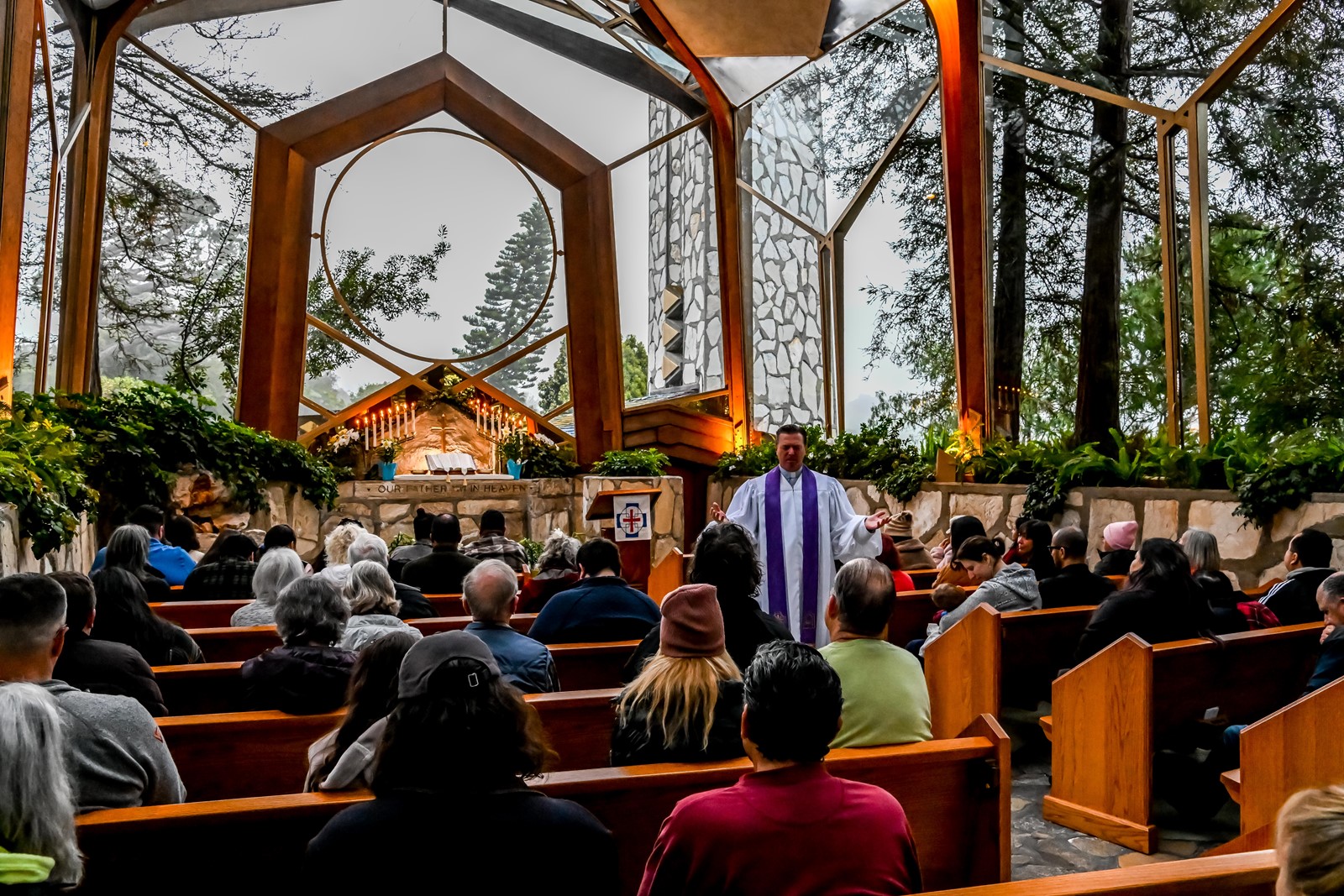


A year ago this month, the seismic consequences of the ongoing land movement in Rancho Palos Verdes was laid bare — when officials at Wayfarers Chapel announced that the National Historic Landmark needed to close.
The unprecedented landslide, caused by historic rains during the 2022 and 2023 winter reasons, had begun damaging the iconic wood-and-glass chapel, designed by Frank Lloyd Wright Jr.
While the chapel was not the only victim of the accelerated land movement that continued well into 2024 before city and resident efforts to slow it began taking hold — trails have closed, homes have been split at their foundations, and Palos Verdes Drive South has needed constant maintenance — it was likely the most well-known in Rancho Palos Verdes.
Countless tourists had flocked there since the church opened in 1951, and it was a popular destination for weddings.
But the land movement made it unsafe for the chapel to remain open. So it shuttered its doors in February 2024, forcing about 260 weddings to be canceled.
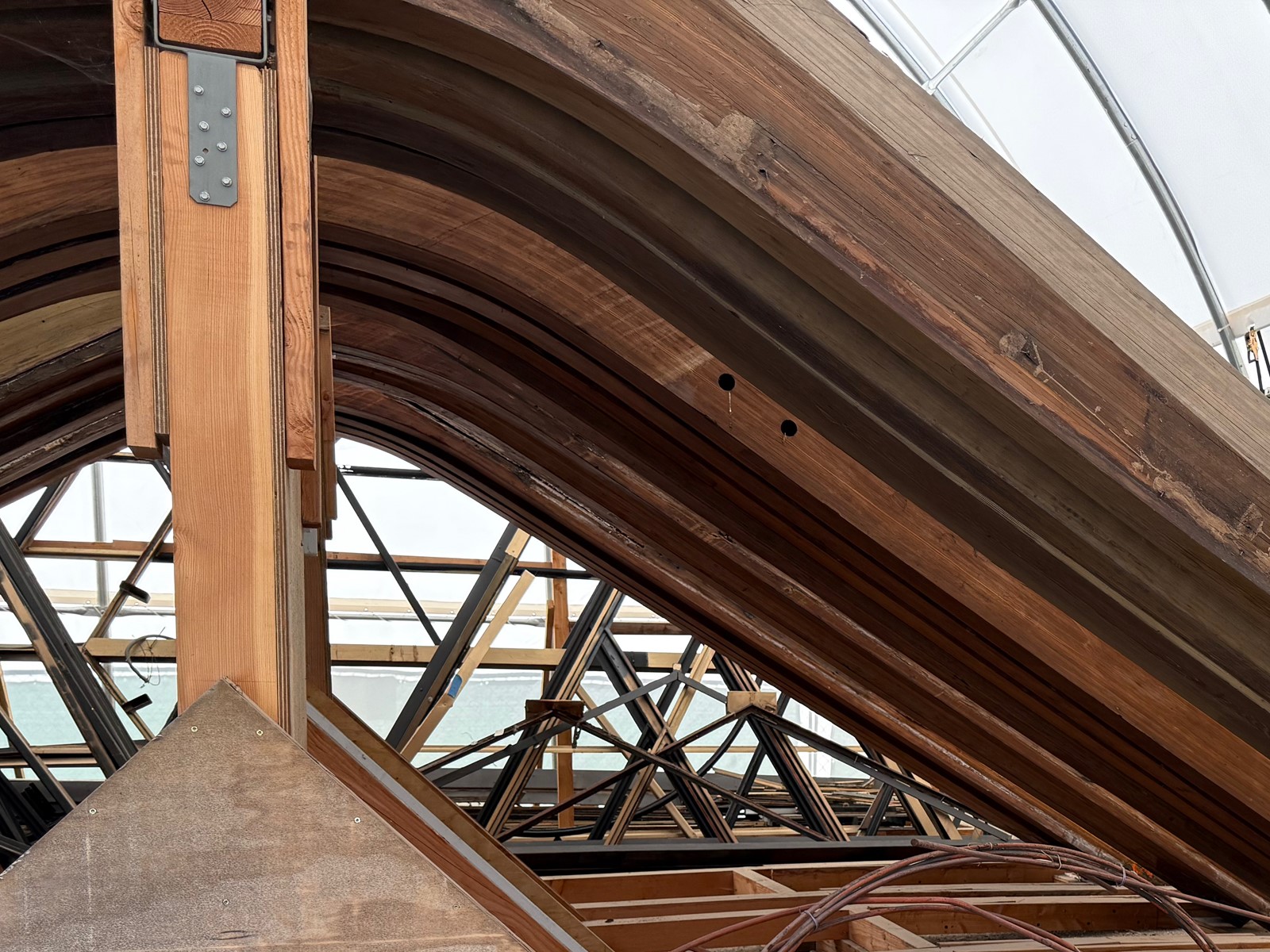
And then, a few months later, a complicated disassembly took place — in an effort to preserve the chapel for future generations.
That effort began just in time, said Robert Carr, who took over as interim administrator of Wayfarers at the beginning of the year.
“We could see that (the buildings) were already twisting or starting to crack, but we got them disassembled before any of them were ruined,” Carr said. “They are all now safely stored and preserved.”
The homeless chapel has incurred plenty of financial costs since its closure. The canceled weddings required about $1.3 million in refunds, Carr said, while disassembling the chapel cost around $1 million, from the church’s own savings. But the biggest cost is yet to come: rebuilding elsewhere.
Wayfarers officials are looking for a place to rebuild the iconic structure, with multiple offers already coming in — some, Carr said, as far as 2,000 miles away. The goal, though, is to keep the chapel in Rancho Palos Verdes.
The faraway offers, Carr said, include rebuilding the chapel at no cost to Wayfarers.
“So very generous offers, but you know, our heart is in Palos Verdes,” Carr said. “That’s where the historic landmark always has been, and that’s where it should be.”
But footing the bill itself would be expensive. An early estimate, Carr said, is that rebuilding the chapel and its surrounding ground and infrastructure would cost $25 million to $30 million.
“People need to recognize that what we lost at the old site was not just the chapel itself,” Carr said. “It was all of our buildings.
“Everything needs to be re-created.”
Another issue is whether the chapel, once rebuilt, would retain its status as a National Historic Landmark, a designation it received in December 2023, just a couple of months before its closure.
It is unclear, Carr said, if the U.S. Department of the Interior would still consider it a landmark if it’s in a new location.
And getting the designation was no easy feat. The journey had taken around 10 years, the Rev. David Brown said in an interview following the December 2023 announcement.
And the requirements to preserve a historic landmark are “pretty stringent,” Carr said.
“One of the requirements is that the landmark, if it does need to be moved due to a natural disaster like this,” Carr said, “the new site should really be as similar to the original site as possible.”
Dismantling began in May with the redwood, steel and glass structure of the chapel, which included salvaging anything historic, such as stone walls, a fountain and more.
“It’s an expensive process because it’s not easy to disassemble a building,” Carr said, “let alone in the middle of a rapid landslide.”
The Architectural Resources Group, which helped complete the National Historic Landmark designation process with Wayfarers, had a short time to turn the chapel into a jigsaw puzzle.
Katie Horak, a principal at ARG’s Los Angeles office, said that relocating historic buildings is a “common practice,” but Wayfarers was unique “because of the incredible pressure of moving the building quickly because of the land movement that was occurring.”
“We had to work really, really quickly,” Horak said in an interview Tuesday, “and to move to disassemble the building before the materials were too damaged to be reused.”
There was new damage to the chapel daily, Horak said, but because of its previous work with Wayfarers, they “knew how the building as put together.”
“We had Lloyd Wright’s original drawings,” Horak said. “We had photos of its construction showing the pieces being put together. So we were able to take it apart and label everything and tie that labeling system to drawings so that it really is sort of a kit of parts that in the future could be put back together again.”
Work to remove the 80-foot bell tower, meanwhile, began in July — but that ran into a problem. Part of the bell tower was saved, including the tower cross, roof tiles and the inside staircase.
But the bell tower was not completely saved, Horak said.
“We weren’t able to use cranes, we weren’t able to use scaffolding and other heavy machinery,” Horak said. “We were really limited (in) what type of equipment we could use on the site. So we were able to disassemble the chapel itself, but unfortunately, the bell tower, due to its height and the materials, the stone materials, we weren’t able to disassemble the bell tower in its entirety. It would have needed a crane, and it’s just too dangerous on the site.”
ARG, Carr said, is one of the “nation’s best historic architecture firms.”
“We assembled a team where they provided all of the architectural expertise and the historic preservation expertise to make sure that we preserved the right things and that we did it the right way,” Carr said. “They are a fantastic partner to work with. We did the disassembly to the very highest standards.”
The goal now, Carr said, is to rebuild the chapel and other buildings just as they were when Wayfarers first opened.
A complete digital model, accurate to one-thousandth of an inch, was created using laser scanners, Carr said. Everything was cataloged, “palletized and well-organized and well protected,” Carr said.
Finding a new home
Finding a new location in Rancho Palos Verdes is the next challenge.
The church, Carr said, has had a “very good relationship” with the city, which was hit hard by rains in the winters of 2022 and 2023 — accelerating the historic landslide area.
Wayfarers was located on 3.5 acres within the Portuguese Bend Landslide Complex, which began moving at a historic and alarming pace after the 2022 winter season.
The movement, however, has slowed in recent months — though not entirely stopped — because of a dry winter and the installation of dewatering wells.
Matt Waters, senior administrative analyst with the city’s Recreation, Parks and Open Space, said in an interview late last year that the city’s Civic Center could be a potential site for Wayfarers — though there are some challenges there — or near the Point Vicente Lighthouse.
For decades, the city has been hoping to replace its aging facilities, including City Hall, but some momentum gained by the City Council approving a conceptional plan in October 2023, has been slowed by the land movement’s uncertain future and financial impact to Rancho Palos Verdes.
The price for a new Civic Center could exceed $100 million, based on some estimates.
The city has leased the land overlooking the Pacific Ocean since 1975, a year after the Nike-Ajax launch site, one of 16 in the greater Los Angeles area since the 1950s, was deactivated.
More than 60 acres of land was acquired by the city in 1979 through the Federal Lands to Parks Program. Deed restrictions to 9.5 acres east of the current City Hall were lifted in 2019, which allows only certain passive usage, like trails and open space.
The city has also been talking to the U.S. Coast Guard about potentially purchasing two areas that is still owned by that agency, including 4 acres overlooking the Point Vicente Lighthouse and bunker, Battery Barnes, which was named after Army Col. Harry C. Barnes, a World War I veteran.
Waters said everything is at the “exploratory level right now.”
“I think their preference is that Battery Barnes, the 4 acres on the edge of the property,” Waters said. “It has a nice, big ocean view, similar, micro-climate.”
A LONG HISTORY
Wayfarers has had a long history on the Palos Verdes Peninsula.
It dates back around 100 years, when Elizabeth Sewall Schellenberg, a Swedenborgian Church member who lived on the Peninsula in the 1920s, had “dreamed of a small chapel of exquisite beauty and spiritual architecture on a hillside above the Pacific Ocean, where wayfarers could stop to rest, meditate, and give thanks to God,” according to the Wayfarers website.
But a cornerstone for Wayfarers was not dedicated until 1949, following a land donation by Narcissa Cox Vanderlip. The cornerstone cracked during the land movement.
The Swedenborgian Church was founded as a small church in London in the mid-18th century by Emanuel Swedenborg, a philosopher, scientist and church reformer, who later took his teaching to America.
Wright Jr. designed Wayfarers, which opened in 1951, as a “spiritual center serving “the wayfarer” — that is, all who come, no matter their faith or status,” according to its website.
Wayfarers has become a landmark because of its history and beauty. That beauty is also why it had long been a destination for weddings and for filming television shows and movies.
The “chapel has never been operated as a traditional church,” said Carr, who took over as the chapel’s interim administrator after former Executive Director Dan Burchett retired before the new year. “It’s really been always operated as a public service institution, is how I describe it.
“We’re very committed to continuing that, and I think that’s one of the reasons we have the sense that we’re beloved by the local community,” Carr added. “We appreciate that sense of love and support from the community, and we really intend to continue that mission of being a public service institution going forward.”
Wayfarers, in fact, is still holding services — Sunday worship, and Wednesday prayer and healing services — but at St. Francis Episcopal Church in Palos Verdes Estates.
Wayfarers will also celebrate the 74th anniversary of its first worship service as a Swedenborgian church on May 13.
When a new site is located, Carr said, officials will start a public building campaign, which would include fundraising because “we don’t have the funds” to rebuild the chapel at this time.
“We will definitely need support from many institutions,” Carr said, “but also from the public.”

