




Huntington Beach police will work to coordinate better with U.S. Immigration and Customs Enforcement when officers book people in the city jail for misdemeanor arrests, but will “walk that fine line” to not violate the state’s sanctuary law, a city spokesperson said.
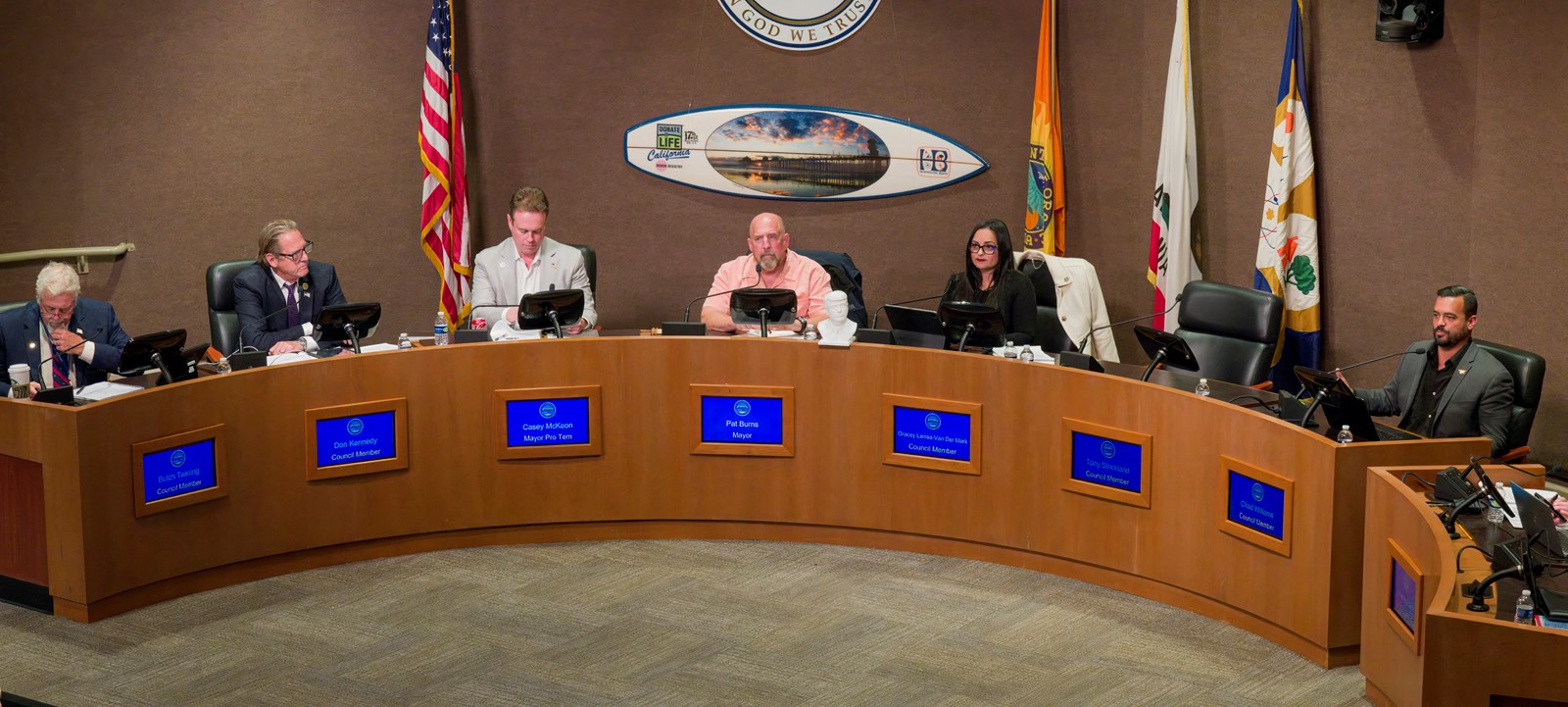
The City Council declared Huntington Beach a “non-sanctuary city” at its Jan. 21 meeting, one day after President Donald Trump took power, with council members decrying limits the California Values Act, or Senate Bill 54, places on cooperation between police and federal immigration enforcement, risking the community’s safety, according to the members.
Jennifer Carey, a spokesperson for the city, said Huntington Beach officials will do what they can to coordinate with Immigration and Customs Enforcement for misdemeanor bookings and are “trying to walk that fine line” between the council’s nonsanctuary city resolution and the California Values Act, a sanctuary law passed during the first Trump administration.
“We are not necessarily changing our policies or working outside of SB 54 or disregarding state law,” she added.
Huntington Beach’s elected leaders have made no secret of their ill view of the state’s sanctuary law. SB 54 is also the target of a federal lawsuit filed by the city on Jan. 7 that seeks to have it declared unconstitutional.
Immigration activists said the declaration by city leaders is a threat to the Latino community and makes the city even more unwelcoming.
Typically in cities when someone is booked for a misdemeanor they are logged into a database that Immigration and Customs Enforcement monitors; that practice will continue, Carey said.
Huntington Beach police will have such people in custody for usually around four to eight hours, Carey said. Now, during that time, police officials will work to better coordinate with Immigration and Customs Enforcement, she said.
“We are saying we are happy to work through the process of coordinating with you in a better way, which a lot of cities would not do,” Carey said.
When Huntington Beach police arrest someone for a felony they are ultimately transported to the Orange County Sheriff’s Department jail, where they are subject to that department’s policies, she said.
Huntington Beach will not, Carey said, seek to take people into custody on suspicion alone that they entered the country illegally; that’s federal law enforcement’s job. Citations issued for traffic violations like a busted taillight are separate from arrests and will not see people logged in the database, Carey said.
Huntington Beach police Capt. Oscar Garcia at a Jan. 27 town hall held in the largely Latino Oak View neighborhood to answer questions over the council’s nonsanctuary city declaration stressed that it’s important the community works with local police on investigations. He said people can still live their day-to-day lives without concern that Huntington Beach police will be the ones enforcing immigration law.
Still, an arrest for an alleged misdemeanor crime could result in Huntington Beach police coordinating with authorities like Immigration and Customs Enforcement.
As the nation wrestles with a new immigration landscape brought by the Trump administration, Huntington Beach elected officials are acting quickly to distance the city from the California Values Act and make clear that they support the renewed crackdown on people who entered the country illegally.
When the council unanimously passed its nonsanctuary city resolution, Mayor Pat Burns branded it as a message to “would-be criminals” to not come to Huntington Beach. He also displayed a small bust of Trump at his place on the dais.
Victor Valladares, co-founder of Oak View Comunidad, a community organization that shares the name of the neighborhood it serves, said the Latino community had already been more weary of being in Huntington Beach in recent months and the nonsanctuary-city resolution has made it worse.
“People are scared to come down to Huntington Beach,” Valladares said. “And it’s unfortunate. How do you debunk or fight against these anti-immigrant policies?”
Valladares said Oak View was once known as the “Slater Slums,” but years of community advocacy has helped to distance the community from the derogatory name. Valladares said the resolution sends a harmful message to the community and is another chapter in the history of a city where activists in the past have received widespread attention for their ardent anti-immigrant views.
“To me, it’s code for going after the Latino community,” Valladares said. “I believe it’s a direct attack on our community.”
The filing in early January of a lawsuit to get the California Values Act struck down marked the second time the city has sued to overturn the law. San Clemente’s City Council at its last meeting discussed joining the Huntington Beach lawsuit, but ultimately decided against it.
Huntington Beach City Attorney Michael Gates has argued it is important to signal a willingness to cooperate and work with immigration enforcement since the Trump administration has indicated it will go after law enforcement that stands in the way.
“The state created the conflict with the federal government,” Gates said. “The city wants to keep our communities safe, including our immigrant communities. That necessarily includes going after criminals who also happen to be illegal immigrants.”
The state attorney general’s office has pushed back on what it called the Trump administration’s “vague threats” and said it would move to take action if the federal government targets law enforcement for lack of cooperation. The attorney general’s office has not commented directly on Huntington Beach’s nonsanctuary-city declaration.
Valladares, who works with the OC Rapid Response Network, a collective of groups that seek to report Immigration and Customs Enforcement sightings and help people understand their rights when interacting with immigration enforcement, said there have been recent sightings of immigration officers in Orange County, but those appeared to have been targeted arrests, not mass deportation operations.
He said the main advice he gives to people is to not spread misinformation online about Immigration and Customs Enforcement sightings and to only spread pictures and videos taken themselves.
Andrés Kwon, an American Civil Liberties Union of Southern California senior policy counsel and organizer, said he didn’t have the wisdom to make a statement on whether people should or shouldn’t avoid Huntington Beach if they fear being caught up with immigration enforcement.
But, Kwon said, the thrust of the California Values Act is to ensure immigrant communities continue to work with police, and the city’s declaration may work counter to that.
Network Coordinator Sandra De Anda of the response network said there was a drop in Immigration and Customs Enforcement arrests in the early years of this decade. De Anda said the group noted a sharp rise in Immigration and Customs Enforcement transfers from the Orange County Sheriff’s Department in 2023, climbing from 17 in 2022 to more than 220 in 2023.
De Anda said it’s important for people to know that over the eight years since the group’s inception, about 75% of Immigration and Customs Enforcement arrests occurred at the Sheriff’s Department jail, and the rest were targeted home arrests.
Orange County Sheriff Don Barnes said in January that his department won’t ask people about their immigration status and “will provide for your safety and respond to your calls for service regardless of your immigration status.”
De Anda said the response network is working to distribute know-your-rights immigration flyers throughout the county, including in the Oak View neighborhood. She called such work essential to combat fear.
She said the group is hearing about members in the undocumented community who are scared to report crimes to the police or sheriff even when they themselves are the victim.
“There is that distrust,” she said.
 PREVIOUS ARTICLE
