





From the time I was a small boy, I’ve loved the rituals of the countdown to Christmas Day, especially the Advent calendar.
Each December, my sister and I would pore over a stiff cardboard sheet printed with some festive illustration. One that comes to mind showed Santa perched on a ladder that improbably supported his ample BMI as he fixed a gold star to the top of a glittering tree. Behind the numbered doors were more pictures: wreaths, gift boxes, ice skates, sleds and so on.
The world has changed since those faraway days, and so have Advent calendars. If I open a little numbered door this year, there’s a good chance I’ll find something to eat or drink.
Will it be a fingertip-size roll of mints wrapped to look like a can of Bush’s baked beans? A packet of freeze-dried dill pickle chips from the 12 Days of Pickles calendar? (Alluring slogan: “a pickle surprise behind every door.”) Or the high point of the holidays since Victorian times, destined to be stirred into a steaming cup of cocoa as I hunker down by the flickering Yule log — an envelope of powdered, chocolate-flavored pea-protein isolate? This last is from Naked Nutrition, a supplement company whose Naked Advent Calendar, I was relieved to learn, features no actual nudity.
Scan these and hundreds of other versions of the holiday countdown that are available this month and you’ll soon realize that these days, almost anything you can put in your mouth can be put into an Advent calendar. Treat-free, two-dimensional calendars like the ones I remember have been swamped by calendars loaded with goodies, now a global industry with sales estimated at $2.6 billion in 2025, according to the Growth Market Reports research firm. In the United States and Canada, the market is growing by about 9% a year, the company says.
There are Advent calendars hiding Star Wars Lego kits or other toys, ones filled with makeup and skincare products, and ones with branded doodads from such luxury brands as Dior and Chanel. The most popular calendars by far, though, offer things to drink and eat.
It is an unlikely fate for a quiet devotional custom of 19th-century Lutherans who found, behind the tiny doors, a Bible verse for each day of the month. But Advent calendars proved extremely adaptable to modern commerce. Highly seasonal products, the ones packed with hidden treats are almost always made in finite numbers, which feeds the current craze for limited editions and product drops.
As the calendars have grown in popularity, they’ve grown in size and complexity, making them ideal subjects for that bizarre media phenomenon the unboxing video.
They also fit neatly into two broader marketing trends, the so-called little treat economy and the appetite for spending money on experiences.
In a recent report on holiday shopping behaviors conducted by Deloitte, half of the respondents said they would give experiences as presents this year. This may come in the form of a restaurant gift card or a concert ticket, but the survey found that nearly 80% of shoppers like to supplement those gifts with a physical item. Advent calendars combine the two, said Natalie Martini, who wrote Deloitte’s report.
As prices for consumer goods keep rising, it’s not surprising that many people say they are searching for value in holiday gifts. On first glance, this does not look like good news for Advent calendars. In some cases, it can be cheaper to buy the surprise treats behind each door separately. The popular calendar from Bonne Maman offers 24 days of miniature jars of jam and other treats for $56, but the company also sells a simple, calendar-free bundle of 30 miniature jars for $34.
A side-by-side comparison is only part of the decision. A 2-ounce nip of bourbon on Dec. 8 can help a consumer decide whether to buy a 750-milliliter bottle on New Year’s Eve. And, Martini said, “you’re not just opening one gift. You’re getting that joy and excitement for 24 days, which for me is value.”
Chocolate Advent calendars are the OGs of the scene. They first appeared in the 1950s and entered the mass market after Cadbury got into the game in 1971. Today they account for almost half of all Advent calendar sales and, according to a recent report by Mintel, a market research group, nearly three-quarters of new releases.
From a traditional chocolate calendar, it’s just one small step and several licensing agreements to the Jelly Belly Harry Potter Marauder’s Map Trivia Advent Calendar, a past offering that held 24 tiny bags of Bertie Bott’s jelly beans.
But as the Advent market has grown, many food and drink brands have moved beyond sweets.
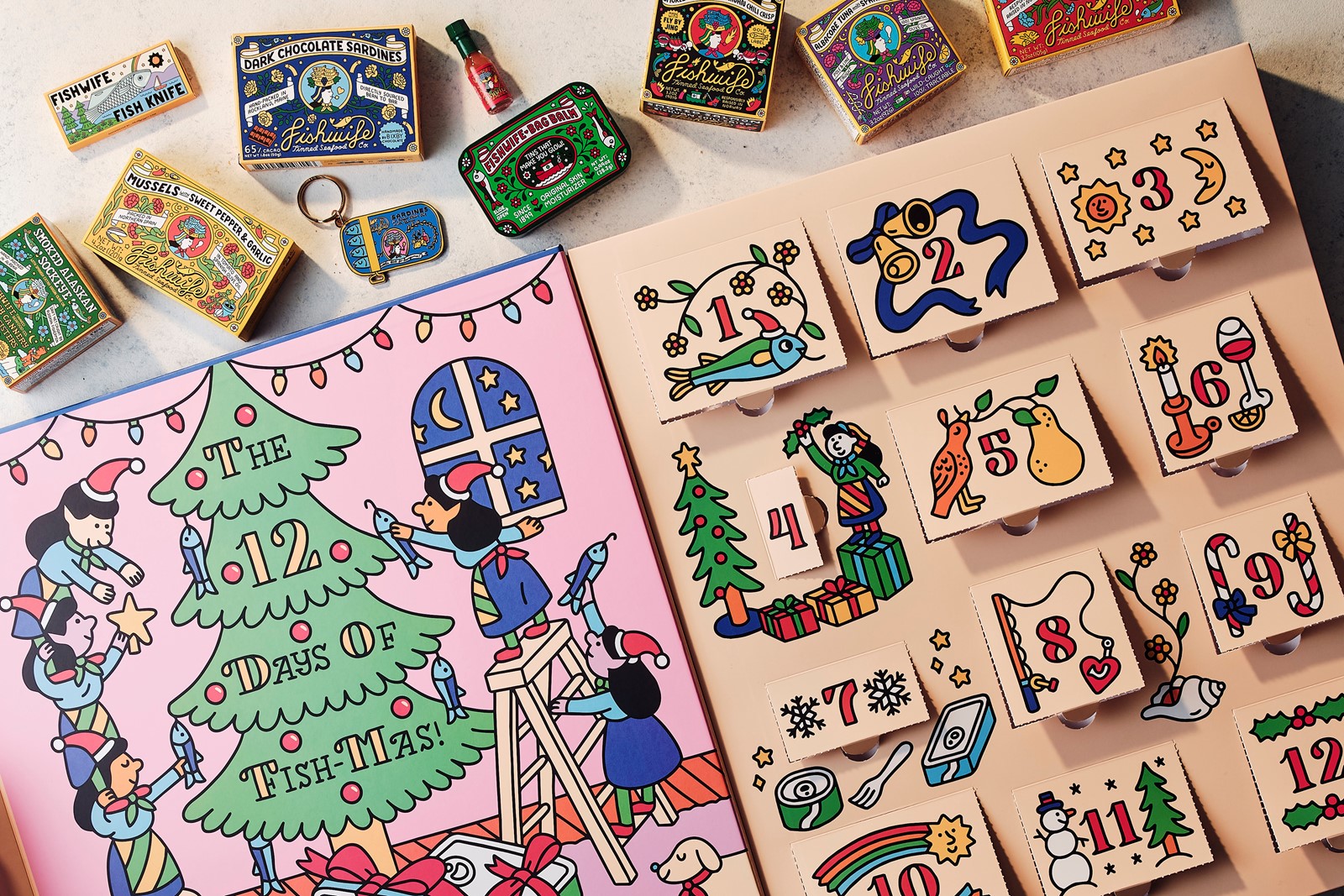
This year, Fishwife, the young firm whose brightly colored packages have turned tinned fish into objects of desire for shoppers with a keen eye for graphic design, introduced the 12 Days of Fishwife calendar. The package, which sells for $150, includes a fish knife, a micro-bottle of Tabasco with the Fishwife logo and, of course, tinned fish.
It may be that when modern children are nestled all snug in their beds, visions of canned sardines dance in their heads. But many of the newer Advent calendars are clearly aimed at adults.
The Mintel report notes “innovation in other categories,” such as the Good & Gather Holiday Espresso Countdown Calendar (24 days of espresso pods) and the Waterdrop hydration calendar (25 soluble cubes containing “natural extracts and vitamins that help you drink more water”).
Online retailer GiveThemBeer specializes in 12-day countdowns you probably shouldn’t give to anyone who still believes in Santa. An adult must sign for delivery of many of its products, which include a calendar for the hard-seltzer connoisseur on your list, one for tequila drinkers and another stocked with canned cocktails. GiveThemBeer also stuffs jerky and booze into a package explicitly for men, the ManVent Calendar, with “a different man approved find” behind each door.
If a man can enjoy a countdown to Christmas designed just for him, why not man’s best friend? The 12 Days of Woofmas promises to “keep your dog in the pawliday spirit” with seasonal, limited-edition treats and biscuits from Milk-Bone. Cats, notoriously prone to jealousy, can feel seen, too, with the freeze-dried salmon snacks in the feline Advent calendar from Trader Joe’s.
Few market niches have been overlooked by Big Advent. NOMO, a British company that makes chocolates without dairy, gluten or nuts, has introduced a calendar in Braille. Bee Well Bakery in Manorville, New York, makes a cookie calendar for snackers on a ketogenic diet and another for those in the paleo camp.
Raw meat, so popular with the paleo set, may well be Advent-resistant. But other perishable items find their way into calendars, often with storage instructions. Murray’s recommends that its 12-day cheese calendar go straight into the refrigerator, and Cowboy Creamery’s 24 Days of Ice Cream package, shipped with dry ice, should not be hung by the chimney.
 PREVIOUS ARTICLE

