




When it was announced that Sarah Burton was leaving Alexander McQueen, the house she had nurtured to new gorgeousness after the suicide of its founder, and would be replaced by an Irish designer named Seán McGirr, it set off a sort of tsunami of angst in the fashion world.
See, it turned out that with McGirr’s appointment, every designer in the stable of its owner, Kering, the second largest fashion conglomerate in the world, would be a white man. And it only got worse when, in quick succession, three more white men, all Italians, were named to the top jobs at Moschino, Tod’s and Rochas.
Where were the women (not to mention the designers of color), in an industry that largely caters to women? Weren’t we supposed to have moved beyond this?
And then, cue the corrective, which comes courtesy of the Metropolitan Museum of Art’s Costume Institute.
“Women Dressing Women,” running through March 3, is a celebration of work from the museum’s own collection by more than 70 female designers from the early 20th century to the present.
It is the first time the museum has held a survey dedicated solely to the work of women, and it will be the first time that at least half of the 83 pieces on display have ever been seen.
That makes the show a symptom of the problem (it’s kind of shocking to think that in the 85 years since the Costume Institute joined the Met no one has done this before, despite the complications of a show based on gender) and, perhaps, a signpost for a possible solution.
Indeed, rarely has an exhibition been more perfectly timed. Even if Mellissa Huber, the associate curator of the Costume Institute, who created the show along with Karen Van Godtsenhoven, the guest co-curator, did not intend it that way.
Intended to coincide with the 100th anniversary of women’s suffrage in the United States in 2020, “Women” was conceived in 2019 and postponed when COVID-19 lockdowns changed the exhibition schedule. That delay has recast the result in a way that makes it feel, ironically, even more politically relevant, not just because of developments in the fashion world, but because global events have renewed the debate over women’s bodies and who controls them.
The miracle is that Huber and Van Godtsenhoven have avoided polemics in favor of simply letting the work, in all its astounding variety and breadth of imagination, speak for itself. And it does.
In whispers and songs, silk faille and satin, cotton and wool, it re-imagines the record of fashion, filling in the gaps and wardrobes of history with names and pieces long, and wrongly, forgotten; elevating them, finally, to the pedestals on which they belong.
Literally: The show opens with two tall columns as you descend the steps to the Anna Wintour Costume Center.
Atop each column are pieces by the only two female designers to be granted solo shows at the Met: a draped white goddess evening gown from Madame Grès, whose retrospective finally took place in 1994 — despite the fact that former Costume Institute curator Diana Vreeland began advocating for it in 1980, according to Huber — and a black moth-eaten sweater and skirt from avant-gardist Rei Kawakubo, whose retrospective occurred in 2017.
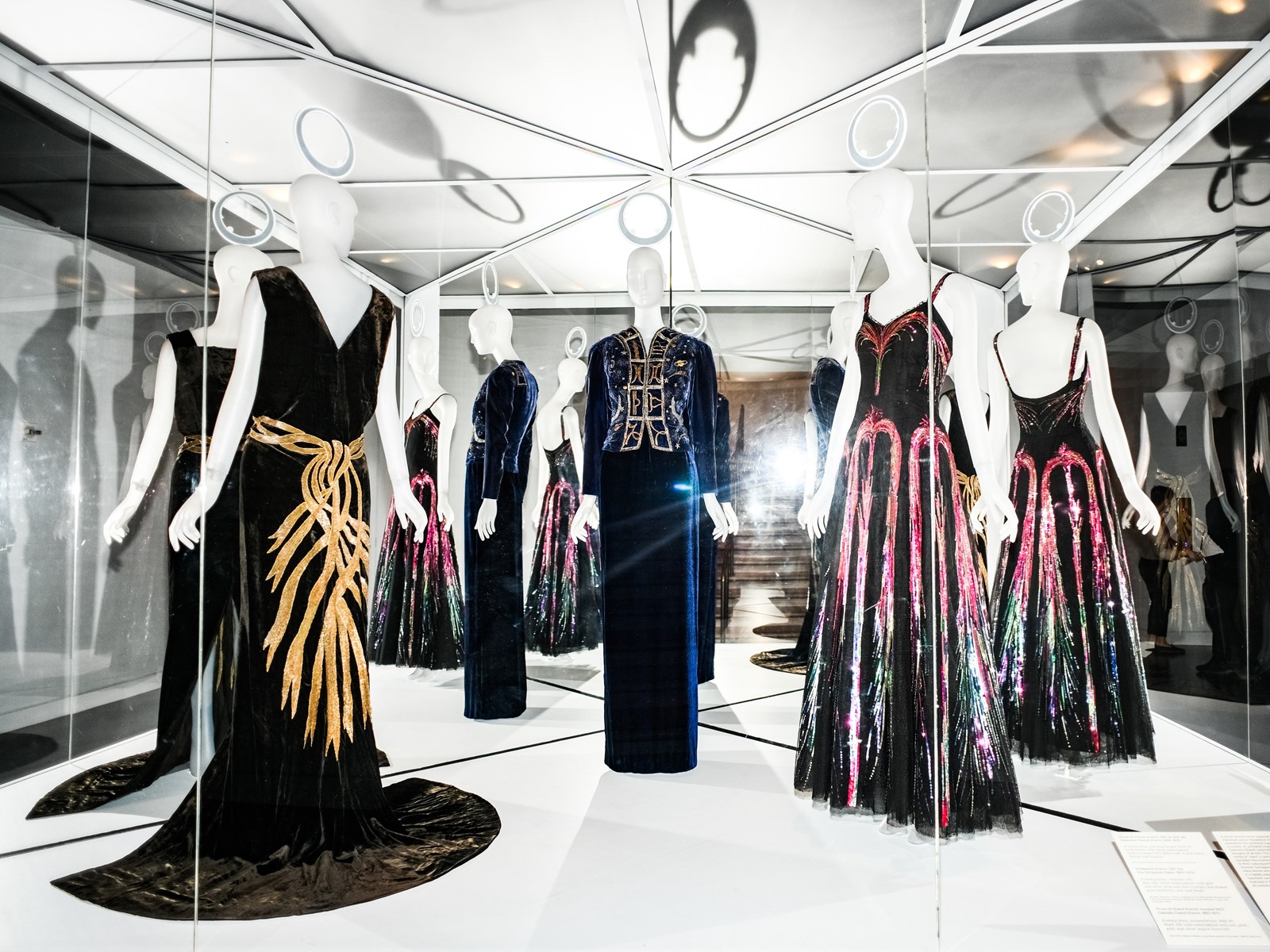
Meanwhile, what greets attendees when they reach the Costume Center itself is three sumptuous black gowns from the troika of fashion wise women: Coco Chanel (a “fireworks” tulle dress, glittering with sequined starbursts), Madeleine Vionnet (a dark brown velvet column with a gold beaded “ribbon” at the waist) and Elsa Schiaparelli (a midnight blue velvet embroidered evening jacket and skirt). Set in a mirrored triangle that refracts the work in an endless loop, this one-two opener drives home the point: Everywhere you look there are works by women at the top of their game.
That the message is conveyed so subtly is what gives the exhibit its power. This is a damning story, gently told. The revelations begin in the Carl and Iris Barrel Apfel Gallery, which focuses on that time, in the 1920s and ’30s, when female designers actually outnumbered men, and serves up introductions to many names that have been lost to history.
Premet, for example. What’s that? A French house led by a series of female designers, all of whom introduced iterations of the little black dress starting in 1923, a few years before Coco Chanel is credited with its invention. On view is one of their many LBDs, a graceful tiered number from 1929 by designer Charlotte Larrazet.
A video of seamstresses bent over their machines, reminder of all the anonymous women who found their livelihood in fashion, provides the bridge from these foundational creators to the world of ready-to-wear: a 360-degree vision housed in the Lizzie and Jonathan Tisch Gallery and anchored by an amethyst velvet Maria Monaci Gallenga gown from 1925 strewn with gold lotus blossoms. Previously attributed to Mariano Fortuny and in fragile condition, it has been repaired and is making its exhibition debut.
From there the show takes you on a whistle-stop tour through the kaleidoscope of female imagination contained in clothing.
The totality creates an unexpectedly emotional experience while refusing to cater to reductionist generalities about “female” design (or who gets to wear the clothes; one of the mannequins is male, a reminder that the show may be gendered, but reality is not necessarily).
Indeed, Van Godtsenhoven pointed out, an underlying theme here is that the axiom that female designers create clothes for life while male designers create clothes for fantasy is as much a canard as the fetishization of the male designer as a sacred monster or an impossible artist.
In other words, the breadth of the exhibit makes a potent argument that the idea that there are not enough women in fashion is misguided; that it is not really about a lack of female representation (or auteurship) but an institutional failure on all parts of the industry — brands, schools, museums, media — to recognize it, remember it and celebrate it.
“When we keep repeating the same names — Dior, Balenciaga — we create a canon and a history, and people start to drop off,” Van Godtsenhoven said. And then, “all of a sudden, all we are talking about are ‘masters’ and ‘fathers,’ ” rather than “mothers.”
 PREVIOUS ARTICLE

