


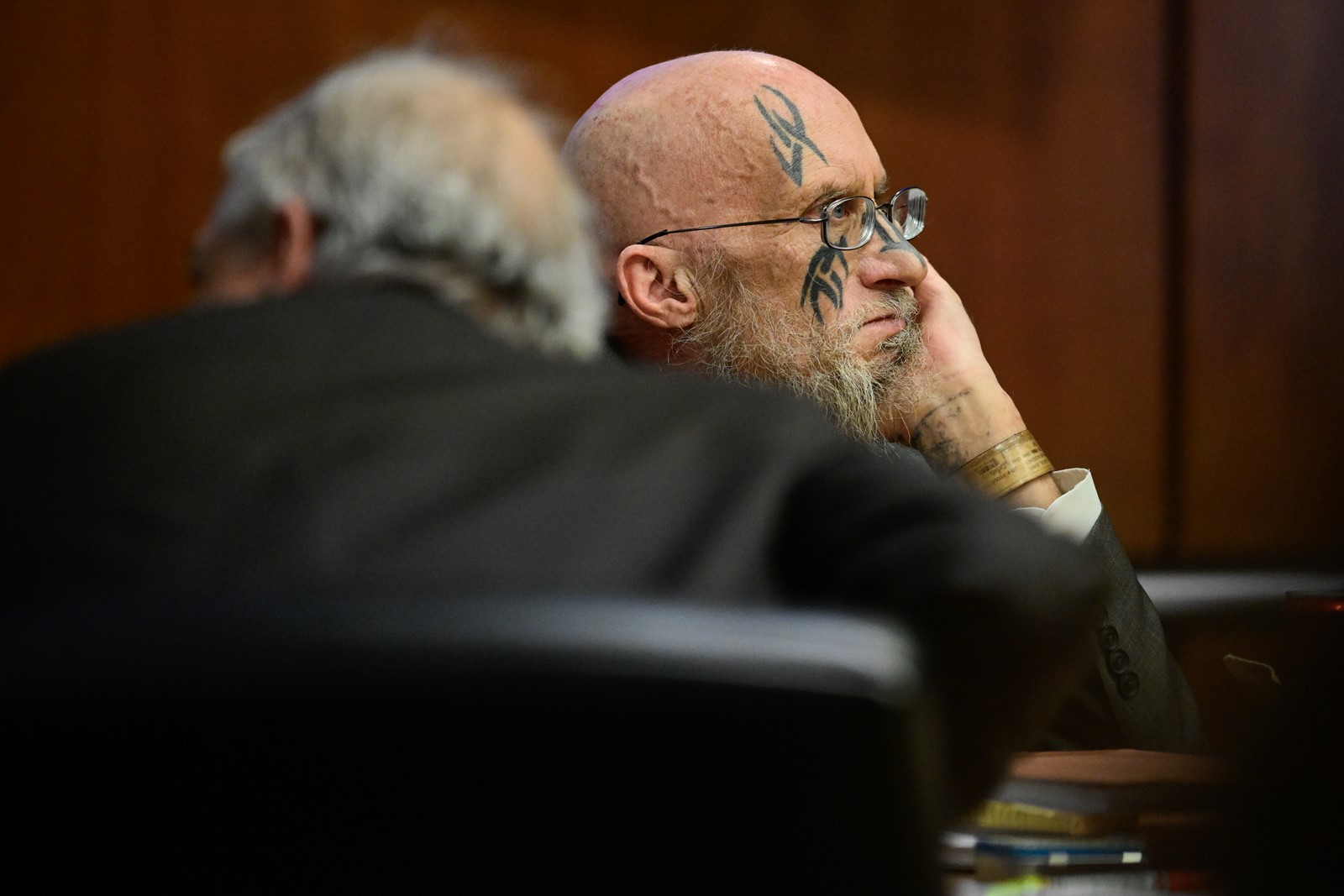


More than 19 years after 38-year-old Angela Wilds was found dead in the canyon southwest of Lyons, prosecutors and defense attorneys debated whether the available evidence was enough to convict an Alaska man during Monday’s opening statements.
John Angerer, 56, pleaded not guilty to one count of second-degree murder. Police say he killed 38-year-old Angela Wilds and left her body in South St. Vrain Canyon. Angerer was originally set for a November 2024 trial but was ordered to undergo a competency evaluation after Boulder District Judge Andrew Hartman ruled there was enough evidence that Angerer was incompetent to stand trial.
Angerer was first arrested in connection with Wilds’ murder in 2010 after a four-year investigation. A judge ruled then that there was not enough evidence to go to a trial.
Angerer was arrested again in March 2023 after prosecutors said they found new evidence in the case.
Nevene Hullender, a Boulder County Deputy District Attorney, made the case Monday that Angerer knew Wilds well, spent time with her, had sex with her and that his DNA was found where Wilds was buried.
“I am firmly convinced that when you consider the totality of the evidence in this case, you will find that John Angerer murdered Angela Wilds,” Hullender said.
Hullender walked the jury through the case from start to finish. She described how a pair of hikers found Wilds’ body decomposing, covered in dirt and quicklime near a trail in the canyon, leading to a years-long police investigation.
She also described Angerer’s interviews with police in Anchorage, Alaska. She said she will bring evidence tying Angerer to the items found at Wilds’ burial site. Hullender also said one forensic expert called Wilds’ death a homicide by asphyxiation, and that Angerer frequented the area where Wilds was later found.
“It was well known that Mr. Angerer was an avid hiker, hunter, camper, and he was known to frequent the South St. Vrain area, where Angie’s body was located,” Hullender said. “He was known to frequent the OUR Center, where Angela frequented.”
The OUR Center is a community resource center on Collyer Street in Longmont.
Among the evidence described, Hullender said a sleeping bag at the scene had Angerer’s DNA on it. She also said Angerer had fled to Alaska after Wilds’ death.
Hullender also shared some of Angerer’s statements to Alaska police, describing his answers as misleading or false.
“There’s a picture of Angerer doing Kung Fu in that exact area,” Hullender said of the canyon trail. “When asked, he said, ‘I don’t know any Angies or Angels in Colorado’ … And then he told detectives — contrary to what they already knew — that he did not spend much time in the South St. Vrain.”
The defense accused the prosecution of jumping to conclusions and unjustly believing that Angerer killed Wilds.
Julia Stancil, one of Angerer’s attorneys, said there are too many possibilities in the case and that too much information is unknown.
Stancil called the prosecution’s argument an assumption and hardly a conclusive depiction of what happened in 2006. She said Wilds was a transient who had poor health and suffered from addiction.
“She had a 90% clogged artery in her heart,” Stancil said. “It could have killed her at any moment.”
She also argued that it took years before the police started to think Angerer was involved in the case. In the three to four years before his arrest, nobody came forward to suggest police talk to Angerer, despite the prosecution’s statement that several people saw Angerer and Wilds together, Stancil said.
Stancil suggested Wilds’ burial site didn’t look like a grave dug by someone trying to hide the person they killed, but instead seemed to be rather obvious and could even have been done to bury her in a more proper way.
The evidence, Stancil said, does not lead to Angerer as Wilds’ killer; it leads to loose ends and more questions. Stancil said the one homicide determination may not be as critical as it sounds, and that Wilds was found without the appearance of injuries or having been harmed.
Stancil, calling the case a nightmare for Angerer because he has been under prosecution since his arrest in 2010, said the DNA evidence isn’t strong either. She said Angerer’s DNA could have gotten on the sleeping bag because OUR Center patrons shared items like sleeping bags when they left the center.
“These items were shared,” Stancil said. “This sleeping bag had at least four male DNA samples.”
Stancil closed by calling the prosecution’s arguments flimsy.
“Put the prosecution’s evidence to the test,” Stancil asked of the jury. “Best guess is the best you’re going to get. There are going to be holes. There are going to be doubts.”
According to an arrest affidavit, hikers found a badly decomposed body on June 4, 2006, in South St. Vrain Canyon. The body appeared to have been dragged from a nearby shallow grave by a large predator, and deputies located a pair of yellow ski pants, the sleeping bag and a pillow in a pillowcase, all neatly folded up near the gravesite.
Investigators couldn’t identify the body or determine the cause or manner of death because it had decomposed. It wasn’t until later that fall, when one of Wilds’ friends reported her missing, and detectives matched Wilds’ DNA to the body’s.
Some friends saw Wilds hugging and kissing Angerer at a barbecue in Longmont in early 2006, the affidavit states. Wilds, who was homeless, disappeared after that, according to the affidavit.
DNA also showed Angerer had sex with Wilds, even though he denied to police that he knew her, investigators said.
DNA samples from items near where the body was found were uploaded into a national database that cross-checks crime scene evidence with convicted criminals, and in early 2009, a couple of samples matched genetic material from Angerer.
Angerer was originally arrested in February 2010 on a probation violation charge in Alaska. He was extradited to Colorado.
He has a lengthy criminal history in Colorado and Alaska, including disorderly conduct, resisting or obstructing a police officer, burglary, driving under the influence, trespassing, arson, assault and menacing.
The trial is expected to last about two and a half weeks.
 PREVIOUS ARTICLE
