


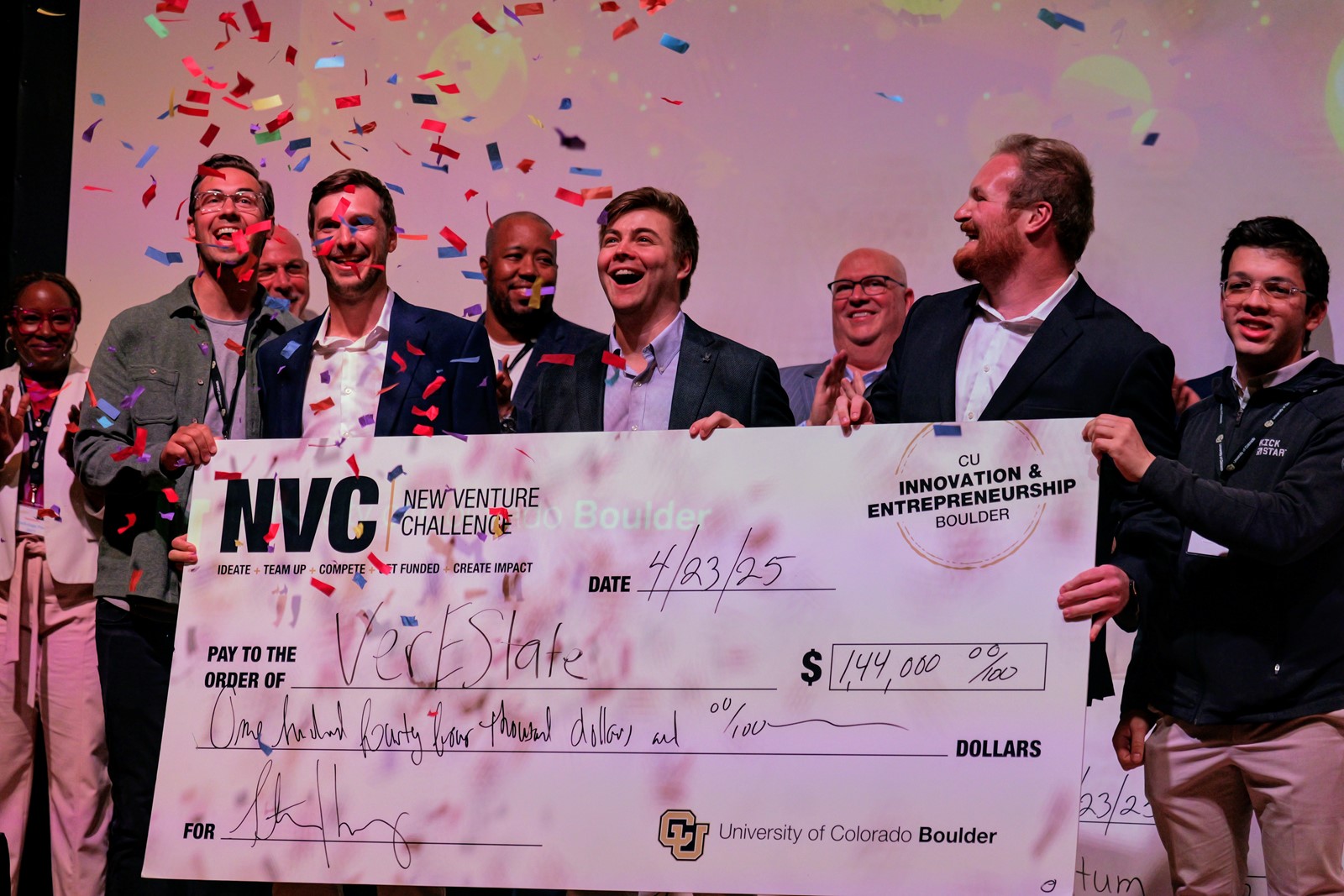


Two teams, one led by students and one by University of Colorado Boulder alumni, won first place in a startup competition on April 23, earning $144,000 each to realize two separate business ideas — one that could modernize the title insurance industry, the other that could improve GPS reliability and accuracy.
The CU Boulder competition, called the New Venture Challenge, allows teams to pitch their business startup ideas to a panel of judges for prize money to fund their ventures. The challenge also connects the teams with mentors and investors from the Boulder community.
For the first time, the New Venture Challenge opened up for competition in two categories instead of one.
The categories were “deep tech” and “open.” The winner in the open category is VerEstate, a student-led startup that aims to become a new title insurance carrier that uses artificial intelligence, or AI, to modernize the industry. The deep tech category was won by the alumni-led PrecisionTerra, which aims to improve GPS reliability and accuracy.“I think what’s cool is that CU Boulder is one of the top universities in the country for innovation and entrepreneurship, and those two companies, as well as the other companies that were competing, were really emblematic of that,” said Stanley Hickory, New Venture Challenge director. “The level of competition and the level of the companies coming out of the NVC this year was far superior to many that we’ve had in the past.”
Senior Camden Dempsey is part of the VerEstate team, which aims to revolutionize the title insurance industry by using AI to make the process more efficient and streamlined. If a problem were to arise in the ownership records of a property, a title insurance agreement ensures that the insurer will fix the problem or compensate for any losses.
Dempsey said many issues in title insurance come from human error, whether that be missing details or not having enough data. AI can eliminate human error and improve the entire process. He said the team hopes by next year they’ll be able to start issuing premiums, starting with residential homes in Boulder and in Colorado.
“We’re so thankful to be in a community that’s so dedicated toward taking risks, toward building things, toward really working on making the world around you better,” Dempsey said. “That’s something that CU has always done a really good job at, and I think we’re definitely benefitting from that.”
Matt Smith, a principal on the investment team of the company Kickstart, helped select VerEstate as the winner of the open competition category.
“In my opinion, it was the one (startup) of the competition that had the biggest upside,” Smith said. “It’s a big bet, it’s a big vision. And that’s what gets us excited, that’s the kind of stuff we like to invest in.”
“If it works, they could be a really big business,” Smith said.
Senior Nicholas Soza was thrilled when his team was announced as the first-place winner.
“I just couldn’t believe it. I couldn’t believe it at all,” Soza said. “We knew we put the work in, we knew we tried our best, and we had this focus … and the support was amazing. We put that expectation on us that we had to come in and win, and now it’s time to settle down and actually start thinking about getting this started once we graduate.”
PrecisionTerra was represented in the deep tech competition by CU Boulder alum, founder and CEO Maithreyi Gopalakrishnan. The technology is a type of software to improve GPS signal processing. Gopalakrishnan plans to partner with GPS receiver manufacturers so they can deploy the software with their hardware to improve accuracy.
“It’s essentially a new way of processing GPS signals so that GPS receivers are more resilient in places where you can imagine GPS has trouble,” Gopalakrishnan said.
With the prize money, the PrecisionTerra team plans to hire people full-time to advance product development.
“I’m thrilled,” Gopalakrishnan said. “I love the Boulder entrepreneurial community, and I love the venture partners organization that helped me start this company, and this is a testament to the strength of that community.”
The New Venture Challenge included 264 participants and 104 ventures in 2025. In its 18 years, the program has supported 1,280 ventures, with $1,772,600 in funding.
“As people recognize the university as one of the top for innovation and entrepreneurship, they’re starting to see that what’s happening on campus can have an impact on the world, and that’s really what the New Venture Challenge is,” Hickory said. “It’s this launchpad for aspiring entrepreneurs to take ideas and turn them into startups.”
 PREVIOUS ARTICLE

