


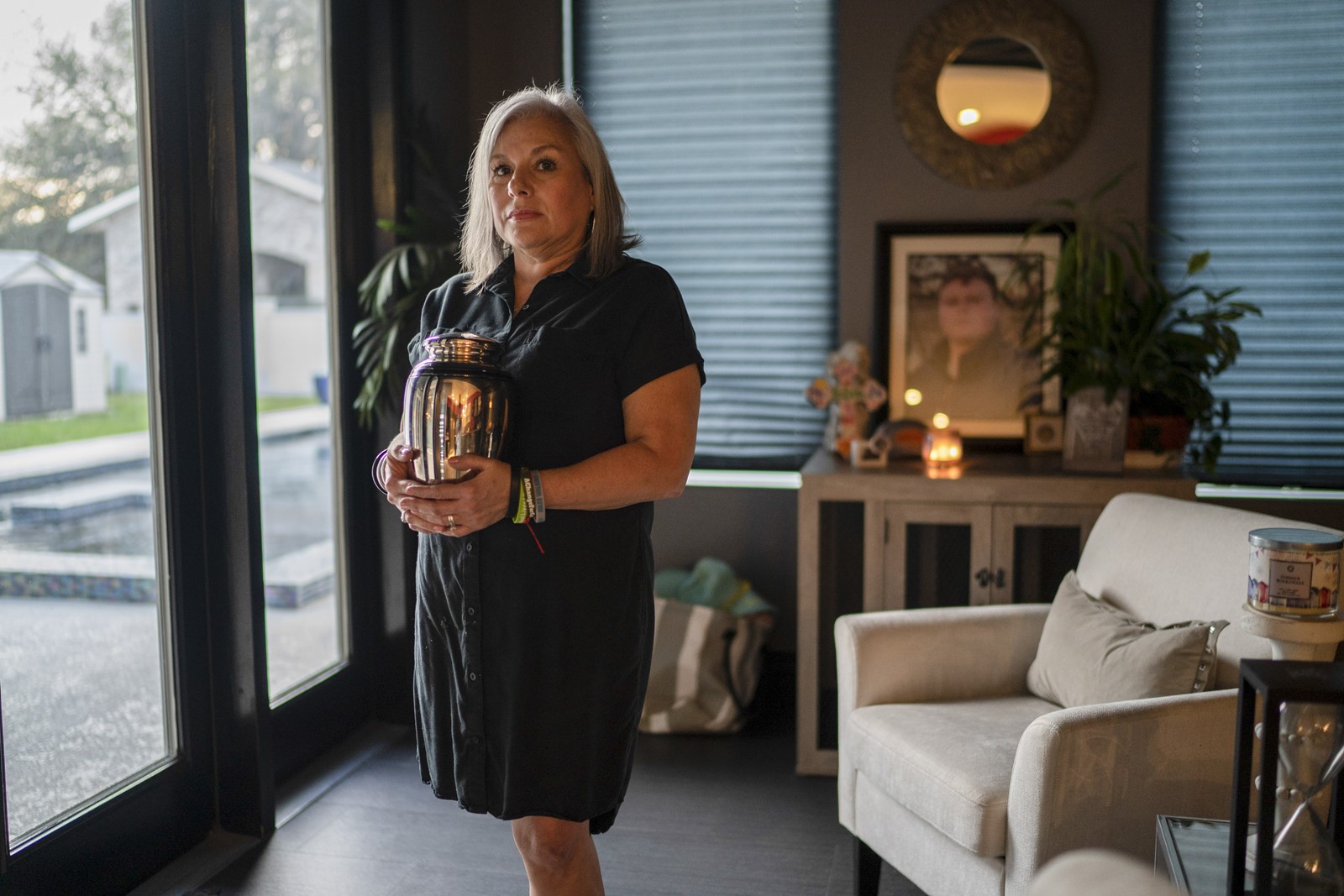


The death certificate for Ryan Bagwell, a 19-year-old from Mission, Texas, states that he died of a fentanyl overdose.
His mother, Sandra Bagwell, says that is wrong.
On an April night in 2022, he swallowed one pill from a bottle of Percocet, a prescription painkiller that he and a friend bought earlier that day at a Mexican pharmacy just over the border. The next morning, his mother found him dead in his bedroom.
A federal law enforcement lab found that none of the pills from the bottle tested positive for Percocet. But they all tested positive for lethal quantities of fentanyl.
“Ryan was poisoned,” said his mother, an elementary-school reading specialist.
As millions of fentanyl- tainted pills inundate the United States masquerading as common medications, grief-scarred families have been pressing for a change in the language used to describe drug deaths. They want public health leaders, prosecutors and politicians to use “poisoning” instead of “overdose.” In their view, “overdose” suggests that their loved ones were addicted and responsible for their own deaths, whereas “poisoning” shows they were victims.
“If I tell someone that my child overdosed, they assume he was a junkie strung out on drugs,” said Stefanie Turner, a co-founder of Texas Against Fentanyl, a nonprofit organization that successfully lobbied Gov. Greg Abbott to authorize statewide awareness campaigns about fentanyl poisoning.
“If I tell you my child was poisoned by fentanyl, you’re like, ‘What happened?’ ” she said. “It keeps the door open. But ‘overdose’ is a closed door.”
For decades, “overdose” has been used by federal, state and local health and law enforcement agencies to record drug fatalities. It has permeated the vocabulary of news reports and even popular culture.
But over the past two years, family groups have challenged its reflexive use.
They are having some success.
In September, Texas began requiring death certificates to say “poisoning” or “toxicity” rather than “overdose” if fentanyl was the leading cause. Legislation has been introduced in Ohio and Illinois for a similar change. A proposed Tennessee bill says that if fentanyl is implicated in a death, the cause “must be listed as accidental fentanyl poisoning,” not overdose.
Meetings with family groups helped persuade Anne Milgram, administrator of the Drug Enforcement Administration, which seized more than 78 million fake pills in 2023, to routinely use “fentanyl poisoning” in interviews and at congressional hearings.
In a hearing last spring, Rep. Mike Garcia, R-Calif., commended Milgram’s word choice, saying, “You’ve done an excellent job of calling these ‘poisonings.’ These are not overdoses. The victims don’t know they’re taking fentanyl in many cases. They think they’re taking Xanax, Vicodin, OxyContin.”
“Language is really important because it shapes policy and other responses,” said Leo Beletsky, an expert on drug policy enforcement at Northeastern University School of Law. In the increasingly politicized realm of public health, word choice has become imbued with ever-greater messaging power. During the pandemic, for example, the label “anti-vaxxer” fell into disrepute and was replaced by the more inclusive “vaccine-hesitant.”
Addiction is an area undergoing convulsive language change, and words such as “alcoholic” and “addict” are now often seen as reductive and stigmatizing. Research shows that terms such as “substance abuser” can even influence the behavior of doctors and other health care workers toward patients.
The word “poison” has emotional force, carrying reverberations from the Bible and classic fairy tales. “ ‘Poisoning’ feeds into that victim-villain narrative that some people are looking for,” said Sheila Vakharia, a senior researcher at the Drug Policy Alliance, an advocacy group.
But although “poisoning” offers many families a buffer from stigma, others whose loved ones died from taking illegal street drugs find it problematic. Using “poisoning” to distinguish certain deaths while letting others be labeled “overdose” creates a judgmental hierarchy of drug-related fatalities, they say.
Fay Martin said her son, Ryan, a commercial electrician, was prescribed opioid painkillers for a work injury. When he grew dependent on them, a doctor cut off his prescription. Ryan turned to heroin. Eventually, he went into treatment and stayed sober for a time.
But, ashamed of his history of addiction, he kept to himself and gradually began to use drugs again. Believing that he was buying Xanax, he died from taking a fentanyl-tainted pill in 2021, the day after his 29th birthday.
Although he, like thousands of victims, died from a counterfeit pill, his mourning mother feels as if others look at her askance.
“When my son died, I felt that stigma from people, that there was personal responsibility involved because he had been using illicit drugs,” said Martin, who lives in Corpus Christi, Texas. “But he didn’t get what he bargained for. He didn’t ask for the amount of fentanyl that was in his system. He wasn’t trying to die. He was trying to get high.”
To a growing number of prosecutors, if someone was poisoned by fentanyl, then the person who sold the drug was a poisoner — someone who knew or should have known that fentanyl could be lethal. More states are passing fentanyl homicide laws.
Critics note that the idea of a poisoner-villain doesn’t account for the complications of drug use.
“That’s a little too simplified because a lot of people who sell substances or share them with friends are also in the throes of a substance use disorder,” said Rachael Cooper, who directs an anti-stigma initiative at Shatterproof, an advocacy group.
People who sell or share drugs are usually many steps removed from those who mixed the batches. They would probably be unaware that their drugs contained deadly quantities of fentanyl, Cooper said.
News outlets occasionally use both phrases, reporting that an overdose took place due to fentanyl poisoning.
Addiction medicine experts note that because most of the street drug supply is now adulterated, “poisoning” is, indeed, the most straightforward, accurate term. Patients who buy cocaine and methamphetamine die because of fentanyl in the product, they note. Those addicted to fentanyl succumb from bags that have more toxic mixtures than they had anticipated.
Martin, whose son was killed by fentanyl, bitterly agrees.
“He was poisoned,” she said. “He got the death penalty, and his family got a life sentence.”
 PREVIOUS ARTICLE

