


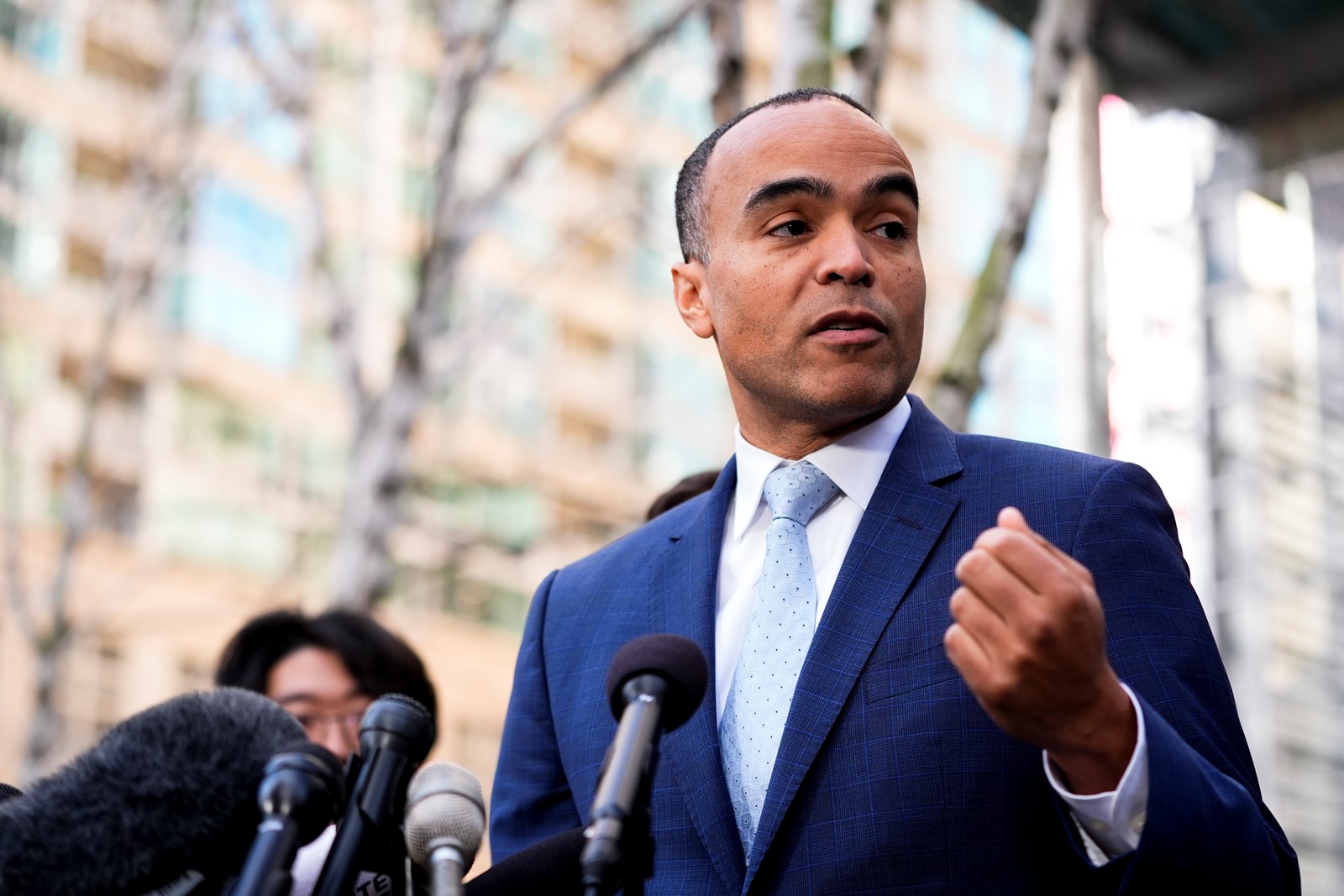


A federal judge Thursday temporarily blocked President Donald Trump’s executive order to end automatic citizenship for babies born on U.S. soil, dealing the president his first setback as he attempts to upend the nation’s immigration laws and reverse decades of precedent.
In a hearing held three days after Trump issued his executive order, U.S. District Court judge John C. Coughenour sided with Washington, Arizona, Illinois and Oregon, the four states that sued, signing a restraining order that blocks Trump’s executive order for 14 days, renewable upon expiration. “This is a blatantly unconstitutional order,” he said.
“Frankly,” he continued, challenging Trump administration lawyers, “I have difficulty understanding how a member of the bar would state unequivocally that this is a constitutional order. It just boggles my mind.”
Trump’s order, one of several issued in the opening hours of his presidency to curtail immigration, both legal and illegal, declared that children born in the United States to immigrants living in the country without legal permission after Feb. 19 would no longer be treated as citizens. The order also extends to babies born to mothers who are in the country legally but temporarily, such as tourists, university students or temporary workers, if the father is a noncitizen.
In response, 22 states, along with activist groups and expectant mothers, filed six lawsuits to halt the executive order, arguing that it violates the 14th Amendment. Legal precedent has long interpreted the amendment — that “all persons born or naturalized in the United States, and subject to the jurisdiction thereof, are citizens of the United States” — applies to every baby born in the United States, with a few limited exceptions: children of accredited foreign diplomats, children born to noncitizens on U.S. territory occupied by an invading army and (for a time) children born to Native Americans on reservations.
The courts have never recognized the constitutional legitimacy of further limitations on birthright citizenship, and Coughenour of the U.S. District Court for the Western District of Washington did not appear eager to break with that pattern Thursday.
Coughenour’s order marks the beginning of what will almost certainly be a long battle between the new administration and the courts over Trump’s ambitious second-term agenda, which seeks to transform American institutions in ways that could be interpreted as running afoul of law and precedent. Other orders, including attempts to strip job protections from career federal employees and accelerate deportations, are also facing court challenges.
Brett Shumate, a lawyer for the federal government, said the administration’s order on birthright citizenship was “absolutely” constitutional. He argued on behalf of the Trump administration that immigrants living in the country without legal permission “remain subject to a foreign power” and therefore “have no allegiance to the United States.” Nor, the government argued in a filing, would their U.S.-born children.
After the ruling, a Justice Department spokesperson promised that the department “will vigorously defend” Trump’s executive order on birthright citizenship, before the courts and “the American people, who are desperate to see our nation’s laws enforced.”
The 14th Amendment refers to people being born in the United States and “subject to the jurisdiction thereof.” The judge asked the government whether children born to immigrants living in the country illegally who committed a crime would be subject to U.S. law. Shumate responded that they would be “subject to the jurisdiction with respect to the laws of this country but not with respect to the citizenship clause of the 14th Amendment.”
“Citizenship is different,” he said.
To that, Coughenour’s decision was emphatic: “I’ve been on the bench for over four decades,” he said. “This is a blatantly unconstitutional order. Where were the lawyers when this decision was being made?”
White House officials did not respond to a request for comment.
In the case before Coughenour, who was nominated to the bench by President Ronald Reagan, the four state attorneys general argued that Trump’s order would deny rights and benefits to more than 150,000 children born each year and leave some of them stateless. States would also lose federal funding for various assistance programs.
The states’ 32-page complaint cited testimony from then-Assistant Attorney General Walter Dellinger. In 1995, Dellinger told Congress that a law limiting birthright citizenship would be “unconstitutional on its face” and that even a constitutional amendment would “flatly contradict the nation’s constitutional history and constitutional traditions.”
A separate federal lawsuit challenging the executive order filed by 18 other states and two cities is being considered by a court in Massachusetts. Four other lawsuits by activists and pregnant mothers have been filed in the district courts of Maryland, Massachusetts and New Hampshire, as well as the Central District of California.
 PREVIOUS ARTICLE
