


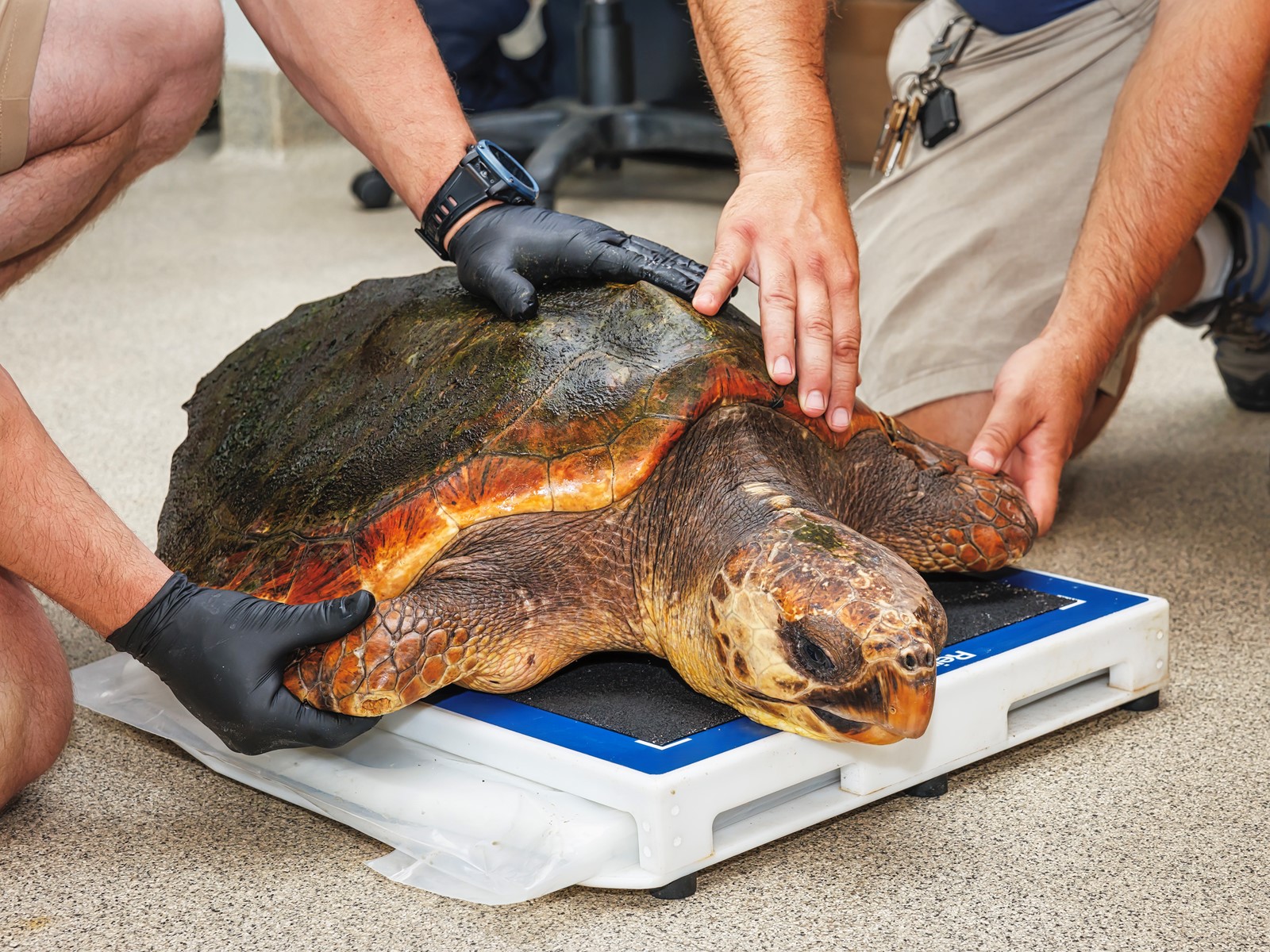


Staff at the Aquarium of the Pacific are rehabilitating a 50-pound loggerhead sea turtle that was recently rescued — with hopes of eventually returning it to the wild.
The turtle, estimated to be anywhere from 10 to 15 years old, was found near Avila Beach in San Luis Obispo County with various ailments.
It was transferred to the Aquarium of the Pacific, according to a recent news release, with authorization from the National Oceanic and Atmospheric Administration’s (NOAA) Fisheries office because the Long Beach facility has expertise in treating and re-releasing injured sea turtles back into the wild.
“Upon arrival, this sea turtle was hypothermic, in poor body condition with flipper wounds and eye ulcers, and dehydrated,” the aquarium’s veterinarian, Brittany Stevens, said in a news release. “We also took X-rays that showed that the turtle had a mild pneumonia.”Aquarium staffers got to work quickly after the turtle arrived in Long Beach. They slowly brought the creature’s temperature back to a normal level, and treated the turtle’s conditions with antibiotics, fluids, eye ointment and wound care.
“We have been giving the sea turtle a daily diet of mixed restaurant-quality seafood,” Stacy Hammond, Aquarium of the Pacific aquarist, said, “to help improve its strength and restore it to a healthy body condition.”
The hope is to release the loggerhead sea turtle back into the wild — which the aquarium has done for various turtle species since 2000.
The last rescued loggerhead sea turtle to come through Long Beach was rehabbed and released in November 2015, the aquarium said. More recently, the aquarium cared for and released a green sea turtle in May.
Loggerhead sea turtles have a wide habitat range. They can be found in oceans around the world, according to NOAA, with nine distinct population segments.
All loggerheads, though, are currently listed as threatened or endangered and are protected by the Endangered Species Act.
Their populations across the world face numerous threats, including their unintended capture in fishing gear, habitat loss, boat strikes near developed coastlines, poaching for human consumption, ocean pollution and climate change, NOAA said.
The loggerheads — which are named for their large heads and powerful jaws, which allow them to prey on hard-shelled sea creatures — can live up to 80 years or longer, according to NOAA, though their exact lifespan is unknown.
 PREVIOUS ARTICLE

