


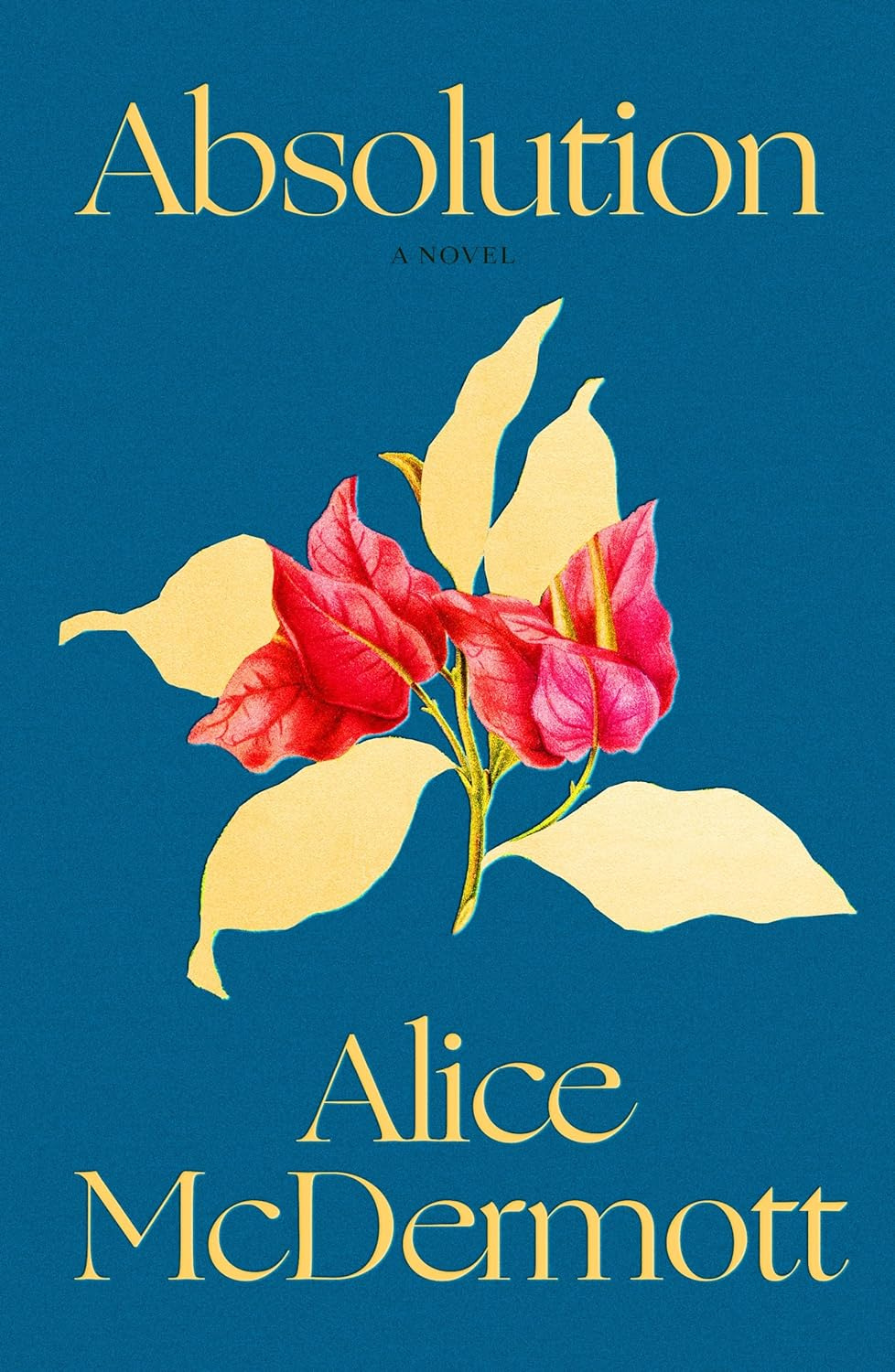


Alice McDermott is rightly celebrated for her granular, nuanced portraits of mid-20th-century life, with a particular focus on Irish Americans. Her fans may be startled, then, to find themselves plunged into 1963 Saigon at the start of her enveloping new novel, “Absolution,” whose lofty title belies its sensory, gritty humanity.
McDermott’s contextual leap is not as great as it might seem. The primary narrator of “Absolution,” Patricia Kelly, and her husband, Peter, a Navy intelligence officer, are Irish American New Yorkers who might easily be part of the same family tree as Billy Lynch from McDermott’s 1998 National Book Award winner, “Charming Billy”; Marie from “Someone”; the Daileys from “At Weddings and Wakes”; or the Keanes from “After This,” my personal favorite. Indeed, Peter Kelly’s sense of mission in Vietnam is bound up with his Catholicism; President Kennedy, a Catholic, initially supported the Catholic president of South Vietnam, Ngo Dinh Diem, in part through the efforts of a Central Intelligence Agency that was jokingly referred to as the “Catholic Intelligence Agency.”
Although she opens with an epigraph from “The Quiet American,” Graham Greene’s 1955 indictment of catastrophic American blundering in post-colonial Vietnam, McDermott asserts her revisionist focus in the novel’s third sentence: “You have no idea what it was like. For us. The women, I mean. The wives.” She then delves into the lives and activities of the blunderers’ wives during the last era in American life in which being a husband’s “helpmeet” was widely seen as a worthy fulfillment of feminine ambition.
Shortly after their arrival in Saigon, shy, 23-year-old Patricia, newly wed and in awe of Peter, meets Charlene, a WASP who is rich, potty-mouthed, pill-popping and lawbreaking — all things Patricia decidedly is not. A bossy insider and mother of three, Charlene masterminds a “cabal” of charitable military-industrial wives bent on helping poor and ailing Vietnamese. Their work consists of channeling black-market profits into buying trinkets and candy to distribute to hospitalized children (some of whom may be recovering from war wounds) and their impoverished families.
In passive Patricia (whom she immediately nicknames Tricia), the aggressive, polarizing Charlene finds a perfect foil for her escalating charitable schemes. Their alliance — more than a partnership and less than a friendship — results, first, in the marketing of “Saigon Barbies” outfitted in Vietnamese attire, and later, in orchestrating the tailoring of exquisite outfits for residents of a leper colony.
Patricia immediately recognizes Charlene as a type — rich and entitled — yet acknowledges, “It was another inborn talent of these privileged girls; they were irresistible, much as you hated them.” Charlene’s magnetism pulls in the reader thanks to McDermott’s eye for the contradictions and complexities that elevate anyone, living or literary, from a generic type (always a measure of our distance from them) into a specific individual. Though brimming with self-regard, Charlene also bites her nails to nubs and is plagued by night terrors. When Patricia, who is desperate for a child, miscarries, Charlene baptizes the embryo and ritualizes the loss in a way that honors its magnitude. Her wish to “do good,” dismissed by the men around her as the irrelevant scurrying of a “dynamo,” is genuine, even spiritual. Of her night terrors, Charlene says: “They’re telling me something. About myself, I suppose. I mean to see what I was meant to see.”
The story is told in retrospect, from a distance of decades, in the form of letters between an older, widowed Patricia and Charlene’s daughter, Rainey, long after Charlene’s early death. Retrospect amplifies McDermott’s narrative approach; her work lives in its shimmering details (she’s especially good with smells and descriptions of light), and nostalgia imbues even simple observations with suggestiveness. When Patricia arrives at Charlene’s home for lunch, “the ladies were drinking manhattans. I’d never had one would have preferred something cool and bubbly — maybe a tall Coke. Although the amber liquid in the small triangular glass looked elegant. The shadowy cherry.”
The shift in time allows Patricia to comment upon her young self, and the events of 1963, from a salty perspective informed by disillusioning history. At the luncheon, after detailing her husband’s meteoric rise, Patricia reflects: “I told Peter’s story, which was my own, and felt, what else to call it but patriotic pride. Saw that the three women felt it, too. Bright young men and their pretty little wives rising, rising, immigrant roots and working-class backgrounds be damned. Spine-straightening, tear-inducing, vaguely orgasmic — the manhattan had its effect (I hope you’re laughing) — patriotic pride in an American romance. God, what a country.”
The debacle of America’s involvement in Vietnam might easily have overdetermined McDermott’s story, and it is a measure of her skill that “Absolution” maintains an oblique relationship to the war. McDermott’s subject is not intervention per se but the altruistic impulse — particularly as practiced by those whose privilege lets them anoint themselves to heal what Charlene calls Vietnam’s “wretchedness.” She’s one of many characters who are trying to “do good,” and they range from the greedy and presumptuous to the genuinely selfless.
 PREVIOUS ARTICLE
