




More than a century ago as Americans fought overseas in World War I, their families would display a flag with a blue star for each active service member. It was a sad day for the entire community if the blue star was changed to a gold star, because that person had died.
That tradition continues as National Gold Star Mother’s and Family’s Day is marked on the last Sunday in September. On this day, those whose loved ones died during or as a result of active service in the U.S. Armed Forces receive special recognition.
Most of the current Gold Star designations result from the wars in Afghanistan (2001-2021) and Iraq (2003-2011), which together claimed over 6,000 U.S. military lives.
Many Gold Star family members find solace by bonding with other Gold Star families. About 1,000 women now are members of the nonprofit membership organization American Gold Star Mothers, founded in 1928.
Denise Williams, president of the Illinois Department of AGSM, said the camaraderie with other Gold Star mothers is what first draws women to the group. Williams lost her son, Army Pfc. Andrew Meari, 21, in 2010 in Afghanistan.
“There is an impossible mixture of pain and pride in our existence. We really benefit by being around others who understand. There is an unspoken bond among us,” Williams said.
The group’s service component is central to helping families through the grieving process, she said.
“We give our hearts the opportunity to heal by finding a purpose in helping others,” said Williams, who also serves on the Will County Veterans Assistance Commission.
After her son was killed, Williams turned to writing, and after five years decided to return
to school. She is finishing up her final internship for a clinical psychology degree with a specialty in trauma and a target population of military personnel, veterans, and first responders.
Other mothers, who have all become friends through AGSM, agree with Williams and have forged their own paths.
Modwene “Modie” Lavin lost her son, Marine Cpl. Conner T. Lowry, 24, in 2012, also in Afghanistan.
“I really needed to be around others who were in my shoes, it was that simple,” said Lavin, of West Beverly. “Joining AGSM changed my life, giving me the strength to carry on and get involved.”
Lavin works as the senior family outreach coordinator with the Road Home Program of Rush health system, which provides mental health care to service people, veterans and their families. She helps “survivors suffering from the invisible wounds of war — depression, grief, anxiety.”
Christine Hotchkin, a schoolteacher in Willowbrook, lost her son, Army Pfc. Gunnar Hotchkin, 31, in 2010 in Afghanistan. He left a wife and three children.
“AGSM is incredibly important to me. It’s a huge comfort that these people understand where I am coming from,” said Hotchkin.
Hotchkin’s priority is her son’s family. She also sends care packages to troops stationed overseas and works with several nonmilitary groups.
The Obama Legacy Initiative, which provides food for struggling people across the country, honored Hotchkin, her son, and the family for Memorial Day by installing a raised garden bed in his name at the Woodridge Village Hall Plaza.
Jean Harris shared the perspective of a stepmother who lost her stepson, Illinois Army National Guard Sgt. Joshua William Harris, 21, in Afghanistan in 2008.
“I’m proud to represent the stepparents who ‘step up to the plate.’ It is my honor to give back not just to Gold Star families but to Joshua’s brothers and sisters (in the military),” she said.
One of her stepson’s duties in the Illinois National Guard was to perform military honors at funerals. Now Harris has taken on the role of facilitating military funeral honors and other services as the survivor outreach services coordinator at Strategic Resources, Inc., for the Army in Northern Illinois.
These Gold Star mothers admit to “feeling conflicted” about the withdrawal of troops from Afghanistan. The deaths of the 13 U.S. military personnel there, and the five Navy sailors near California just days later, sent waves of concern through the Gold Star community.
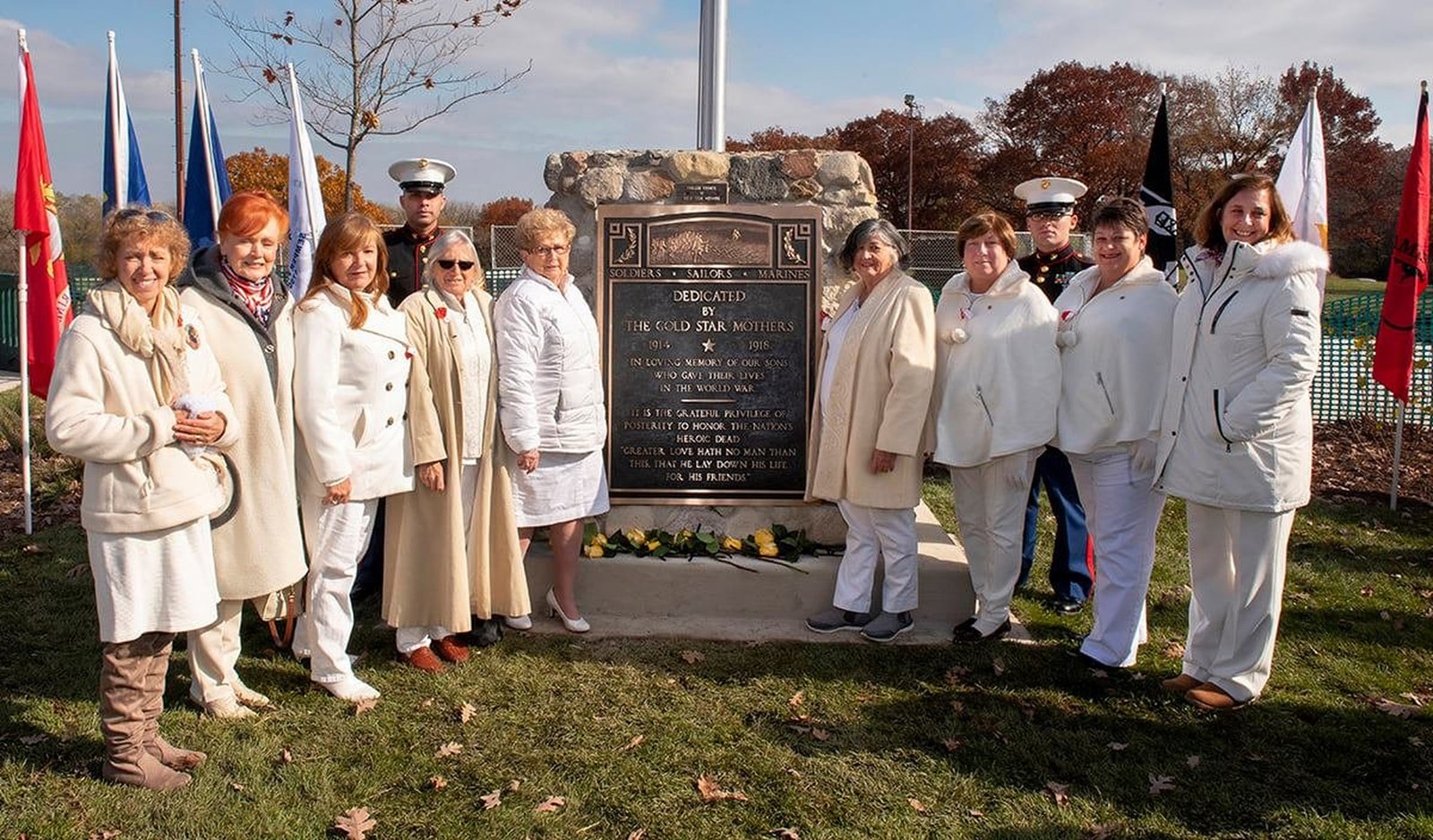
Reaching out to these new Gold Star families, AGSM members will be a presence at many of the funeral services in their “uniforms” of white street clothes, chosen instead of black mourning garb to keep alive the memory and contributions of their children. They also wear Gold Star lapel buttons given by the government to Gold Star family members since shortly after World War II.
Gold Star Mother’s Day is the one day of the year these women allow themselves some recognition and “pampering,” according to Lavin. While the luncheon usually put on by the Illinois Department of Veterans Affairs has been canceled for two years because of the COVID-19 pandemic, last year an AGSM group instead visited the Gold Star Mothers monument in Dan Ryan Woods, which dates to World War I and was restored and rededicated in 2018. This visit honored the many women who went before.
“It’s been a journey,” said Lavin, summing up her own growth and that of the Gold Star movement.
These women deserve recognition, not for losing their children, but for channeling their grief into good works for others.
“These are the most remarkable and strongest women I ever met,” Williams said.
Carol Flynn is a freelance reporter for the Daily Southtown.
 PREVIOUS ARTICLE
