


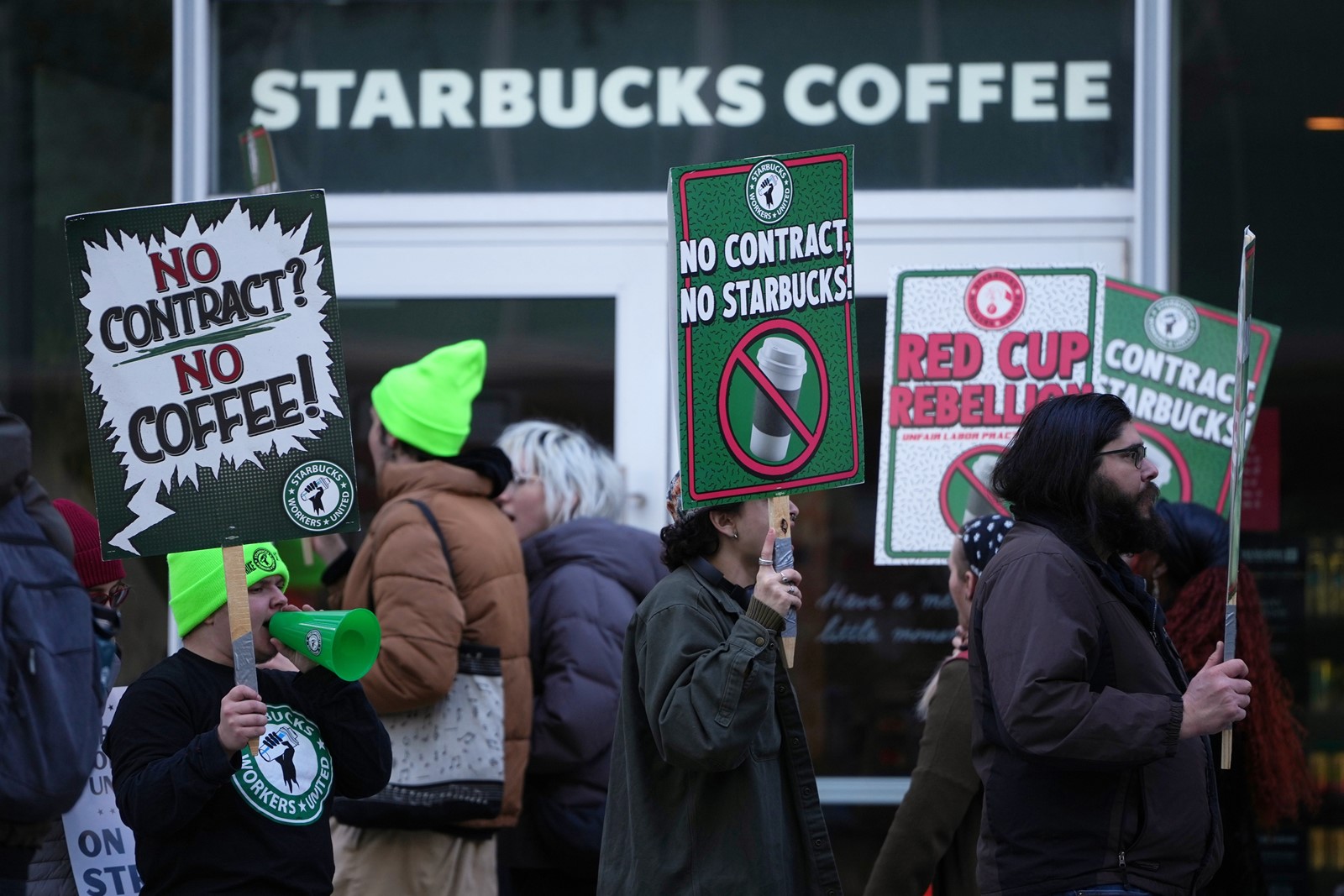


More than 1,000 unionized Starbucks workers went on strike at 65 U.S. stores Thursday to protest a lack of progress in labor negotiations with the company.
The strike was intended to disrupt Starbucks’ Red Cup Day, typically one of the company’s busiest days of the year. Since 2018, Starbucks has given out free, reusable cups on that day to customers who buy a holiday drink. Starbucks Workers United, the union organizing baristas, said Thursday morning that the strike had already closed some stores and was expected to force more to close later in the day.
Starbucks Workers United said stores in 45 cities would be affected, including New York, Philadelphia, Minneapolis, San Diego, St. Louis, Dallas, Columbus, Ohio, and Starbucks’ home city of Seattle. There is no date set for the strike to end, and more stores are prepared to join if Starbucks doesn’t reach a contract agreement with the union, organizers said.
Starbucks emphasized that the vast majority of its U.S. stores would be open and operating as usual Thursday. The coffee giant has 10,000 company-owned stores in the U.S., as well as 7,000 licensed locations in grocery stores and airports.
As of noon Thursday on the East Coast, Starbucks said it was on track to meet or exceed its sales expectations for the day at its company-owned stores.
“The day is off to an incredible start,” the company said in a statement.
Around 550 company-owned U.S. Starbucks stores are currently unionized. More have voted to unionize, but Starbucks closed 59 unionized stores in September as part of a larger reorganization campaign.
Here’s what’s behind the strike.
A stalled contract agreement
Striking workers say they’re protesting because Starbucks has yet to reach a contract agreement with the union. Starbucks workers first voted to unionize at a store in Buffalo in 2021. In December 2023, Starbucks vowed to finalize an agreement by the end of 2024. But in August 2024, the company ousted Laxman Narasimhan, the CEO who made that promise. The union said progress has stalled under Brian Niccol, the company’s current chairman and CEO. The two sides haven’t been at the bargaining table since April.
Workers want higher pay, better hours
Workers say they’re seeking better hours and improved staffing in stores, where they say long customer wait times are routine. They also want higher pay, pointing out that executives such as Niccol are making millions and the company spent $81 million in June on a conference in Las Vegas for 14,000 store managers and regional leaders.
Dochi Spoltore, a barista from Pittsburgh, said in a union conference call Thursday that it’s hard for workers to be assigned more than 19 hours per week, which leaves them short of the 20 hours they would need to be eligible for Starbucks’ benefits. Spoltore said she makes $16 per hour.
“I want Starbucks to succeed. My livelihood depends on it,” Spoltore said. “We’re proud of our work, but we’re tired of being treated like we’re disposable.”
The union also wants the company to resolve hundreds of unfair labor practice charges filed by workers, who say the company has fired baristas in retaliation for unionizing and has failed to bargain over changes in policy that workers must enforce, like its decision earlier this year to limit restroom use to paying customers.
Starbucks stands by its wages, benefits
Starbucks says it offers the best wage and benefit package in retail, worth an average of $30 per hour. Among the company’s benefits are up to 18 weeks of paid family leave and 100% tuition coverage for a four-year college degree. In a letter to employees last week, Starbucks’ Chief Partner Officer Sara Kelly said the union walked away from the bargaining table in the spring.
Kelly said some of the union’s proposals would significantly alter Starbucks’ operations, such as giving workers the ability to shut down mobile ordering if a store has more than five orders in the queue.
Kelly said Starbucks remained ready to talk and “believes we can move quickly to a reasonable deal.” Kelly also said surveys showed that most employees like working for the company, and its barista turnover rates are half the industry average.
 PREVIOUS ARTICLE

