


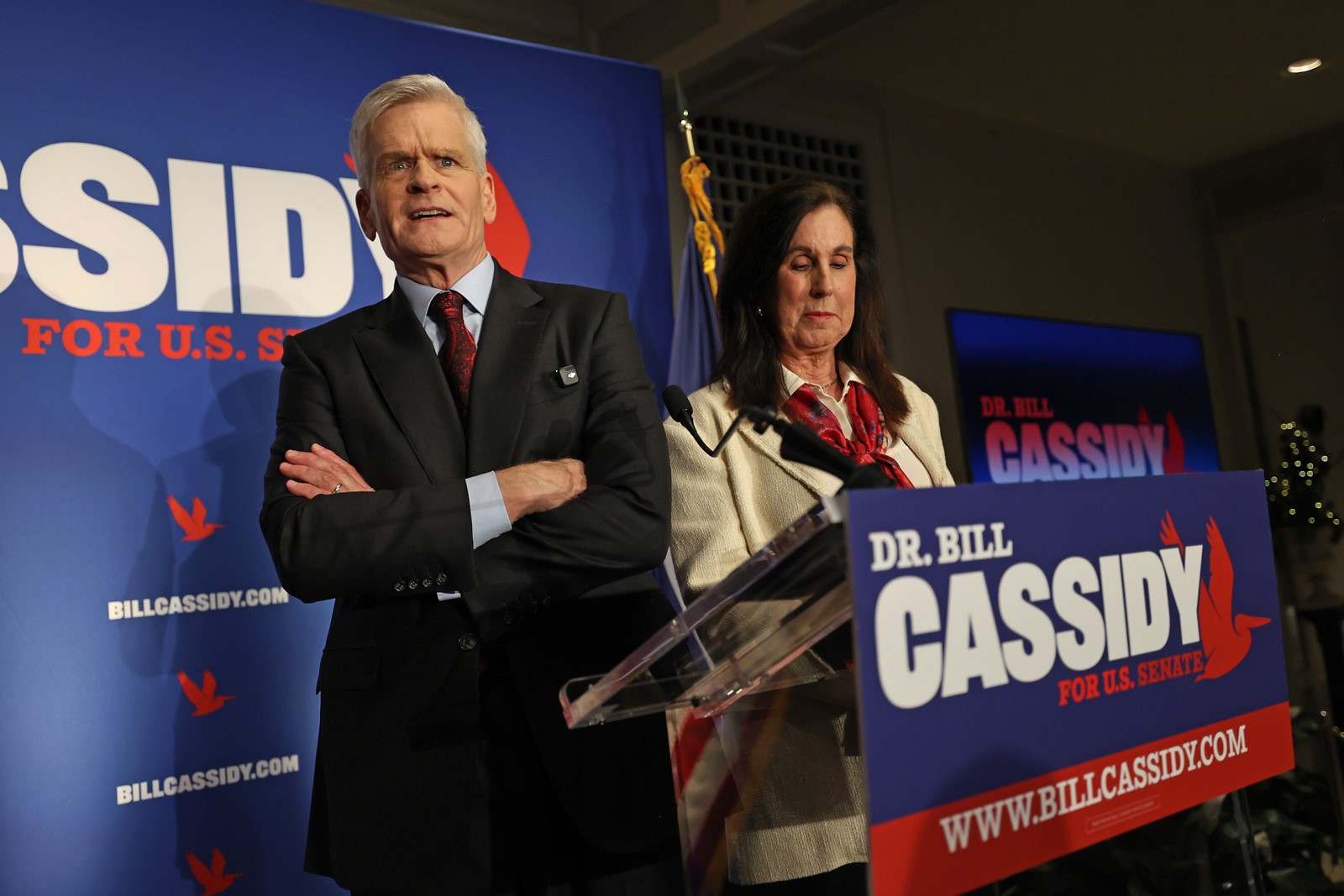


NEW ORLEANS — When Charles Wandfluh voted in Louisiana’s Republican primary over the weekend, he could only conjure the unflattering image of a panicked rodent when talking about Bill Cassidy’s desperate attempt to cling to his U.S. Senate seat despite opposition from President Donald Trump.
“He’s just a squirrel running around the tree, chasing nuts to find whatever he can get to benefit him,” said Wandfluh, 57, in a suburb of New Orleans.
Cassidy’s scramble was in vain, and his defeat on Saturday demonstrated the near-impossibility of a political future within the Republican Party without Trump’s acquiescence. Despite outspending his rivals, Cassidy finished third in the primary, falling short of even making a runoff. The outcome was the latest and perhaps most spectacular failure by a Republican who tried to cross Trump and get away with it.
Even within a party notorious for its political contortions during the Trump era, Cassidy stood out. As a doctor, he overlooked Robert F. Kennedy Jr.’s anti-vaccine activism to support his nomination as Trump’s health secretary, only inevitably to clash with Kennedy once he took the job.
Cassidy was also unable to repair his relationship with Trump five years after voting to convict him during his impeachment trial over the Jan. 6 attack on the U.S. Capitol. Although Cassidy tried to assure Republican voters that he remained committed to Trump’s agenda, that did not satisfy their loyalty to the Republican president.
“He was trying to portray himself side by side with Trump, like he has worked with Trump on this and that,” Wandfluh complained. “I’m like, ‘You voted to impeach the guy!’”
Primary changes
Cassidy’s decision on Kennedy also may have cost him crucial support with independent voters and centrists who might otherwise have crossed party lines to vote for him. Louisiana had also changed its election law to hold closed primaries, diminishing Cassidy’s potential base of support.
The change was championed by Gov. Jeff Landry, a Republican who endorsed Letlow. Cassidy’s campaign accused him of engineering it to benefit her.
Trump’s endorsed candidate
U.S. Rep. Julia Letlow, endorsed by Trump, and state Treasurer John Fleming, a former Trump administration official, will compete for the Republican nomination on June 27.
“There is no greater endorsement than the endorsement of President Trump,” said Letlow, who was first in the voting Saturday. “We’ll always be singing that from the mountaintops.”
Trump liked what he heard, posting on social media that it was a “great victory speech tonight by Julia!!!” The president stomped on Cassidy’s electoral grave, describing the senator as ungrateful for previous support.
“His disloyalty to the man who got him elected is now a part of legend, and it’s nice to see that his political career is OVER!” Trump wrote.
U.S. Sen. Lindsey Graham, a South Carolina Republican who feuded with Trump in the past but has since become a model of loyalty to the president, had no sympathy for his vanquished colleague.
“What’s the headline? Trump’s strong. Those who try to destroy Trump politically, stand in the way of his agenda, are going to lose,” Graham said Sunday on NBC’s “Meet the Press.”
Purging the party
Graham once described Trump as a “kook” who was “unfit for office,” and he appeared to break with Trump after the Jan. 6 riot by saying “enough is enough.” But Graham did not vote to convict Trump during the impeachment trial, unlike Cassidy and six other Republican senators.
Four of them — Richard Burr of North Carolina, Mitt Romney of Utah, Ben Sasse of Nebraska and Pat Toomey of Pennsylvania — did not run for another term afterward.
Alaska’s Lisa Murkowski, who remains in office and is a vocal Trump skeptic, won reelection in 2022 when Trump was out of office. There also is Maine’s Susan Collins, who has faced Trump’s wrath but not a primary challenge as she runs for a sixth term in November. As a Republican senator from a state won by Democratic candidate Kamala Harris in the last presidential election, she remains crucial for her party’s control of Congress.
Trump’s grip on his party is noteworthy given his lame-duck status — he is constitutionally prohibited from running for a third term even though he has mused about it — and his low poll numbers. He is presiding over lingering inflation, economic dissatisfaction and an unpopular war with Iran, yet Republicans remain largely in lockstep with him.
Earlier this month, he successfully dislodged five Indiana state senators who opposed his redistricting plan. On Tuesday, he is backing a challenger to U.S. Rep. Thomas Massie in Kentucky’s primary. Massie angered Trump by opposing his signature tax legislation over concerns about the national debt, pushing for the release of the Jeffrey Epstein files and opposing his decision to go to war with Iran.
All about Trump
After his defeat, Cassidy addressed Trump’s influence without naming him.
Cassidy expressed his view that America’s leaders should be focused not on “one individual” who demanded absolute loyalty but rather on the general welfare of the public.
“And if someone doesn’t understand that and attempts to control others through using the levers of power, they’re about serving themselves,” he said. “They’re not about serving us. And that person is not qualified to be a leader.”
But Trump’s role was central for many Republican voters.
Mark Schulingkanp, who is 46 and works in the shipping industry, said he voted for Letlow precisely to avoid the conflict that has marked Cassidy’s relationship with Trump.
“Getting federal dollars into the state is the most important thing to me, to help people with jobs,” he said. “Clearly having a senator that the president doesn’t like could cause a challenge or impede federal dollars coming to the state for roads, bridges, so many different programs.”
This report includes information from the New York Times.
 PREVIOUS ARTICLE

