


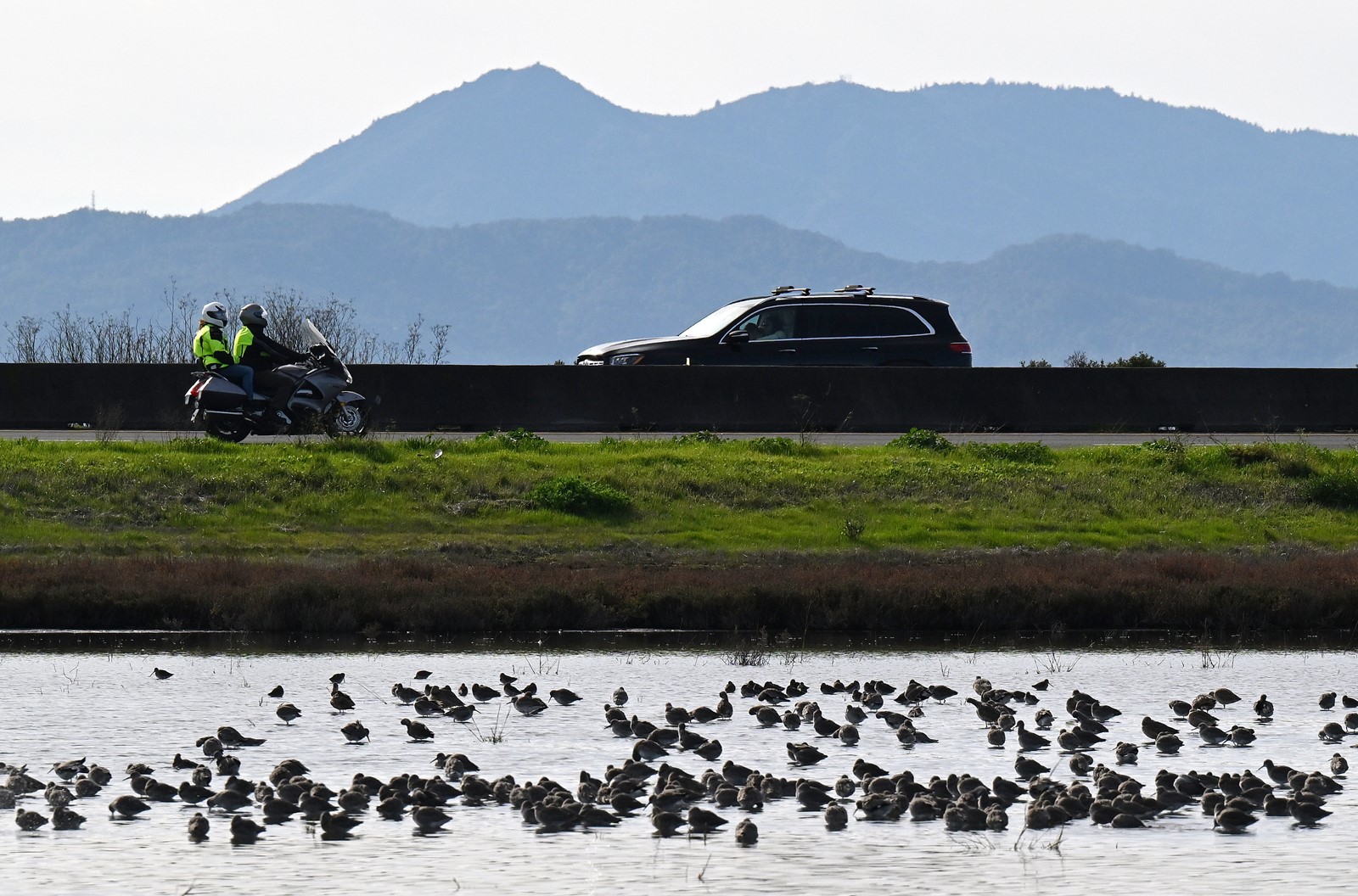


A $500 million project along Highway 37 has been altered to include marsh restoration work.
The Sears Point to Mare Island Improvement Project will widen the Tolay Creek Bridge and add a carpool lane in each direction in an effort to reduce traffic congestion. New updates include restoring a 3.5-mile section of degraded tidal salt marsh, called Strip Marsh East, which will help protect against sea-level rise and flooding while creating habitat.
“Establishing a network of new channels connected to San Pablo Bay will support the creation of new wetlands, waters, and habitats for threatened and endangered species,” said Bart Ney, a Caltrans spokesperson.
Caltrans released a draft supplemental environmental report for the project in December — around a year after the environmental impact report for the project was finalized. The 2023 report found the project had no significant impact on the environment. The supplemental report comes to the same conclusion, with most project elements having no or less than significant impacts.
Ney said the supplemental report was to study and disclose the potential impacts of the changes. He said the project would improve drainage at the marsh to San Pablo Bay by lowering berms and creating channels. The new elements will counteract the seasonal flooding that creates the marsh’s extremely salty conditions, which has led to land subsidence and the death of seasonal vegetation.
The area is notorious for its traffic, with thousands of commuters from Sonoma County traveling daily to work in Marin and Napa. The project focuses on a 10-mile section of road that narrows from two lanes to one in each direction between Highway 37 and State Route 121.Afternoon commutes are delayed by more than 90 minutes, and morning travel by 50 minutes, according to James Cameron, the executive director of the Sonoma County Transportation Authority, which is a partner in the project. Cameron noted that those delay averages are only for the project.
“Lane merges on SR 37 are the major causes of congestion along this segment of the corridor,” the report states. “Within the Project limits, faster vehicles cannot pass slower vehicles because there is only one lane in each direction, and no passing is allowed.”
Cameron said the project is expected to result in a 20-minute travel time, in both directions, to get through 20 miles of the corridor. He said the carpool lane would bypass tolls, while the general traffic lane would have to pay a toll.
The environmental assessment approved in 2023 cleared widening the Tolay Creek Bridge, but the project would now replace the 60-foot bridge with a structure about 375 feet long and 90 feet wide.
The project is not without controversy. The report noted public concerns about the long-term resilience of Highway 37 because of sea-level rise, which could be underwater by 2040 according to Caltrans. Marin County Supervisor Eric Lucan, who represents Novato, said the stretch needs to be elevated.
“What’s really missing is, in my opinion, is a rethink of the bridge over Tolay Creek,” Lucan said. “It’s great that they’re planning to lengthen it and that’s now been environmentally cleared, but I still really question why are we even considering building a brand new bridge over Tolay Creek if it’s going to be underwater in 15 years.”
The project is estimated to cost around $500 million, paid for by a mix of federal and state funding alongside some grants and future toll revenue. Cameron said planners have around $100 million so far.
Lucan wondered if the project could be phased to ease costs, starting with elevating the Tolay Bridge Creek. Still, he said, the changes, while small, are still worth recognizing.
“There is tremendous opportunity for restoration of that area, and that’s really exciting and something that we should celebrate, but there’s more that could be done,” Lucan said. “How do we find a project that addresses the environmental restoration and the bottleneck, those stuck in traffic, and that’s really built for, you know, long-term sustainability and sea-level rise?”
“I think we’re getting closer but we’re not there yet,” he said.
Cameron said the project is phased to address near-term concerns, like traffic congestion, while working toward the longer-term goal of elevating the road.
“It’s not throwaway work, it is the first phase of the long-term project,” Cameron said.
Ney said construction is expected to start in the the spring and finish in the summer of 2029.
Caltrans is planning a public hearing on the supplemental environmental report on Jan. 14 at the John F. Kennedy Library in Vallejo and online. Meeting details and teleconference access instructions are online at shorturl.at/ZtHaL.
 PREVIOUS ARTICLE
