


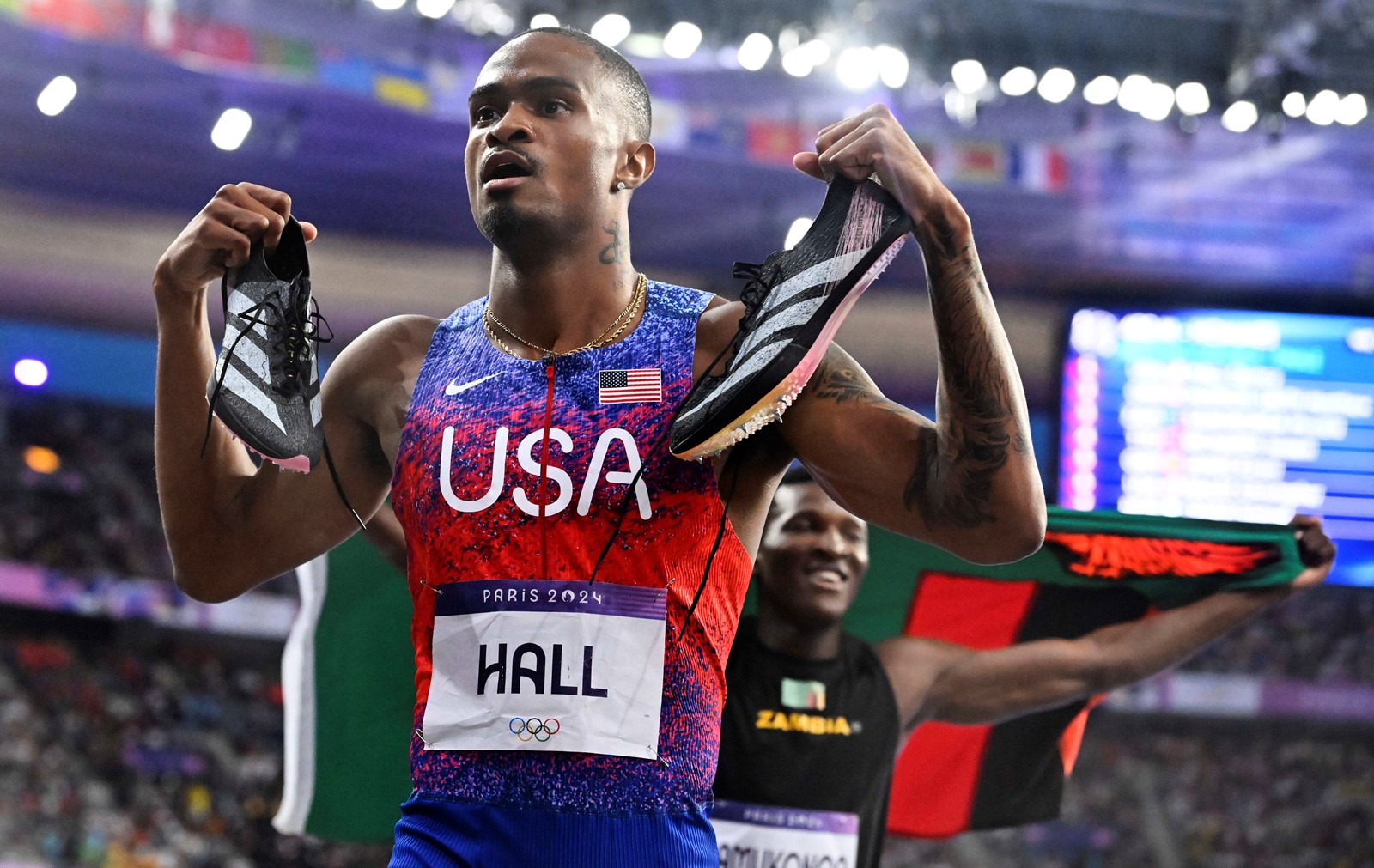


four years earlier in London, marking the first time since 1976 that the event had been won by a non-American runner in a Games not boycotted by the U.S.
Norman, fifth in the 2016 Olympic trials 200 shortly after graduating from Vista Murrieta, was billed along with Noah Lyles, another prep phenom, as the next great American sprinter.
Norman, the consensus with the sport went, wouldn’t just regain the Olympic title and the world record, but would be the first man to break the 43-second barrier.
He appeared to be on course for just that when he ran 43.45, the fourth fastest time in history, at the Mt. SAC Relays in April 2019 and then a few weeks later knocked off Lyles in the 200 at Rome’s Golden Gala meet, running 19.70, a mark faster than the personal bests than all but two Olympic champions — Jamaica’s Usain Bolt and Michael Johnson of the U.S.
“He’s going to be the first man to run under 43,” said Ato Boldon, a former world 200 champion. “It’s not a matter of if. It’s only a matter of when.”
Five years later it is not unreasonable to question whether with those two races, Norman had already reached the pinnacle of his career. Later that summer he was knocked off by Fred Kerley at the U.S. Championships. Then concerned about a hamstring injury, backed off in a World Championships heat that fall and didn’t advance to the final.
Norman made the Olympic final in Tokyo only to finish a distant fifth as Steven Gardiner of the Bahamas won the gold medal on a night when an American failed to make the medal podium for the second time in three Games.
Norman won the 2022 World Championships 400 in Eugene only to miss most of the 2023 season with a knee injury after deciding to focus on the 100 and 200 and switching coaches, from Quincy Watts, the 1992 Olympic 400 champion and his coach at USC, to John Smith, himself the world record-holder at 440 yards and the coach of multiple Olympic champions.
He switched back to Watts for this Olympic season but couldn’t match Hall at the U.S. Olympic Trials.
Wednesday night, Norman was never a factor and by the time the rest of the field reached the final dramatic stretch it was like he was in a different race, finishing nearly a second behind seventh-place finisher Samuel Ogazi of Nigeria (44.73).
Hudson-Smith went through the first 200 in 20.9 and the fast early pace seemed to be taking a toll on the field coming off the final turn.
Hudson-Smith appeared to be on the way to Great Britain’s first gold medal in the event since Eric Liddell’s victory at the 1924 Paris Olympics, a race immortalized in the film “Chariots of Fire.”
“It was right there,” Hudson-Smith said.
And then it wasn’t.
“We knew the last 50 was going to determine who got the gold,” Hudson-Smith said “and he got the last step on me, and that is all she wrote.”
 PREVIOUS ARTICLE

