


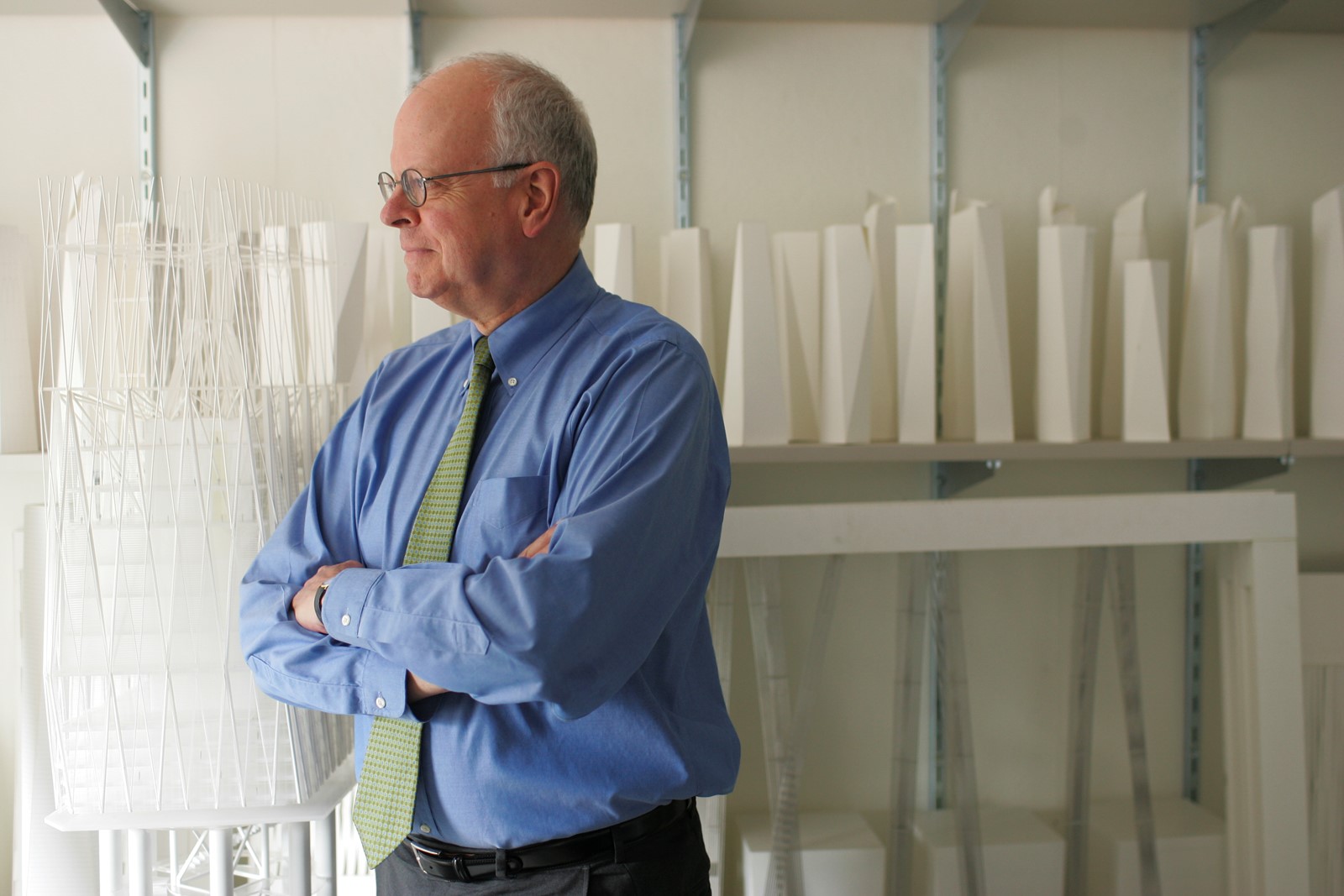


David M. Childs, an architect who crowned the New York City skyline with the tallest building in the Americas — a shimmering new One World Trade Center in place of the twin towers destroyed on 9/11 — died Wednesday in Pelham, New York. He was 83.
The cause was Lewy body dementia, his wife, Annie, said. Childs had homes in Manhattan and Keene, New York. The couple were staying in Pelham to be near two of their children.
One World Trade Center (also called Freedom Tower) is a tapering, eight-faceted exclamation point abutting the National September 11 Memorial in lower Manhattan. Known to millions of visitors, it is just one of a dozen transformative buildings in Manhattan that Childs and his colleagues at Skidmore, Owings & Merrill designed from the 1980s to the 2010s. Some are crisp evocations of midcentury modernism; others conjure the more decorative towers of the Jazz Age.
“At SOM, you don’t know what my next building will look like,” Childs told Julie Iovine of The New York Times in 2003. “You know what a Richard Meier building will look like; there’s a style. I’m more like Eero Saarinen, whom I revere. His buildings all look different.”
Paul Goldberger, a former architecture critic at the Times and The New Yorker and the author of “Up From Zero: Politics, Architecture and the Rebuilding of New York” (2004), assessed Childs’ career in a recent email: “There was always an earnestness to his architecture, a seriousness of intention and a deep belief in urbanistic values. He was concerned about the larger civic good, and he worked hard to convince developers to take this into account. This was his legacy as much as pure design.”
Because Childs often tackled projects with contentious histories and competing constituencies, his work could be pushed and pulled in many directions, as it was at One World Trade Center. That design went through at least five iterations during the protracted rebuilding of ground zero, where the original twin towers stood until the terrorist attacks of Sept. 11, 2001.
To admirers, the final version of One World Trade Center, completed in 2014, repaired an awful hole in the skyline and symbolized civic resilience. To detractors, it demonstrated how politics, commerce and fear had strangled imagination in the redevelopment of ground zero. To visitors, it was synonymous with New York itself, judging by the tchotchke market it spawned.
To Childs, One World Trade Center also served as something else: a pylon to mark the abutting memorial. “It subtly recalls, in the sky, the tragedy that has happened here,” he said in 2005.
Tall and bespectacled, affable and urbane, Childs was the Ivy League embodiment of a virtuoso architect. He joined SOM, a storied architecture and engineering firm, in 1971; served as its chair from 1991 to 1993 and again from 1998 to 2000, the only partner ever to repeat in the role; and was a consulting partner until his retirement in 2022.
Childs was the antithesis of a “starchitect,” whose celebrity derives from unmistakable flourishes. And he candidly acknowledged his place in the architectural pantheon.
“I know a lot of what I’ve designed is not ‘A’ work,” he said to Nicolai Ouroussoff, then the Times’ architecture critic, in 2005. “But my role was different. I wanted to raise the level of everyday development as much as I could.”
David Magie Childs was born on April 1, 1941, in Princeton, New Jersey. He grew up in Mount Kisco, New York, with his mother, Mary (Cole) Childs, who was executive director of the Children’s Book Council. His father, Alton Quentin Childs, taught classics at Princeton University. His parents divorced when David was a child.
After attending Deerfield Academy in Massachusetts, he went on to Yale University, where a mesmerizing lecture by architectural historian Vincent Scully persuaded him to forgo studies in zoology and pursue architecture instead. Around that time he met Anne Woolman Reeve, known as Annie, who was attending Sarah Lawrence College. They wed in 1963.
His wife survives him, as do their children, Joshua, Nicholas and Jocelyn Childs; six grandchildren; and a sister, Ellyn Allison. (When Childs was terribly sick with nonalcoholic fatty liver disease in 2016, Joshua helped save his father’s life by donating much of his own liver for a transplant.)
Childs earned a master’s degree in architecture at Yale in 1967, then joined a presidential commission in Washington that sought to transform a dilapidated Pennsylvania Avenue into a ceremonial boulevard. There, he met Nathaniel A. Owings, a founding partner of SOM, and Daniel Patrick Moynihan, a future senator from New York. Both became his mentors.
 PREVIOUS ARTICLE
