


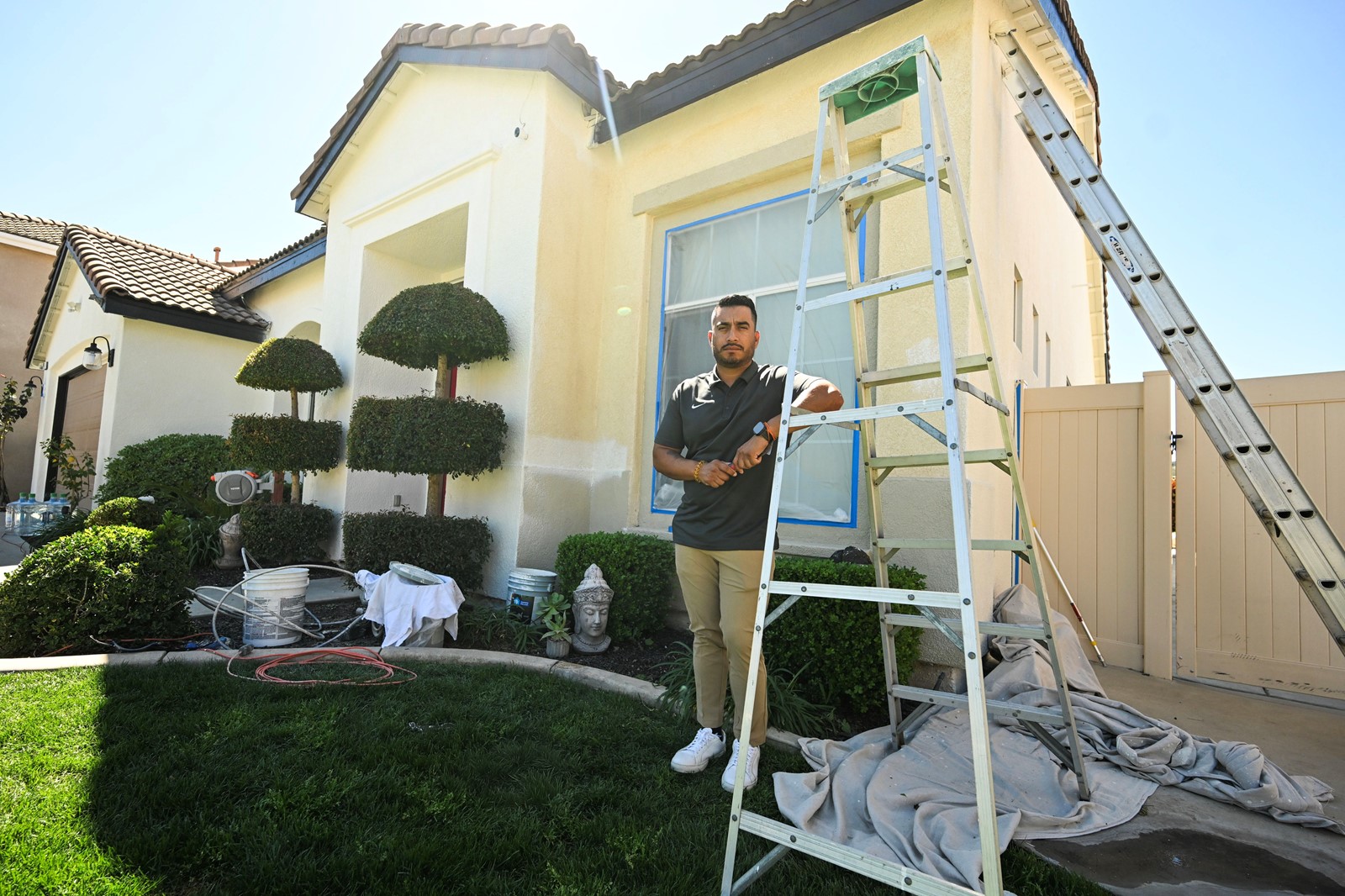


Military veteran Francisco Sanchez had a deposit and plans ready for his dream home on a sprawling, 2-acre lot in Wildomar when reality came crashing down around him.
Instead of building the contemporary, Mediterranean-style home with floor-to-ceiling windows and views to the Santa Ana Mountains, he walked away, disheartened by the development fees that gobbled up his budget.
The commercial real estate adviser and Marine veteran of 20 years thought he had it all figured out. He got a Veterans Affairs construction loan to cover all building costs and his lot was on a utility-serviced street of tract homes connected to water, electricity and gas. With a budget of $950,000, he would use profits from selling his tract home 5 minutes away, and life savings for the nearly $200,000 lot.
But just as he began imagining where to put the batting cage for his 11-year-old daughter, he hit one of the big hurdles to building a house in California — more than $130,000 in development fees.
“I knew institutional investors were always complaining about the cost of building here in California,” Sanchez said. “I never thought that those same costs translated to just ordinary people with life savings trying to build a simple house.”
What’s an impact fee?
Impact fees are used by cities, regions and states to add infrastructure for sewage, water, roads and schools by charging new construction developments for those services based on the impact they predict they will have.
Most commonly paid for by developers, the fees are later passed into homebuying costs. Sanchez was charged for the fees that KB Homes, a national homebuilder, originally paid Wildomar to develop the neighborhood.
Impact fees have been a part of the ongoing conversation around high housing costs, even prompting the Supreme Court case Sheetz vs. El Dorado, which ruled that local governments, including county boards of supervisors, must justify their impact fees.
The case did not say to what degree, which remains a problem, says Ben Metcalf, managing director of UC Berkeley’s Terner Center for Housing Innovation.
That there’s some benefit back to the property creates “at least a theoretical ceiling for how high those fees can go,” Metcalf said. “But in practice, we see just an incredible amount of interpretation.”
He says municipalities across California have come to increasingly depend on these fees to raise city revenue following the 1970s-era Proposition 13, which capped property taxes at 2% and limited the tax rate to 1% of the assessed value.
The fees, he said, have a stronger effect on suppressing development in communities with smaller economies compared to those with larger ones.
“In cities where new supply can command very, very high rents relative to cost impact, fees can have less of an impact in terms of overall diminishment of new supply,” Metcalf said.
Riverside County has a median income of $93,000 and an average home cost of $640,000. In Wildomar, the median income is $103,506 and its home cost is $645,000. There are a little more than 10,000 homes in the city of about 38,000 people.
Wildomar’s city impact fees make up about 5% of the city’s revenue, according to Community Development Director Robert Flores. That is in addition to regional transportation and conservation impact fees. Over the last decade, the city has made about $12.4 million from residential impact fees, which apply to homebuilders and local residents alike.
More rules to lower impact fees
There are ways costs can be kept down and sticker shock reduced, says Dan Dunmoyer, president and CEO at California Building Industry Association. His organization is lobbying lawmakers this year to lower impact fees.
Senate Bill 1036 would amend the Mitigation Fee Act to push local governments to more closely evaluate the degree of impact a development will have on the billed service. Assembly Bill 1820 would make the jurisdictions publish those studies on their websites.
Dunmoyer said the bills would help cities be more transparent about fees associated with homebuilding.
“When we sell a home, we don’t say $150,000 of this home was paid to the local government like you would see maybe in a car you would buy that had new wheels or new stereo,” Dunmoyer said. “Those things are hidden, built into the cost that’s passed onto the consumer.”
Dunmoyer said that there are a number of ways cities and other jurisdictions are exempt from performing these analyses, also known as nexus studies, under current laws. Reasons include proof that square footage is not an appropriate metric to calculate fees imposed on a housing development project alongside other variables.
Wildomar, Flores said, does not perform nexus studies.
It’s part of the larger problem of fragmented authorities across California’s 540 jurisdictions of cities, regions, states and all the various departments in between, according to Metcalf.
“We need to figure out how to reconcile, and ideally bring these different municipal agencies that all have a hand in taxing these properties together to give a comprehensive picture. That work is yet to be done,” Metcalf said.
He added that the challenge, from a political economy perspective, is that the residents who pay the tax are usually future residents, and thus not voting in those neighborhoods.
Barriers to build
Sanchez eventually took his deposit for the lot back, let the loan fall out of escrow and remained in his house of 12 years nearby.
He called the turn of events a “heartbreaking” end to a goal he thought he’d earned after two decades in the military and five years in the real estate industry.
“California leadership frequently emphasizes the need for housing production and affordability,” he said. “However, fee structures at the local level may be functioning as a significant barrier, not only to homeowners like myself, but also to small builders and families trying to remain in their communities.”
While recent legislative proposals are pushing for greater transparency on impact fees and to waive them entirely for affordable housing projects, they continue to add anywhere from 6% to 18% to the median home price, according to the Terner Center.
“The impact fees and costs are not commensurate with the impact that is happening right now,” Dunmoyer said. “But of course the impact to the homebuilder and the person who’s trying to build a single home is enormous.”
 PREVIOUS ARTICLE
