


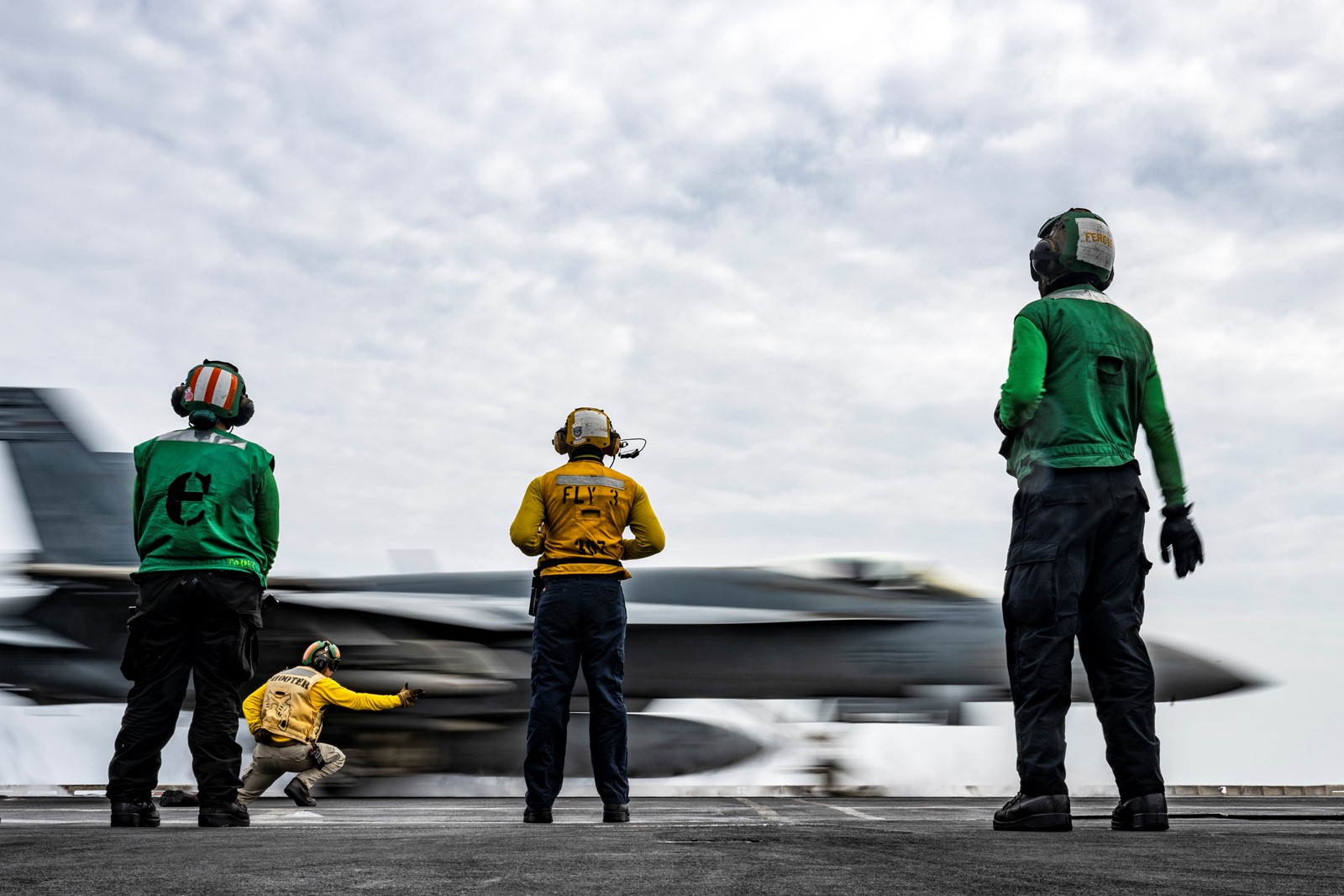


WASHINGTON — The intelligence breach was bad enough, current and former fighter pilots said. But Defense Secretary Pete Hegseth’s refusal to acknowledge that he should not have disclosed sensitive information about when American fighter pilots would attack sites in Yemen, they said, was even worse.
On air bases, in aircraft carrier “ready rooms” and in communities near military bases this week, there was consternation. The news that senior officials in the Trump administration discussed plans on Signal, a commercial messaging app, for an impending attack angered and bewildered men and women who have taken to the air on behalf of the United States.
The mistaken inclusion of the editor-in-chief of The Atlantic in the chat and Hegseth’s insistence that he did nothing wrong by disclosing the secret plans upend decades of military doctrine about operational security, a dozen Air Force and Navy fighter pilots said.
Worse, they said, is that going forward, they can no longer be certain that the Pentagon is focused on their safety when they strap into cockpits.
“The whole point about aviation safety is that you have to have the humility to understand that you are imperfect, because everybody screws up. Everybody makes mistakes,” said Lt. John Gadzinski, a former Navy F-14 pilot who flew combat missions from aircraft carriers in the Persian Gulf. “But ultimately, if you can’t admit when you’re wrong, you’re going to kill somebody because your ego is too big.”
He and other pilots said that each day since Monday, when The Atlantic published an article about the chat disclosures, had brought a stunning new revelation. First came the news that Hegseth had put the operational sequencing, or flight schedules, for the F/A-18 Hornets targeting the Houthi militia in Yemen on March 15 in the unclassified Signal group chat, which included several other senior officials.
“We intentionally don’t share plans with people who don’t need to know,” said one Navy F/A-18 pilot, who has flown frequently in missions in the Middle East. “You don’t share what time we’re supposed to show up over a target. You don’t want to telegraph that we’re about to show up on someone’s doorstep; that’s putting your crew at risk.” He and several other current and former pilots spoke on the condition of anonymity to avoid reprisals from the Pentagon and from allies of President Donald Trump.
But then came Hegseth’s initial response to the disclosures. He attacked Jeffrey Goldberg, the editor-in-chief of The Atlantic, as a “so-called journalist,” and sought refuge in a semantic argument, saying that he had never disclosed “war plans.”
So on Wednesday, The Atlantic published the actual text of what he had written, at 11:44 a.m. the day of the attack, in the group chat: “1215et: F-18s LAUNCH (1st strike package),” Hegseth texted, some 30 minutes before it happened. “1345: ‘Trigger Based’ F-18 1st Strike window Starts (Target Terrorist is @his Known Location so SHOULD BE ON TIME).”
This text was two hours in advance of the strikes.
Hegseth added, “1410: More F-18s LAUNCH (2nd strike package).” And then, “1536: F-18 2nd Strike Starts — also first sea-based Tomahawks launched.”
That text gave almost three hours’ notice.
On Wednesday, Hegseth called his disclosure a “team update” to “provide updates in real time, general updates in real time” to keep Trump national security officials informed.
But details of military operations are usually kept so secret that even the service members taking part in them are “locked down.” That sometimes means they are not allowed to speak to others who do not have a need to know, let alone tell people about the plans, the fighter pilots interviewed said. In aircraft carrier “ready rooms,” where flight squadrons spend their time when they are not in the air, crews burn instructions to destroy them.
“It’s important to understand the degree that OPSEC is involved in every aspect of your life on an aircraft carriers,” said former Navy Capt. Joseph Capalbo, who commanded a carrier air wing and two F/A-18 squadrons, in a reference to operational security. “Red Sea ops are conducted in complete silence; no one is talking on the radio. Because everything can be heard by somebody.”
A former Air Force fighter pilot, Maj. Anthony Bourke, added, “When you disclose operational security, people can get killed.” He said that “these things are not taken lightly. I have never met anybody in the military who does not know this.”
Hegseth, a former Fox News weekend host, served as a National Guard infantryman.
Cmdr. Parker Kuldau, a former Navy F/A-18 pilot, called Hegseth’s disclosures and subsequent response to them “infuriating.”
“It’s so beyond what I would expect from anyone in the military,” said Kuldau, who also flew combat missions in the Middle East.
 PREVIOUS ARTICLE
