




“Acércate! Estamos Escuchando!” is the newly launched attempt by Florida Democrats to win support from the state’s Hispanic voters, a constituency party leaders hope will help them win back some of the ground they’ve lost in recent elections.
The plan — which translates as “Come closer! We’re listening!” — is aimed at countering both decades of messaging from Republicans to Hispanic voters that has contributed to Florida turning increasingly red, and a sense by some that Democrats come around only during election season, only to disappear until the next election approaches.
The question is will it work, and if so, when?
Rolando Barrero, president of the Democratic Hispanic Caucus of Florida, said the effort could pay dividends as early as November, possibly reversing some of the losses his party has taken in recent rounds of voting.
Others, including supporters of the Barrero-led effort, have a less sanguine view, praising a push they said is overdue — but should be seen as a long-term investment that might not pay off for years.
“It’s going to take a while,” said Lourdes Diaz, a Pembroke Pines Hispanic media and branding strategist, who is also president of the Democratic Hispanic Caucus chapter in Broward and president of the Pembroke Pines Democratic Club.
“For 2024, you needed to start in 2022. This is a long-term strategy,” she said. “You have to commit. It’s marketing. We’ve severely lost market share.”
The Pew Research Center reported in January that Florida is home to 3.5 million Hispanics who are eligible to vote. Pew said 22.5% of Florida’s eligible voters are Hispanic, one of the highest shares in the country.
Democrats need to do better with Hispanic voters if they ever want to climb out of the electoral hole they’re in, with Republicans controlling all statewide elected offices plus overwhelming majorities in the congressional delegation, the Florida Senate, and the state House of Representatives.
There’s a more immediate imperative Barrero, Diaz and others are working on: upcoming municipal elections.
The Democratic Hispanic Caucus of Florida is attempting to mobilize Hispanic voters for the March 19 city, town and village elections in Broward, Palm Beach and other counties.
They are hoping that calls from volunteers and efforts through social media could provide an edge for Hispanic Democrats running in the nonpartisan contests, in which party labels aren’t on the ballot.
The plan
The state Hispanic Democratic Caucus plan, unveiled in February, is aimed at building relationships with Hispanic voters who see themselves ignored by Democrats.
Barrero, elected president of the statewide caucus six months ago after serving as president of its Palm Beach County chapter, said Democrats will listen to people’s concerns. And, when they can, they’ll connect them with programs that might offer them assistance.
It’s not a direct pitch for votes. Rather it’s a way, Barrero said, to make connections by showing that Democrats care what is happening with their constituents — or people they hope to attract or bring back to the Democratic Party.
By demonstrating that they don’t just show up at election season, he said the caucus hopes to build more trust, awareness and enthusiasm for Democrats among Hispanic voters.
“We need to let our constituents know that we are here 100% of the time, every day serving our Hispanic community,” Barrero said. “We are tirelessly making friendships,” he said, describing it as “a listening space, for people to exchange ideas.”
Elements include a new website, under development, and a range of social media platforms, including Facebook, Instagram, Threads, Signal and WhatsApp. “WhatsApp is used a lot by Latinos. We’re plugging ourselves into a lot of different channels that are strictly Spanish-speaking,” Barrero said.
Hispanic Floridians have backgrounds that are Cuban, Puerto Rican, Mexican and from many countries in Central and South America. There are powerful connecting factors, including language, but many of the cultural traditions and world outlooks are different.
“Everyone has always discussed that we are a voting block, that we’re Hispanic. What they don’t realize is every single one of our countries has their own dialect, receives information differently, and has to be spoken to differently,” Barrero said.
The new effort is not one-size-fits-all, he said, citing recent engagements with Ecuadorians, Peruvians and Bolivians. On Tuesday, the caucus posted information for the Dominican community.
“We’re trying to answer the one big question that most of the communities that speak different languages always have: That’s what do you do for me in exchange? What do I get out of registering? I’m invisible. I don’t get engaged because it doesn’t make a difference. We’re trying to let them know that we’re here to make a difference,” Barrero said.
Long-term challenge
The effort is smart strategically for the Democrats, and long overdue, said Eduardo Gamarra, a political science professor at Florida International University, and founder of the Latino Public Opinion Forum at FIU’s School of International and Public Affairs.
He doesn’t think it will pay off quickly. “It’s late. They should have already been doing this, not starting in an election year,” Gamarra said.
“The Democratic Party in Florida is trying to do things today that it should have been doing for the last decade,” Gamarra said. “What they’re doing is interesting. It’s good. … Maybe we’re talking about the fruits of this are not going to be felt in November, they’re going to be felt years from now — if they continue to do it.”
Too often what happens, Gamarra said, is that the party makes an effort in the ramp up to an election, and “it’s all over” immediately after the election season.
“I think it’s a good approach, but I don’t think that you’re going to get an immediate result,” Gamarra said. “If they’re willing to invest long term, and if they’re willing to wait long-term, I think you’re going to see some pretty good results. This year is going to be a very difficult one to see some immediate results to the strategy.”
Making the challenge more difficult for Florida Democrats is that national party strategists and donors don’t see Florida as a swing state, and they can win the presidency without the state’s electoral votes. That means it’s less likely for national financial support to help fund outreach efforts to Hispanics or any other voters.
Diaz emphasized that it’s a long game.
“I don’t really believe in short-term. I think you’ve got to commit long-term if you’re going to go after the Hispanic market,” she said.
Republicans
Florida Republicans have been courting Hispanic voters for decades, and they’ve stuck with it.
“They start earlier. They have candidates in place, and they don’t take their constituents for granted, which Democrats have historically done, especially Hispanics,” Gamarra said.
He said Democrats neglected the kind of work they needed to do in Hispanic communities, assuming that most Cuban-Americans would vote Republican and that Democrats would get some share of that vote, and would do well with other Puerto Ricans and people from other countries.
“The Republicans didn’t do that. The Republicans targeted everybody,” Gamarra said.
Republicans have contrasted themselves with the Democrats, whom they label as communists or socialists, a compelling message to communities that include many people who fled repressive regimes in places such as Cuba and Venezuela.
Gamarra said the Republican messaging on communism and Democrats isn’t accurate, but “it’s worked extraordinarily well.”
Democrats haven’t figured out an effective counter-messaging strategy. Barrero said he’s not getting tangled in back and forth on those subjects “because that keeps the conversion alive. It’s a falsehood.”
“The Democratic Hispanic Caucus does not play Whac-A-Mole. If the Republicans throw something at us, we don’t respond. We just work, we stay in our lane, we support the community,” Barrero said. “Look at (our) social media. You’ll not find any Republican mentioned, criticized.” Instead it’s messages focused on positives about Hispanic Democratic candidates.
Aside from the communist/socialist labeling, Diaz said the Republican playbook offers lessons for the Democrats.
“We just have to grow it little by little, just the way the Republicans grew their market share in Miami. If you want a market, you have to target it, you have to invest in it, you have to be there not just four months before an election. You have to do it every single day,” she said.
“Republicans have been doing this since (President Ronald) Reagan” in the 1980s, she said. “They have very good people that work on their side, that are dedicated to the Hispanic community. I think we finally woke up.”
Republicans aren’t letting up.
Jaime Florez, the Miami-based Hispanic Communications Director for the Republican National Committee, said in a video posted online in February that “Hispanics are very disappointed with the Democrats that have taken them for granted for way too long and have made promises that they never fulfilled. … So Hispanics are becoming more and more Republicans, and we’re working on that.”
Chris Marino, chair of the Broward Republican Party, said via email the Hispanic community “has now recognized that the Democratic Party has failed them continuously.”
“A definitive tide is turning for the Republican party, not because of demagogy or rhetoric, but because of the lack of leadership and results that benefit Latinos and Hispanics in Broward County and the rest of Florida,” Marino said.
Dreaming big
Barrero offers the most optimistic possible vision for November. Having former U.S. Rep. Debbie Mucarsel-Powell, an Ecuadorian immigrant, as the Democratic candidate for U.S. Senate this year will give his party a chance at defeating U.S. Sen. Rick Scott.
The contest isn’t seen as a realistic pickup opportunity by independent national analysts.
Mucarsel-Powell, speaking last month at an event in Greenacres, a Palm Beach County city with a growing Hispanic population, noted Scott’s three statewide election victories have been exceedingly close.
And, she added, “He has never run against a Latina like myself that knows exactly how to fight back, how to communicate with our communities, set the record straight on all of this information that we continue to hear.”
But just because Mucarsel-Powell is Hispanic, that doesn’t give her an advantage over Scott with Hispanic voters. Scott, who is wealthy, can spend heavily on his reelection campaign, as he has done in his previous victories. Mucarsel-Powell has to raise money for her campaign.
But Gamarra said Scott — who won the first of his two terms as governor in 2010 — started paying attention to Hispanic voters from the beginning. “He had this idea that he had to invest in Hispanics,” he said.
He learned Spanish — vastly improved in the past few years, Gamarra said. He looked beyond the Cuban American community to show support for Puerto Rico after that storm was hit by devastating hurricanes while he was governor. He runs his campaign ads in English and Spanish.
And he frequently speaks out on issues related to the Americas. On Friday, his campaign issued a statement in English and Spanish declaring that “Democrats’ Hearts are in Havana.”
March 19
Florida’s Republican presidential primary is on March 19, eclipsing the elections running the same day for city, town and village governments.
The candidates run without party labels, but the Hispanic Democratic caucus is touting Hispanic Democratic candidates who are running in the municipal elections on March 19. (Republicans Party organizations do the same thing for their preferred candidates).
The Democratic Hispanic Caucus is endorsing Hispanic Democrats running in contests against Republicans, including Maria Rodriguez, a candidate for Pembroke Pines City Commission who is Colombian American.
The caucus can’t endorse in contests with more than one Democrat running. Instead, it signaled support while not officially endorsing. The caucus messaging to voters is that Angelo Castillo, a Pembroke Pines commissioner running for mayor, and Yvette Drucker, a Boca Raton City Council member running for reelection, are examples of “outstanding Hispanic leaders.”
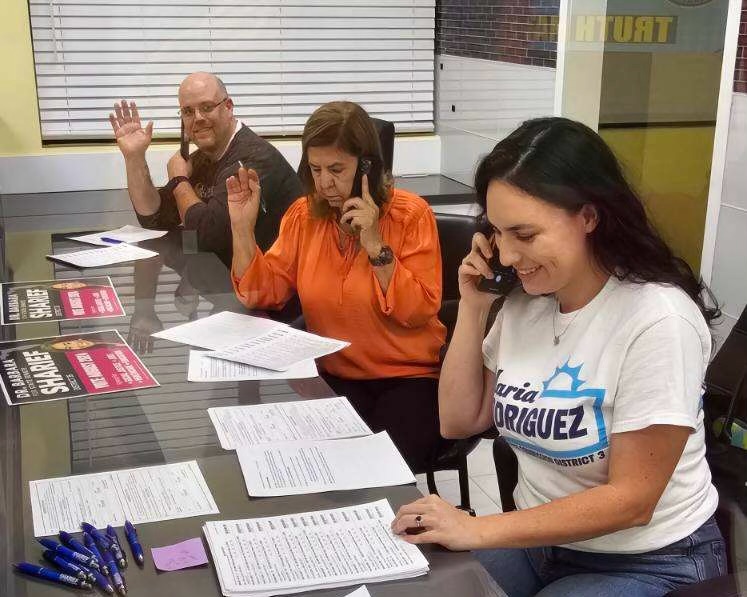
On Thursday evening, using office space provided by a business in Davie, volunteers from the Democratic Hispanic Caucus of Broward and the Pembroke Pines Democratic Club gathered for phone banking.
Callers, including Rodriquez, highlighted March 19 candidates to Democratic and no party affiliation voters. “We’re just reaching out to them in Spanish,” Diaz said. “Not really to put a lot of time into Republican Hispanics.”
Anthony Man can be reached at aman@sunsentinel.com and can be found @browardpolitics on Bluesky, Threads, Facebook and Post.news.
 PREVIOUS ARTICLE
