


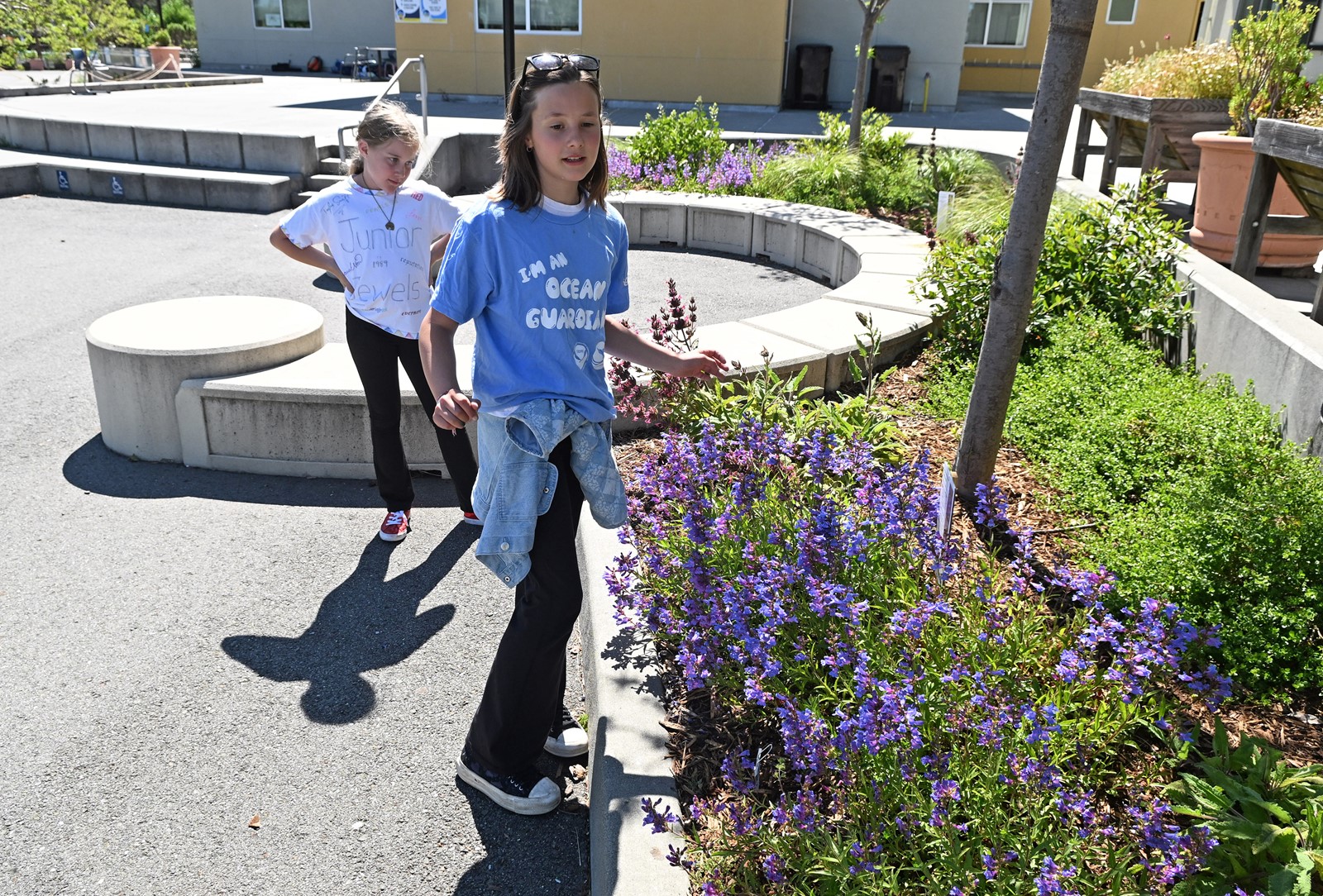


Children at a Corte Madera school are working to improve the ecosystem through gardens.
The Ocean Guardian Club at Neil Cummins Elementary School includes about 15 students who have planted two native plant gardens so far at the campus, with hopes to continue the work next year.
The club is linked to a program of the National Oceanic and Atmospheric Administration. It encourages children to explore the natural environment and build connections with the watershed where they live.
“I joined last year,” fifth-grader Eva Chirko said. “I kind of just like planting and stopping global warming. It’s fun and creative, and it has a lot of benefits. Also, the shirts are so cool.”
“I joined because it was fun last year and I like protecting the environment,” fifth-grader Aaron Carlsen said.
“I joined to help the Earth and stuff,” fifth-grader Allie Long said. “I really wanted to help the environment. My favorite part was planting the garden because we got to design a lot of it. We got to shove tools into the dirt. It’s very therapeutic.”
Native plants — flora that have evolved in an ecosystem over a long period of time — are essential to watershed health. They stabilize soil, prevent erosion and encourage water retention.
“They were so surprisingly enthusiastic,” said teacher Dana Swisher, who heads the club. “I think having an actual impact, like a real world impact, doing something at your school, making decisions and having a real impact, is a big deal to them. They have agency and they’re doing something that they see right outside their classrooms.”In the club’s first year, students planted 63 plants in an area outside the fourth-grade classrooms. This year, students decided on planters outside the fifth-grade classrooms, but they had to solve one problem: Kids walked through those areas regularly. The club studied how students moved through the space and designed the garden based on the data.
“They decided, we’re going to put stepping stones here or pathways where the kids are naturally moving through, and then, we’re going to decide on plants that are a little bit bigger near areas where they would discourage them from trying to walk,” Swisher said. “It’s been amazing how much the students just follow that. They have not been walking through the planters at all.”
Native plant gardens also have other benefits such as supporting local pollinators and serving as wildlife habitat. One garden has a pair of nesting blue birds, and both have bees and hummingbirds. This year’s garden featured several keystone species — those whose absence would change the ecosystem drastically.
Swisher said many people recognize that pollen is good for pollinators, but the plants also support moths that produce the caterpillars that birds rely on for food.
This year’s lineup included more than 40 native California plants, including buckwheat, hollyleaf cherry, California wildrose, California lilac, manzanita, hummingbird sage, coffee berry and coyote bush.
Fourth-grader Angie Paredes said she likes everything about the club. She recalled planting “like 40” plants.
“I think I liked the coyote bush the most,” Angie said.
“I like being with my friends and raising awareness,” fifth-grader Luke Simon said.
Brett Geithman, superintendent of the Larkspur-Corte Madera School District, said the children are setting a great example. The club presented its work to the school board in April.
“The students in the Ocean Guardian Club are leading with purpose and passion,” Geithman said.
The school has to apply every year for the NOAA program, which comes with a grant of up to $4,000 over four years.
Many fifth-graders hope to start a similar club in middle school, and the fourth-graders are eager to join again next year.
Fourth-grader Henry Blair said he was part of a green team in third grade and loved it. He said plants are life, too, and people need to protect them.
“I thought doing this would be pretty fun and I also really like nature,” Henry said. “I’ll probably do it again next year.”
 PREVIOUS ARTICLE

