




With a little over a month-and-a-half before ballots hit mailboxes, a large swath of the California electorate is “largely unenthusiastic” about the crowded field vying to succeed Gov. Gavin Newsom, according to a new poll from the Institute of Government Studies at UC Berkeley.
“I’ve never seen a gubernatorial election quite like this with so many voters disengaged,” Mark DiCamillo, the director of Berkeley IGS Poll, said.
The latest governor’s poll, which was conducted March 9-15, reinforced much of what other recent public polling has already shown: voters have yet to rally around a favorite — even as Election Day quickly approaches.
The top lines of many of those surveys seem to remain the same, albeit some minor jockeying between candidates with differentials often smaller than the poll’s margin of error.The Berkeley IGS poll, which surveyed 5,019 registered voters — 3,889 of whom are considered likely to vote in the June 2 primary — also found that virtually every one of the ten candidates had a higher unfavorable image rating than favorable among likely voters. Former Orange County Rep. Katie Porter and billionaire philanthropist Tom Steyer, both Democrats, had the highest unfavorable image rating at 37%.
Former Fox News host Steve Hilton, one of two prominent Republicans in the race, led in the IGS Poll with 17% support followed by his fellow GOP contender Riverside County Sheriff Chad Bianco at 16%.
Among Democrats, East Bay Rep. Eric Swalwell and Porter tied at 13%, followed by Steyer at 10%, former health secretary and Attorney General Xavier Becerra at 5%, former Los Angeles Mayor Antonio Villaraigosa and San Jose Mayor Matt Mahan at 4% and former State Controller Betty Yee and State Superintendent of Public Instruction Tony Thurmond at 1%. The poll found 16% of likely voters are either undecided or are voting for someone else. The poll had a margin of error of 2.5 percentage points.
DiCamillo attributed the disengagement and lack of enthusiasm among voters to many of the candidates being unknown — only three have ever held statewide office, and they weren’t even topping the poll — as well as the wide range of issues at the forefront of Californians’ minds.
“I think none of them have been able to make the case that this is what I’m running on and this is what’s important,” he said.
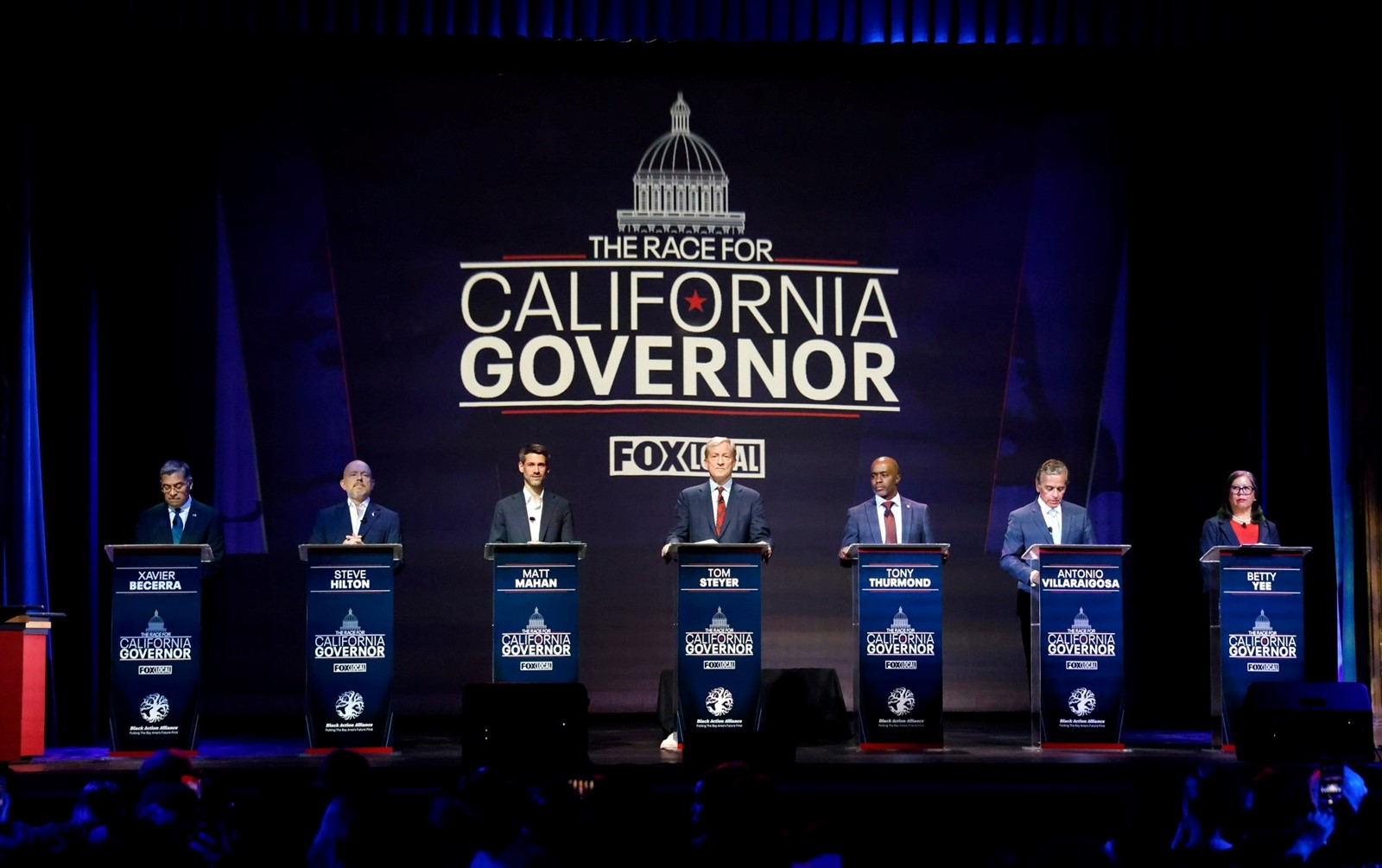
Candidates could get that chance at two upcoming televised debates, though organizers are limiting who is on stage — a move that has sparked pushback from some of the excluded candidates.
Nexstar Media Group’s debate, which is being held on April 22, instituted a 5% polling threshold that invited only Swalwell, Hilton, Bianco, Steyer and Porter to the debate stage.
The March 24 debate hosted by ABC7 and the USC Dornsife Center for Political Future used what they called an “independent and objective criteria” to assess viability — a metric that produced the same candidates that will be in Nexstar Media’s debate plus Mahan.
Villaraigosa called the inclusion of Mahan, a centrist Democrat who was a late entrant into the race, a “biased and bigoted action by USC to manipulate the date to exclude every qualified Black, Latino and API candidate in favor of a less qualified white candidate.” Becerra also said he was “fighting for answers” about his exclusion from the USC debate.“They figured out a way to bootstrap (Mahan) into the debate,” he said in a video posted to social media. “How? They rigged the formula.”
USC has defended its methodology saying that the formula for scoring the candidates was done blindly.
Villaraigosa’s attorney, though, sent a letter to debate organizers on Tuesday, criticizing the methodology and asking for them to “rectify” the former mayor’s exclusion or they’d have to pursue “other legal remedies.”
Despite the inability for some candidates to catch the electorate’s attention, Hilton and Steyer saw significant momentum between the most recent IGS poll and the one conducted in October. Hilton increased his support from 8% to 17% while Steyer, who has dumped more than $80 million of his own money into his bid, grew from 1% to 10%.
Melissa Michelson, a political science professor at Menlo College, said that while Hilton has increased his support, so has Bianco — potentially undercutting any confidence that Democrats may have had in a recent poll that appeared to show Republicans coalescing around Hilton. With the top two vote-getters regardless of political party set to move onto the November election, Democrats have worried that their candidates will fracture the vote enough that Hilton and Bianco will capture both spots.
“Whatever small sigh of relief Democrats may have been expressing in the last set of numbers is gone now because that risk of Republican versus Republican runoff is very much alive,” she said.
Porter used the poll results as an opportunity to fundraise, warning that Democrats could be locked out of the November election and making a case for why she’s the “best positioned” candidate to prevent that scenario.
Among Democratic candidates, Michelson said that it’s clear that Steyer’s money has paid off based on his surge in the polls. But for Mahan, who quickly amassed a sizable war chest and has two tech-backed independent expenditure committees supporting him, she said that he isn’t making “much of an impact” on voters compared to the “hype” around his entry into the race.
The IGS poll found 64% of likely voter said they had no opinion about the San Jose mayor compared to 15% who had a favorable view and 21% that had an unfavorable view.
The poll was completed just days before Mahan made several notable appearances on East Coast-based media shows including MS Now’s “Morning Joe” and “The Daily Show.” Michelson said that while most of “The Daily Show’s” audience is outside of California, voters are more tuned into national news than state or local news these days.
“There is still probably millions of Californians watching ‘The Daily Show’ so you’re still getting in front of all those California eyeballs,” she said.
Mahan also picked up the support this week of Majority Democrats — a group formed last year that brands itself as the next-generation of leaders who are willing to break with the party status quo.
“There’s a growing movement of Democrats getting back to basics and focusing on what it will take to ensure that government makes life better for working people,” Mahan said in an interview this week.
The group has a slew of other well-known Democratic centrists in its ranks including Virginia Gov. Abigail Spanberger, Michigan Sen. Elissa Slotkin and Texas Rep. James Talerico.
 PREVIOUS ARTICLE
