


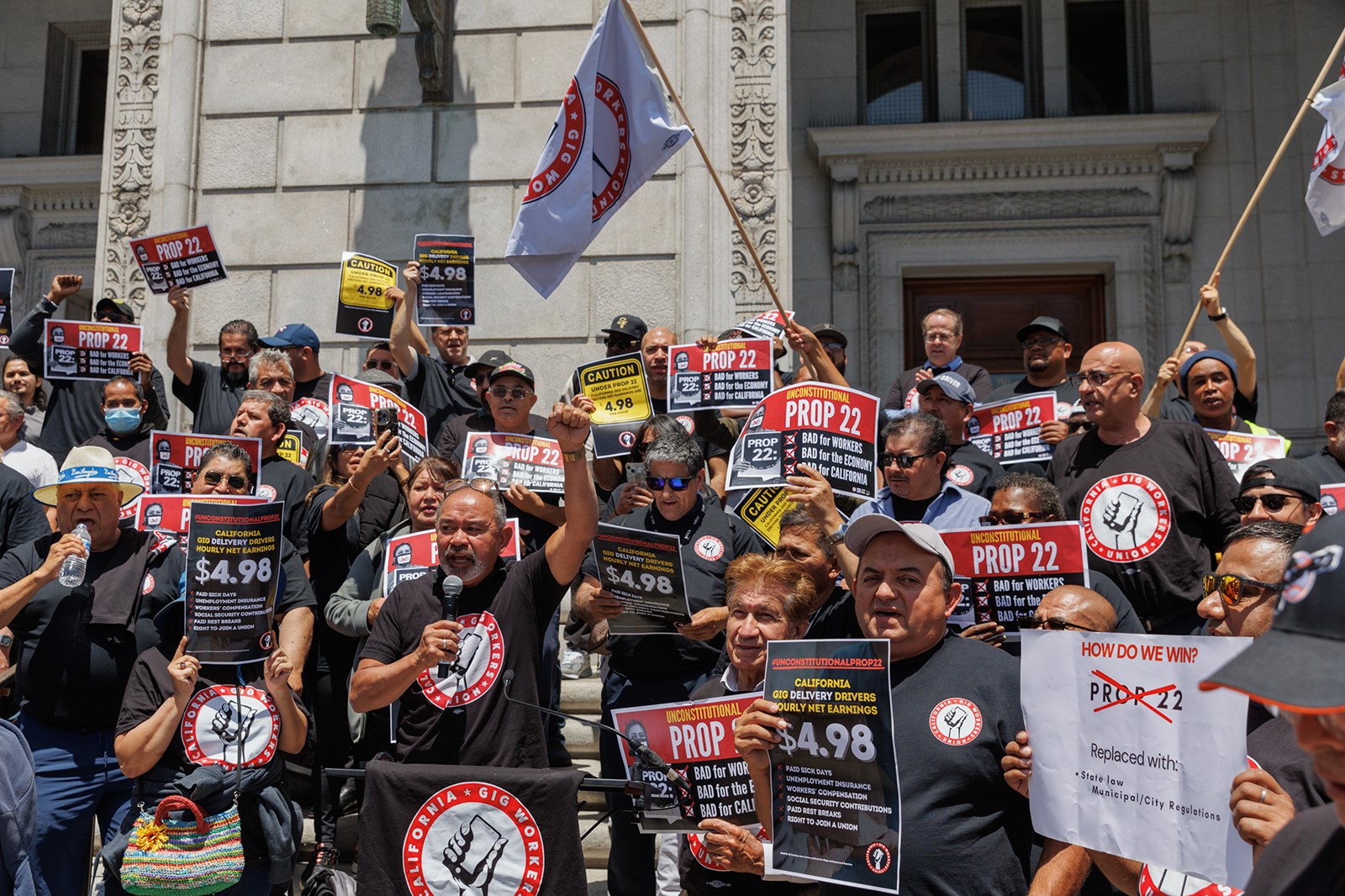


Proposition 22, the gig industry-backed initiative that 58% of state voters passed in 2020, has been mired in a legal back-and-forth since it became law — including being ruled unconstitutional by a Superior Court judge before being upheld by a state appeals court.
Uber, Lyft, DoorDash, Instacart and other companies have used the law to treat their drivers and delivery workers in California as independent contractors, not employees.
The specific question before the state’s highest court is whether Proposition 22 conflicts with the Legislature’s constitutional power to enforce a complete workers’ compensation system. Because of a clause in the initiative declaring gig workers independent contractors not eligible for workers’ comp, the whole law could be thrown out. The justices did not seem to want to do that.
When Scott Kronland, the lawyer who argued on behalf of SEIU California and four gig workers, said Proposition 22 conflicts with the Legislature’s exclusive and unlimited authority over workers’ comp, Chief Justice Patricia Guerrero asked whether legislators could restore workers’ comp for gig workers.
Associate Justice Goodwin Liu said there is “still ambiguity there” over voter initiative power, which is supposed to be equal to legislative power: “Does that mean voters cannot act in this field, (workers’ comp), whatsoever?”
Kronland responded that the Legislature’s power over workers’ comp is unlimited.
Attorney Jeffrey Fisher, arguing on behalf of the gig companies, said “the constitution lets voters act on any subject.” That sparked a question from Associate Justice Leondra Kruger: “Could voters by initiative eliminate workers’ comp altogether?”
Fisher said yes, but that “we’re miles away from that.”
At the end of the hourlong oral arguments, Kronland reminded the justices that “If court is going to decide this case on the premise that the Legislature could restore workers’ comp to gig workers … Proposition 22 says this section can’t be amended. The drafters of Proposition 22 put it on the ballot as all or nothing.”
If Proposition 22 is thrown out in its entirety, it would affect some gig workers who have come to depend on some of its provisions — such as guaranteed earnings of 120% of minimum wage for the time they spend driving or delivering, which they didn’t have before the initiative became law.
Hector Castellanos, the lead plaintiff in the case, spoke at a rally ahead of the oral arguments about getting hurt as a gig driver years ago and being unable to get workers’ comp. He said his daughter had to drop out of school to help support his family.
“We are asking the justices to stand behind drivers,” Castellanos told the crowd. After the hearing, he told CalMatters that he knows plenty of drivers who regret voting for Proposition 22, which he said was bought by ride-sharing companies.
The court’s seven justices have 90 days to hand down a decision, which could transform the gig economy in California. If Proposition 22 is thrown out, gig companies would be subject to Assembly Bill 5.
AB 5, passed in 2019, would throw the companies’ business models out of whack: The companies could be required to pay employment taxes for their estimated 1.4 million workers around the state, and provide those workers with additional benefits they don’t have now, such as sick pay and overtime, and occupational accident insurance beyond the $1 million coverage limit under Proposition 22.
Opponents point to labor-backed studies that reflect continued concerns over pay and inadequate benefits. A study released by the UC Berkeley Labor Center found that after expenses are taken into account and not including tips, average earnings for ride-hailing drivers in the state work out to $7.12 an hour, while for delivery workers that number is $5.93. When tips are included, the study — which is based on data from a third-party app used by gig workers — found drivers’ average hourly wages were $9.09 an hour, and delivery workers’ average was $13.62.
Katie Wells, co-author of “Disrupting D.C.: The Rise of Uber and the Fall of the City,” a book that explored Uber’s rise in the nation’s capital and its relationship to urban decay, said the outcome of the Proposition 22 case “is hugely concerning for those of us who don’t ascribe to Uber and the like’s worldview — the idea that if they don’t like a law, they can get it unwritten.”
For example, Wells mentioned recent related developments in Minnesota, where lawmakers passed a bill to establish minimum pay rates for Uber and Lyft drivers after the companies threatened to leave the state because of higher proposed minimum rates under a Minneapolis ordinance. “It’s a dangerous set of dominoes,” Wells said. “We can mark the moments in which (gig companies) are trying to undo laws. It’s not in isolation.”
 PREVIOUS ARTICLE
