


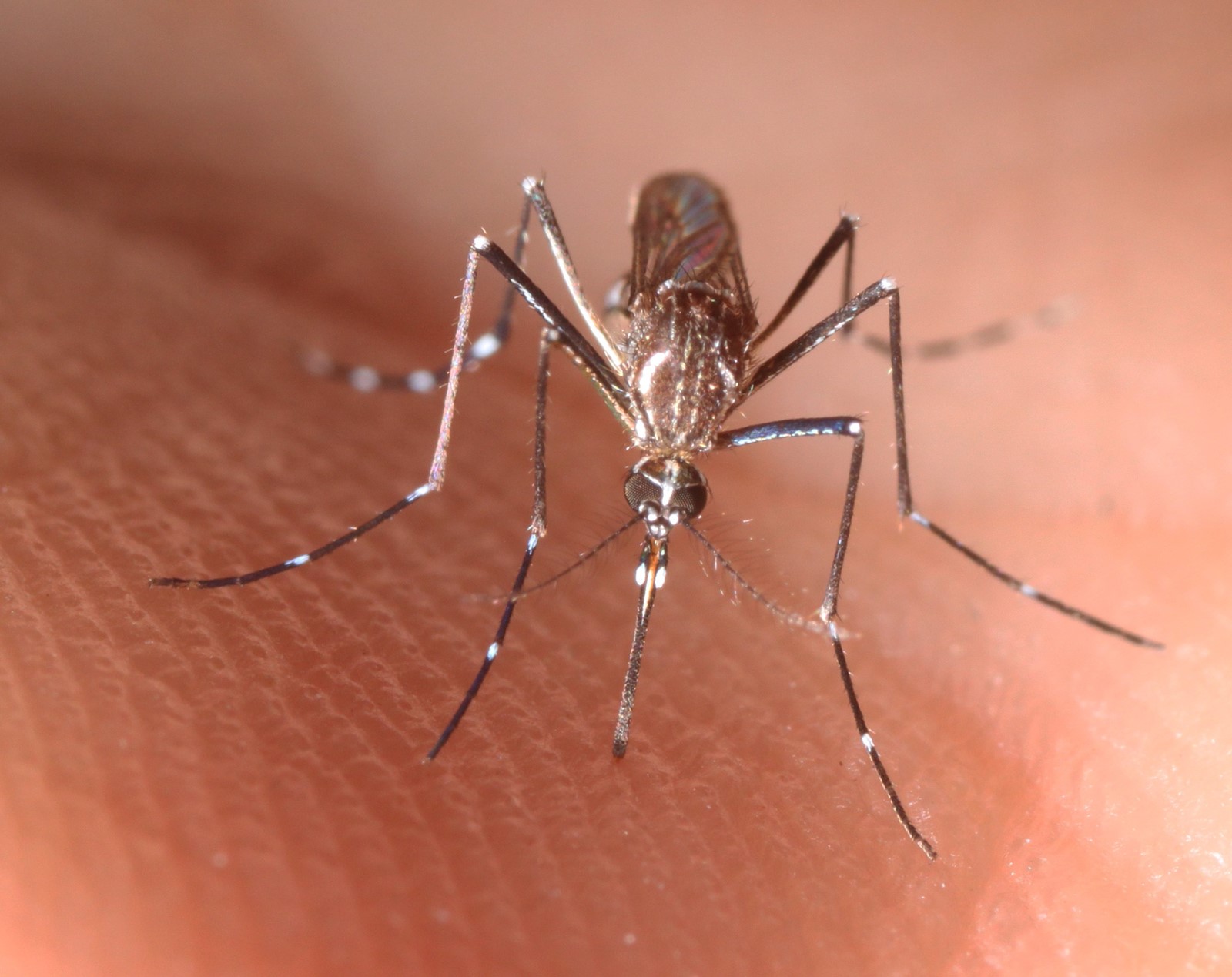


Climate change is likely to disrupt the lives of many species, including some pests, but what about Florida mosquitoes? Nope, said a new study by the University of Florida and others. Researchers found that the species that carries the Zika virus, dengue fever and the chikungunya virus can evolve quickly to temperature stress.
Known as Aedes aegypti, the buzzing pest is a tropical species originally from Sub-Saharan Africa, and first came to Florida 200 years ago. They don’t attack at dusk in the Everglades. Instead, they feed in daylight hours, live in urban areas on the east and west coast of Florida, and prefers humans to other animals. The species was responsible for a Zika virus outbreak in Miami in 2016.
As climate change shifts temperature norms, health officials want to know how a spreader species like Aedes aegypti will adapt.
It turns out quite well. Researchers found that in just 10 generations, or 10 months, the species can specialize to a new temperature range, live longer, and create larvae that survive better as well.
That doesn’t mean this tropical species can populate Canada, but they can adapt to be more robust, and have more offspring in tougher conditions, than researchers thought.
That throws a monkey wrench into current modeling used to predict how warmer temperatures will affect the spread of tropical diseases.
The problem with current disease forecasting models is that they’re based on the temperature fitness of mosquitoes from labs, or from one area, said Matthew Thomas, director of UF’s Invasion Science Research Institute.
Thomas was part of a team that tested whether Aedes aegypti mosquitoes from different places respond to temperature and temperature change in the same way.
To do this, the team gathered mosquito populations from five disparate climates in Mexico, as well as lab mosquitoes, and stressed them with heat.
In phase one, they put each group into an unrealistically hot environment to see how they responded to heat stress. “It wasn’t biologically realistic, but it was meant to challenge them to see if there’s a difference in the speed that they die,” Thomas said.
The mosquitoes from the warmest climate fared the best in the heat stress, even though they were all the same species. “However, that could be by chance,” Thomas said.
So they devised a second phase.
They took one of the populations and ran it for 10 generations under two different temperature regimes, one hot, one cooler.
Each generation lives for about a month.
They then put those mosquitoes back through the heat stress test.
They found that the hot group survived heat stress better than the cool group.
“That’s a nice confirmation that the signal we were seeing in the field was likely to be a consequence of adapting to temperature,” Thomas said.
They then used the hot and cool strain of Aedes aegypti to look at other fitness traits when they were living in different environments.
They found that when the warm strain lived in a warm environment, they had higher fitness in longevity, larval mortality and adult mortality.
And when the cool strain lived in a cooler environment, they, too, had better fitness in longevity, larval mortality and adult mortality.
Zika facts
According to the website for the Centers for Disease Control and Prevention, the Zika virus is spread by the bite of infected Aedes aegypti and Aedes albopictus mosquitoes, and can be passed from a pregnant woman to her fetus.
Though symptoms for adults are likely to be mild, and can include fever, rash, headache, joint pain, conjunctivitis and muscle pain, an infection during pregnancy can cause certain birth defects, and there is no vaccine.
In 2015, there were large outbreaks in South and Central America and the Caribbean, and in 2016 an outbreak in Miami infected 29 people, prompting aerial spraying.
What does it all mean?
Basically, it’s not a one-mosquito-fits-all world as climate change alters the possibilities of tropical diseases.
The models health officials currently use to predict the effect of climate change on disease transmission need more nuanced mosquito data.
An Aedes aegypti from the Keys is going to have different cold or heat tolerances than one in Georgia or New Jersey, and therefore have more or less offspring to spread disease.
Health officials need to plug those differences into their models, or, Thomas warns, a town thought to have low transmission rates might turn out to have high transmission rates.
Bill Kearney covers the environment, the outdoors and tropical weather. He can be reached at bkearney@sunsentinel.com. Follow him on Instagram @billkearney or on X @billkearney6.
 PREVIOUS ARTICLE
