


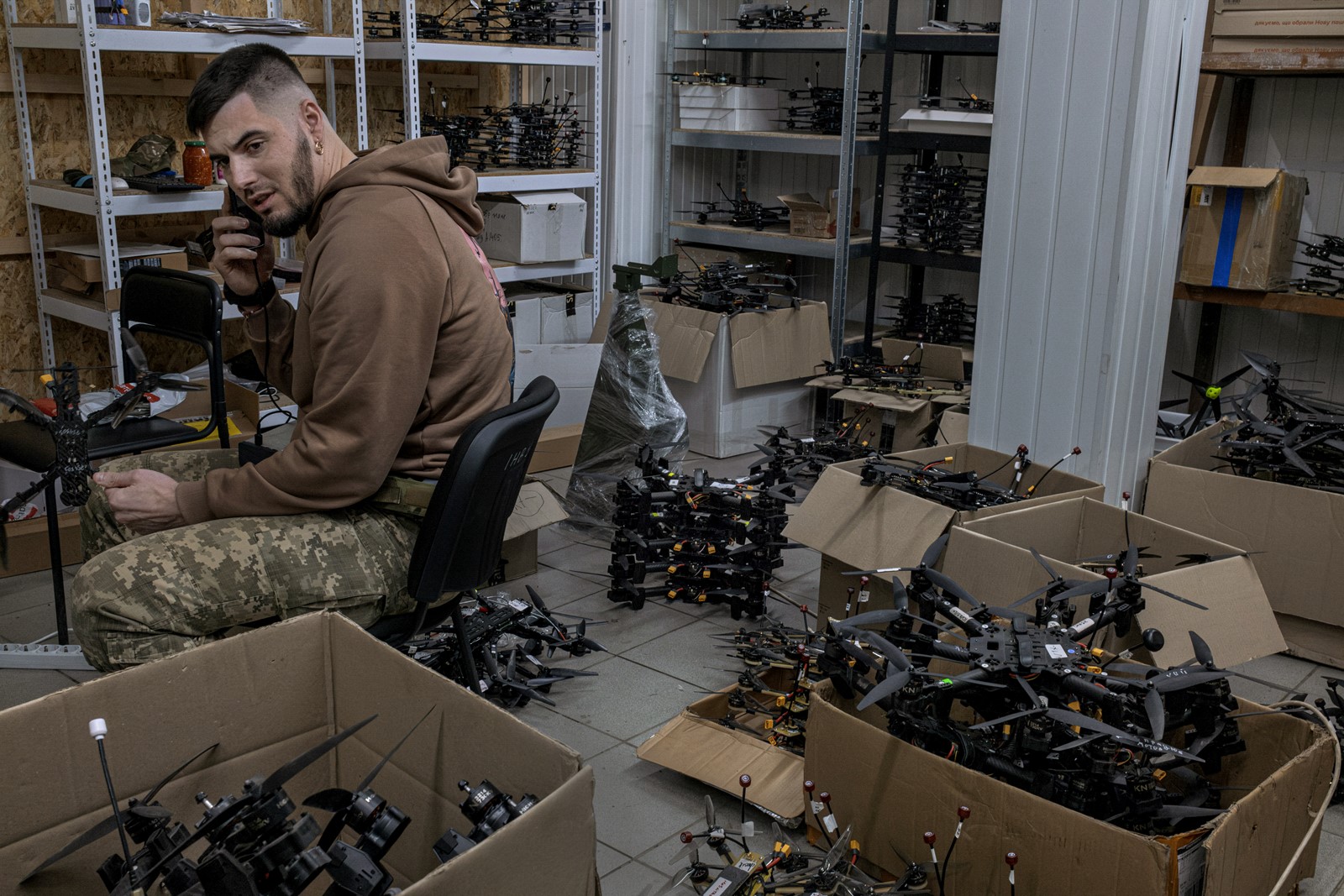


DONETSK REGION, Ukraine >> The commander stepped over boxes stacked full of plastic drones and opened the lid on a new delivery. Inside lay the light-gray fins of a mini-plane, the latest addition to his arsenal of crewless aerial vehicles for fighting the Russian army.
The 33-year-old leader of what an internal report declared Ukrainian army’s best-performing drone unit, Senior Lt. Yuriy Fedorenko — popularly known by his call sign, Achilles — has been the main constraint on the Russian attempt to seize the strategic town of Chasiv Yar on Ukraine’s teetering eastern front.
For months, his drone teams, part of the 92nd Assault Brigade, have been filling a gap for other units of the army that have struggled with a shortage of troops and ammunition. The teams work day and night attacking Russian armor, dropping explosives on Russian positions and using their drones to ferry supplies to Ukrainian soldiers along the front line.
For the Ukrainians, holding Chasiv Yar is critical. Set on a ridge, 5 miles west of the destroyed city of Bakhmut, the town commands the heights above a crescent of industrial cities and villages that are home to roughly 200,000 residents.
Chasiv Yar is the gateway to the last part of the Donetsk region that is still in Ukrainian hands. If Russian forces were to capture the town, they would have the whole of the larger eastern area known as the Donbas within their grasp, long a goal of Russian President Vladimir Putin’s. The cities of Kostiantynivka, Druzhkivka, Kramatorsk and Sloviansk, just miles beyond Chasiv Yar, have come under increasingly heavy bombardment in recent months.
“Without us, the Russians would be in Kyiv region by now,” Achilles said in an interview in a secret base set back from the front line. An exaggeration, perhaps, he said. (Kyiv, the capital, is far to the west.) Yet, he insisted, “Without the drones, we would lose.”
Achilles showed reporters from The New York Times his workshops, proudly pointing out where engineers installed and updated software and mechanics tested the machines and added components, readying the drones for battle.
But when he sat down to talk, Achilles, a trained martial arts fighter, expressed anger and disappointment at the broken promises of Western allies and the losses that, he said, Ukraine took as a result. A monthslong delay by the U.S. Congress in approving a supplemental aid package for Ukraine left its forces drastically short of artillery and air defense weapons, he said.
“We have an absolutely absurd situation,” he said. “Imagine a boxing match where there are equal boxers but one of them can hit once while his opponent can hit 10 times.
“It’s an absolute theater of the absurd,” he said. With no air defense weapons, the Ukrainians were reduced to mounting machine guns on the back of pickup trucks to shoot at Russian Shahed drones, he said.
The fighting on the eastern front has never been more brutal, he said. Since a lack of artillery rounds was first felt in September, the Ukrainian army has been steadily losing ground before a relentless and expanding Russian attack.
The Ukrainians managed to prevent a major Russian breakthrough over the winter, but at the end of February, the Russians began an all-out assault toward Chasiv Yar, Achilles said.
With his reconnaissance drones, he saw Russian soldiers massing. “I realized they were coming,” he said. But without enough artillery shells, the Ukrainians could not hit the Russian rear supply routes as they usually would to preempt an attack.
The Russian offensive followed a tactic that the Ukrainians saw in the cities of Bakhmut and then Avdiivka — using glide bombs, aerial bombs that can weigh up to 1 1/2 tons and that can smash through concrete bunkers and multistory buildings — to inflict a devastating barrage on Ukrainian forward positions.
“They were going step by step, taking one position after the other,” Achilles said. “Where our lines were very strongly fortified, the Russians were using guided aviation bombs, just leveling these positions to the ground. This is how they approached close to Chasiv Yar.
“This happened after our shortage of ammunition and our artillery had nothing to fire with.”
Cannons were firing only two rounds a day instead of at least 30, he said.
 PREVIOUS ARTICLE
