


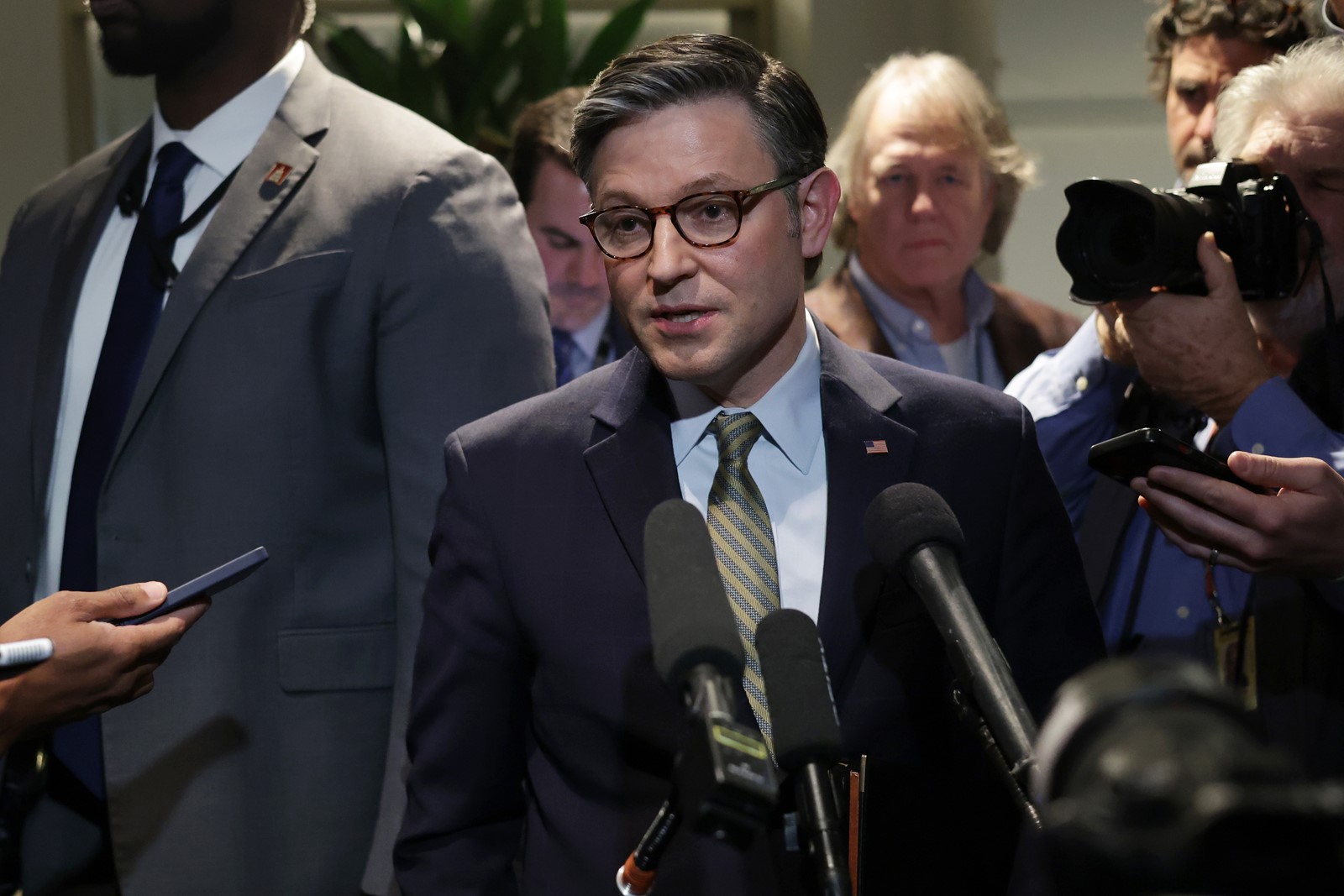


WASHINGTON — Veering toward a midnight Friday government shutdown, House Speaker Mike Johnson was proposing a new plan that would temporarily fund federal operations and disaster aid, but punts President-elect Donald Trump’s demands for a debt limit increase into the new year.
House Republicans met behind closed doors on next steps after Trump doubled down on his insistence that a debt ceiling increase be included in any deal — and if not, he said in an early morning post, let the closures “start now.”
“We will not have a government shutdown,” Johnson said as he left the basement session at the Capitol.
Johnson declined to disclose the new idea under consideration but lawmakers said it would fund the government at current levels through March and adds $100 billion in disaster aid and $10 billion in agricultural assistance to farmers.
Gone would be Trump’s demand on the debt ceiling, which GOP leaders told lawmakers would be debated as part of their tax and border packages in the new year.
It is almost impossible to meet Trump’s last-minute pressure. Johnson was aware there wouldn’t be enough support within the GOP majority to pass any package, since many Republicans prefer to slash federal government rather than fund it, and won’t allow more debt.
Instead, Johnson was in talks Friday with Democratic Leader Hakeem Jeffries, whose party’s support would be needed to ensure passage of any deal.
“We will meet our obligations,” Johnson said.
Trump, who has not yet been sworn into office, is showing the power and limits of his sway with Congress, as he intervenes and orchestrates affairs from Mar-a-Lago, alongside his billionaire ally Elon Musk, who is heading up the incoming administration’s new Department of Government Efficiency.
“If there is going to be a shutdown of government, let it begin now,” Trump posted early in the morning on social media.
Trump does not appear to fear government shutdowns the way Johnson and the lawmakers see federal closures as political losers that harm the livelihoods of Americans. The incoming Trump administration vows to slash the federal budget and fire thousands of employees. Trump himself sparked the longest government shutdown in history in his first term, the monthlong closures over the 2018-19 Christmas holiday and New Year period.
More important for the president-elect is his demand for pushing the thorny debt ceiling debate off the table before he returns to the White House. The federal debt limit expires Jan. 1, and Trump doesn’t want the first months of his new administration saddled with tough negotiations in Congress to lift the nation’s borrowing capacity. It gives leverage to Democrats, who will be in the minority next year.
“Congress must get rid of, or extend out to, perhaps, 2029, the ridiculous Debt Ceiling,” Trump posted — increasing his demand for a now five-year debt limit increase. “Without this, we should never make a deal.”
Johnson is racing behind closed doors to prevent a shutdown, but his influence has its limits. Trump and Musk unleashed their opposition — and social media army — on the original plan Johnson presented, which was a 1,500-page bipartisan compromise he struck with Democrats that included the disaster aid for hard-hit states, but did not address the debt ceiling situation.
A Trump-backed second plan, Thursday’s slimmed down 116-page bill with his preferred two-year debt limit increase into 2027, failed in a monumental defeat, rejected by most Democrats as an unserious effort — but also by Republicans who refuse to pile on the nation’s red ink.
On Friday morning, Vice President-elect JD Vance arrived early at the speaker’s office at the Capitol, where a group of the most hard-line Republican holdouts from the House Freedom Caucus were meeting with Johnson.
Government workers have already been told to prepare for a federal shutdown which would send millions of employees — and members of the military — into the holiday season without paychecks.
“Welcome back to the MAGA swamp,” Jeffries posted.
In the Senate, which is controlled by the Democrats for a few more weeks, there is talk of trying to push forward the original package, the bipartisan compromise that Johnson, Jeffries and the Senate leaders had negotiated to strike a deal earlier this week. That would be difficult, but not impossible.
Senate Majority Leader Chuck Schumer called the original agreement “the quickest, simplest and easiest way we can make sure the government stays open while delivering critical emergency aid to the American people.”
“I’m ready to stay here through Christmas because we’re not going to let Elon Musk run the government,” said Sen. Patty Murray, D-Wash., the chair of the Appropriations Committee who was instrumental in that first deal. “We had a bipartisan deal — we should stick to it.”
President Joe Biden has played a less public role in the debate, drawing criticism from Trump and Republicans who are trying to shift the blame for any shutdown on him.
Biden has been in discussions with Schumer and Jeffries, White House press secretary Karine Jean-Pierre said Friday.
But, she said, “Republicans blew up this deal. They did, and they need to fix this.”
 PREVIOUS ARTICLE
